
The Fable of Arachne, c.1657 Diego Rodriguez de Silva Velazquez (1599-1660)
Location: Prado Museum Madrid SpainOriginal Size: 220 x 289 cm
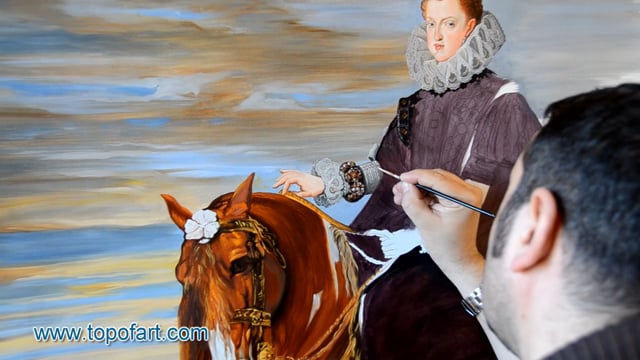
Recreating Velazquez: A Video Journey into Museum-Quality Reproductions by TOPofART
Video showcasing the process of hand-painting a Velazquez masterpiece with the utmost precision and care for detail.
Oil Painting Reproduction
If you want a different size than the offered
Description
Painted by European Аrtists with Academic Education
Museum Quality
+ 4 cm (1.6") Margins for Stretching
Creation Time: 8-9 Weeks
Creation Process
We create our paintings with museum quality and covering the highest academic standards. Once we get your order, it will be entirely hand-painted with oil on canvas. All the materials we use are the highest level, being totally artist graded painting materials and linen canvas.
We will add 1.6" (4 cm) additional blank canvas all over the painting for stretching.
High quality and detailing in every inch are time consuming. The reproduction of Diego Rodriguez de Silva Velazquez also needs time to dry in order to be completely ready for shipping, as this is crucial to not be damaged during transportation.
Based on the size, level of detail and complexity we need 8-9 weeks to complete the process.
In case the delivery date needs to be extended in time, or we are overloaded with requests, there will be an email sent to you sharing the new timelines of production and delivery.
TOPofART wants to remind you to keep patient, in order to get you the highest quality, being our mission to fulfill your expectations.
We not stretch and frame our oil paintings due to several reasons:
Painting reproduction is a high quality expensive product, which we cannot risk to damage by sending it being stretched.
Also, there are postal restrictions, regarding the size of the shipment.
Additionally, due to the dimensions of the stretched canvas, the shipment price may exceed the price of the product itself.
You can stretch and frame your painting in your local frame-shop.
Delivery
Once the painting The Fable of Arachne is ready and dry, it will be shipped to your delivery address. The canvas will be rolled-up in a secure postal tube.
We offer free shipping as well as paid express transportation services.
After adding your artwork to the shopping cart, you will be able to check the delivery price using the Estimate Shipping and Tax tool.
Museum Quality
The paintings we create are only of museum quality. Our academy graduated artists will never allow a compromise in the quality and detail of the ordered painting. TOPofART do not work, and will never allow ourselves to work with low quality studios from the Far East. We are based in Europe, and quality is our highest priority.
Additional Information
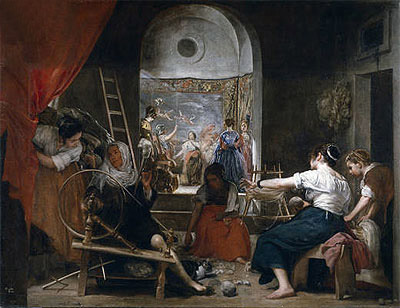
The second ambiguity concerns the subject matter. Traditionally, it was believed that the painting depicted women workers in the tapestry workshop of Santa Isabel. In 1948, however, Diego Angula observed that the iconography suggested Ovid's Fable of Arachne, the story of the mortal Arachne who dared to challenge the goddess Athena to a weaving competition and, in losing the contest, was turned into a spider. This is now generally accepted as the correct interpretation of the painting.
In Las Hilanderas, Velazquez developed a layered composition, an approach he had often used in his earlier bodegones, such as the Kitchen Scene with Christ in the House of Martha and Mary. In the foreground is the contest. The goddess Athena, disguised as an old woman, is on the left and Arachne, in a white top facing away from the viewer, is on the right. Three helpers assist them. In the background, a raised platform (perhaps a stage) displays the finished tapestries. The one visible to us is Arachne's, showing The Rape of Europa - another Greek myth. This is in fact a copy of Titian's version of the subject, which was in the Spanish royal collection.
The painting has been interpreted as an allegory of the arts and even as a commentary on the range of creative endeavor, with the fine arts represented by the goddess and the crafts represented by Arachne. Others think that Velazquez' message was simply that to create great works of art, both great creativity and hard technical work are required. Other scholars have read political allegories into the work.

1 Reviews
5.00 Overall rating

Painted between 1644 and 1648, the painting represents a scene in Juan Alvarez' tapestry and carpet workshop in Madrid.
In the background hangs a tapestry with a representation of Ariadne, in which Veronese motifs appear. The mythological title, attested by ancient sources, is valid only for the tapestry; for the picture as a whole the title of Las Hilanderas, the Tapestry Weavers (caught at their work in the textile factory), is more justified. Here, too, the over-all composition is of an extreme simplicity: two diagonal lateral wings, lighted in contrast to the shadowed background; in the centre a triangular figure against the light, contrasting with the background illuminated by a vivid blade of sunlight; stepped planes moving in alternate lateral jumps towards the background. The scene is a striking close-up. As in the master's last period, and through the impulse derived from his Italian visits, Velazquez, without abandoning his Caravaggesque compositions of linked masses and dialectics of light and dark, is more and more attracted to the pictorial freedom of the Venetians.
He is taken by their direct impasto, quivering brushwork, the charm of a dense, warm atmosphere rendered by nuances and reflections. The approach permits an improbable perspective (elsewhere the perspective is strict and measured) to obtain a more intimate movement on all sides - the weavers and the women - with the pulsating effects of light which gives a vitally cheerful movement to the scene. Here are seen some of the most exceptional and original renderings of movement, as in the hand of the girl on the right, which is multiplied to indicate its gesture, and in other parts that are veiled or caught in action, like the spinning-wheel.
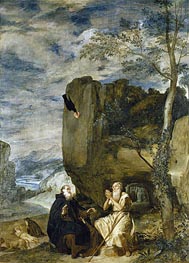
Saint Anthony the Abbot and Saint Paul the First Hermit c.1634
$1731
$88.98
Diego Rodriguez de Silva Velazquez
Original Size:257 x 188 cm
Prado Museum, Madrid, Spain
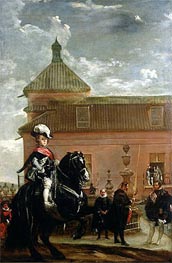
Prince Baltasar Carlos with Count-Duke of Olivares c.1636
$1194
$70.17
Diego Rodriguez de Silva Velazquez
Original Size:144 x 90.8 cm
Private Collection
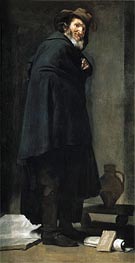
Menippus c.1639/40
$1501
$64.11
Diego Rodriguez de Silva Velazquez
Original Size:179 x 94 cm
Prado Museum, Madrid, Spain
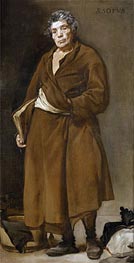
Aesop c.1638
$1572
$63.23
Diego Rodriguez de Silva Velazquez
Original Size:179 x 94 cm
Prado Museum, Madrid, Spain
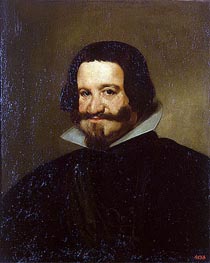
Portrait of Count-Duke Olivares 1638
$1006
$90.08
Diego Rodriguez de Silva Velazquez
Original Size:67 x 54.5 cm
The State Hermitage Museum, St. Petersburg, Russia