
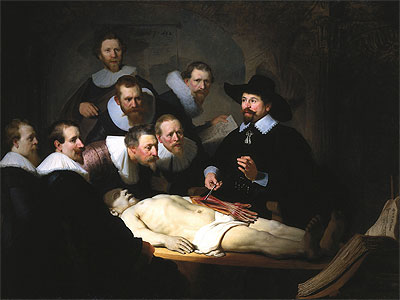
The Anatomy Lecture of Dr. Nicolaes Tulp, 1632 van Rijn Rembrandt (1606-1669)
Location: Mauritshuis Royal Picture Gallery The Hague NetherlandsOriginal Size: 169.5 x 216 cm
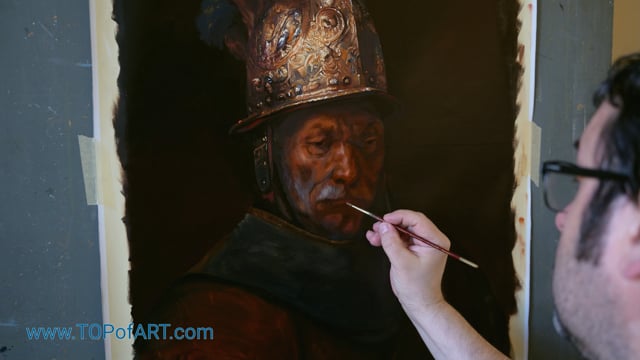
Recreating Rembrandt: A Video Journey into Museum-Quality Reproductions by TOPofART
Video showcasing the process of hand-painting a Rembrandt masterpiece with the utmost precision and care for detail.
Oil Painting Reproduction
If you want a different size than the offered
Description
Painted by European Аrtists with Academic Education
Museum Quality
+ 4 cm (1.6") Margins for Stretching
Creation Time: 8-9 Weeks
Creation Process
We create our paintings with museum quality and covering the highest academic standards. Once we get your order, it will be entirely hand-painted with oil on canvas. All the materials we use are the highest level, being totally artist graded painting materials and linen canvas.
We will add 1.6" (4 cm) additional blank canvas all over the painting for stretching.
High quality and detailing in every inch are time consuming. The reproduction of van Rijn Rembrandt also needs time to dry in order to be completely ready for shipping, as this is crucial to not be damaged during transportation.
Based on the size, level of detail and complexity we need 8-9 weeks to complete the process.
In case the delivery date needs to be extended in time, or we are overloaded with requests, there will be an email sent to you sharing the new timelines of production and delivery.
TOPofART wants to remind you to keep patient, in order to get you the highest quality, being our mission to fulfill your expectations.
We not stretch and frame our oil paintings due to several reasons:
Painting reproduction is a high quality expensive product, which we cannot risk to damage by sending it being stretched.
Also, there are postal restrictions, regarding the size of the shipment.
Additionally, due to the dimensions of the stretched canvas, the shipment price may exceed the price of the product itself.
You can stretch and frame your painting in your local frame-shop.
Delivery
Once the painting The Anatomy Lecture of Dr. Nicolaes Tulp is ready and dry, it will be shipped to your delivery address. The canvas will be rolled-up in a secure postal tube.
We offer free shipping as well as paid express transportation services.
After adding your artwork to the shopping cart, you will be able to check the delivery price using the Estimate Shipping and Tax tool.
Museum Quality
The paintings we create are only of museum quality. Our academy graduated artists will never allow a compromise in the quality and detail of the ordered painting. TOPofART do not work, and will never allow ourselves to work with low quality studios from the Far East. We are based in Europe, and quality is our highest priority.
Additional Information
Dr. Nicolaes Tulp is pictured explaining the musculature of the arm to medical professionals. The corpse is that of the criminal Aris Kindt, strangled earlier that day for armed robbery. Some of the spectators are various doctors who paid commissions to be included in the painting.
The event can be dated to 16 January 1632: the Amsterdam Guild of Surgeons, of which Tulp was official City Anatomist, permitted only one public dissection a year, and the body would have to be that of an executed criminal.
Anatomy lessons were a social event in the 17th century, taking place in lecture rooms that were actual theatres, with students, colleagues and the general public being permitted to attend on payment of an entrance fee. The spectators are appropriately dressed for a solemn social occasion. It is thought that, with the exception of the figures to the rear and left, these people were added to the picture later.
One person is missing: the Preparator, whose task it was to prepare the body for the lesson. In the 17th century an important scientist such as Dr. Tulp would not be involved in menial and bloody work like dissection, and such tasks would be left to others. It is for this reason that the picture shows no cutting instruments. Instead we see in the lower right corner an enormous open textbook on anatomy, possibly the 1543 De Humani Corporis Fabrica (Fabric of the Human Body) by Andreas Vesalius.
Medical specialists have commented on the accuracy of muscles and tendons painted by the 26 year old Rembrandt. It is not known where he obtained such knowledge; it is possible that he copied the details from an anatomical textbook. However, in 2006 Dutch researchers recreated the scene with a male cadaver, revealing several discrepancies of the exposed left forearm compared to that of a real corpse. The surgically astute will notice that the origin of the exposed forearm muscles would seem to indicate that the flexor compartment originates at the lateral epicondyle, when it is, in fact, the medial epicondyle. It is the common extensor origin that originates at the lateral epicondyle.
The face of the corpse is partially shaded, a suggestion of umbra mortis (shadow of death), a technique that Rembrandt was to use frequently. The painting is signed in the top-left hand corner Rembrandt f 1632. It is the first known instance of Rembrandt signing a painting with his forename as opposed to the initials RHL (Rembrandt Harmenszoon of Leiden), and is thus a sign of his growing artistic confidence.

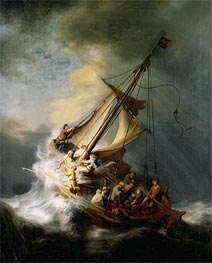
Storm on the Sea of Galilee 1633
$1535
$59.83
van Rijn Rembrandt
Original Size:161.7 x 129.8 cm
Isabella Stewart Gardner Museum, Boston, USA

The Holy Family c.1630
$1795
$60.65
van Rijn Rembrandt
Original Size:183.5 x 123 cm
Alte Pinakothek, Munich, Germany

Christ and St Mary Magdalene at the Tomb 1638
$1523
$61.71
van Rijn Rembrandt
Original Size:61 x 49.5 cm
The Royal Collection, London, United Kingdom
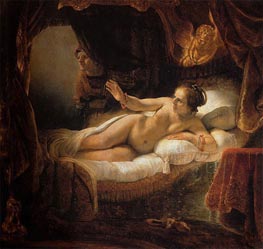
Danae 1636
$1918
$86.77
van Rijn Rembrandt
Original Size:185 x 203 cm
The State Hermitage Museum, St. Petersburg, Russia

Flora (Saskia van Uylenburgh in Arcadian Costume) 1635
$1832
$58.20
van Rijn Rembrandt
Original Size:123.5 x 97.5 cm
National Gallery, London, United Kingdom