
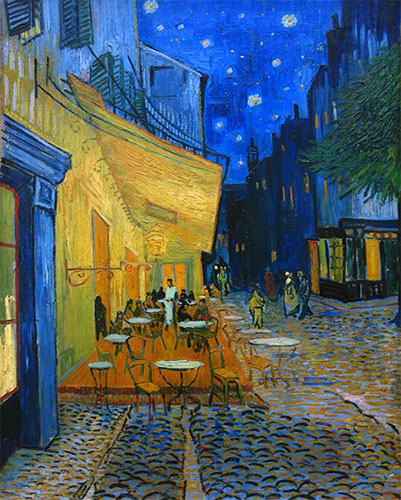
The Cafe Terrace on the Place du Forum, Arles, 1888 Vincent van Gogh (1853-1890)
Location: Kroller-Mueller Museum Otterlo NetherlandsOriginal Size: 81 x 65.5 cm
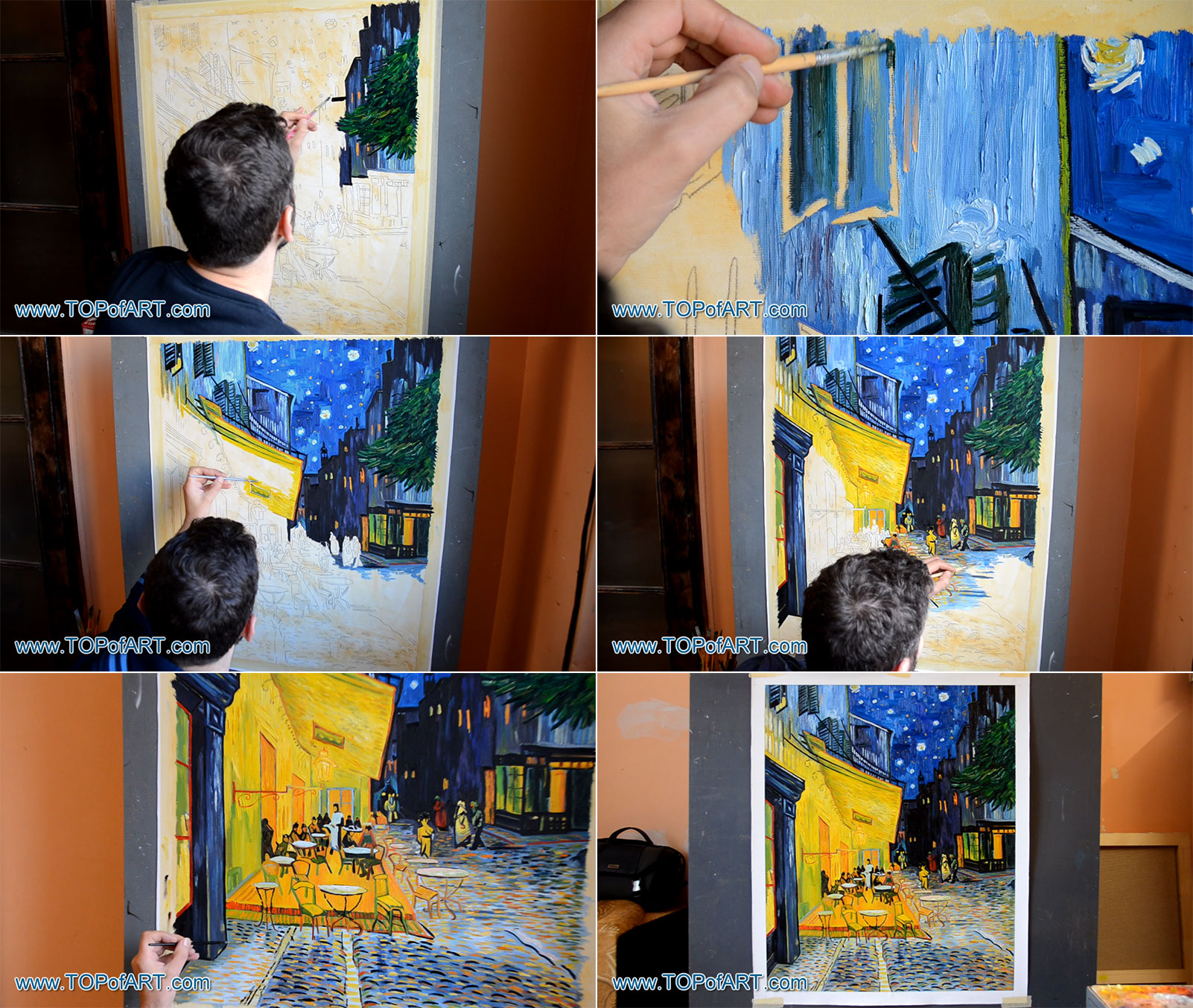
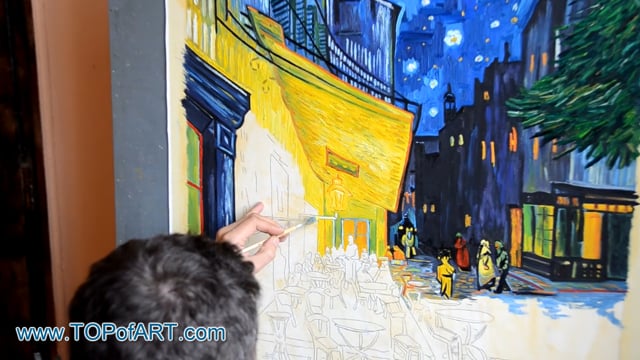 The Cafe Terrace on the Place du Forum, Arles - Video
A Glimpse into Our Studio: Creating Museum-Quality Oil Painting Reproductions
Watch a video showcasing the creation of a hand-painted reproduction of The Cafe Terrace on the Place du Forum, Arles by Vincent van Gogh in our TOPofART studio. Witness the step-by-step process as our artists bring this masterpiece to life.
Oil Painting Reproduction
If you want a different size than the offered
Description
Painted by European Аrtists with Academic Education
Museum Quality
+ 4 cm (1.6") Margins for Stretching
Creation Time: 8-9 Weeks
Creation Process
We create our paintings with museum quality and covering the highest academic standards. Once we get your order, it will be entirely hand-painted with oil on canvas. All the materials we use are the highest level, being totally artist graded painting materials and linen canvas.
We will add 1.6" (4 cm) additional blank canvas all over the painting for stretching.
High quality and detailing in every inch are time consuming. The reproduction of Vincent van Gogh also needs time to dry in order to be completely ready for shipping, as this is crucial to not be damaged during transportation.
Based on the size, level of detail and complexity we need 8-9 weeks to complete the process.
In case the delivery date needs to be extended in time, or we are overloaded with requests, there will be an email sent to you sharing the new timelines of production and delivery.
TOPofART wants to remind you to keep patient, in order to get you the highest quality, being our mission to fulfill your expectations.
We not stretch and frame our oil paintings due to several reasons:
Painting reproduction is a high quality expensive product, which we cannot risk to damage by sending it being stretched.
Also, there are postal restrictions, regarding the size of the shipment.
Additionally, due to the dimensions of the stretched canvas, the shipment price may exceed the price of the product itself.
You can stretch and frame your painting in your local frame-shop.
Delivery
Once the painting The Cafe Terrace on the Place du Forum, Arles is ready and dry, it will be shipped to your delivery address. The canvas will be rolled-up in a secure postal tube.
We offer free shipping as well as paid express transportation services.
After adding your artwork to the shopping cart, you will be able to check the delivery price using the Estimate Shipping and Tax tool.
Museum Quality
The paintings we create are only of museum quality. Our academy graduated artists will never allow a compromise in the quality and detail of the ordered painting. TOPofART do not work, and will never allow ourselves to work with low quality studios from the Far East. We are based in Europe, and quality is our highest priority.
Additional Information
Still today, visitors of the site can take the place at the north eastern corner of the Place du Forum where the artist set up his easel. He looked south towards the artificially lighted terrace of the popular coffee house as well as into the enforced darkness of the rue leading up to the building structure far back comprising the town house (to the left, not pictured) and, beyond this structure, the tower of a former church (now Musee lapidaire). Towards the right, Van Gogh indicated a shop lighted as well, and some branches of the trees surrounding the place but he omitted the remainders of the roman monuments just aside this little shop.
After finishing Cafe Terrace at Night, Van Gogh wrote a letter to his sister expressing his enthusiasm:
"I was only interrupted by my work on a new painting representing the exterior of a night cafe . On the terrace there are small figures of people drinking. An immense yellow lantern illuminates the terrace, the facade, the side walk and even casts light on the paving stones of the road which take a pinkish violet tone. The gables of the houses, like a fading road below a blue sky studded with stars, are dark blue or violet with a green tree. Here you have a night painting without black, with nothing but beautiful blue and violet and green and in this surrounding the illuminated area colours itself sulfur pale yellow and citron green. It amuses me enormously to paint the night right on the spot. Normally, one draws and paints the painting during the daytime after the sketch. But I like to paint the thing immediately. It is true that in the darkness I can take a blue for a green, a blue lilac for a pink lilac, since it is hard to distinguish the quality of the tone. But it is the only way to get away from our conventional night with poor pale whitish light, while even a simple candle already provides us with the richest of yellows and oranges."
Van Gogh used oil paint on canvas and the painting is 81/65.5 cm (32"/26").
When exhibited for the first time, in 1892, the painting was entitled Coffeehouse, in the evening (Cafe, le soir)
This is the first painting in which he used starry backgrounds. He went on to paint star filled skies in Starry Night Over the Rhone, painted the same month, and the better known Starry Night a year later. Also, in Portrait of Eugene Boch Van Gogh painted a starlight background.

7 Reviews
4.86 Overall rating

Thanks a million for your assistance
A happy customer
The Plowed Field 1888
$581
$58.12
Vincent van Gogh
Original Size:65 x 81 cm
Van Gogh Museum, Amsterdam, Netherlands
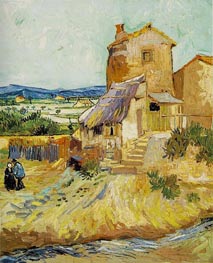
The Old Mill 1888
$424
$61.63
Vincent van Gogh
Original Size:83.2 x 73 cm
Albright-Knox Art Gallery, Buffalo, USA
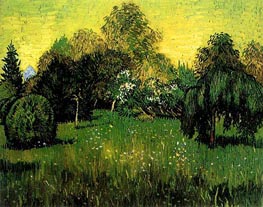
Public Park with Weeping Willow 1888
$581
$58.92
Vincent van Gogh
Original Size:73 x 92 cm
Art Institute of Chicago, Illinois, USA
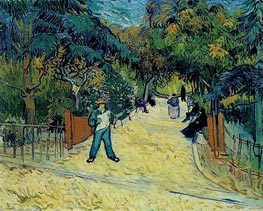
Entrance to the Public Garden in Arles 1888
$604
$58.12
Vincent van Gogh
Original Size:72.4 x 90.8 cm
Phillips Collection, Washington, USA
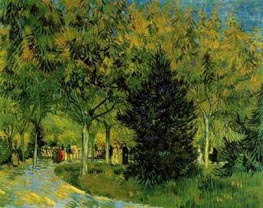
A Lane in the Public Garden at Arles 1888
$581
$58.39
Vincent van Gogh
Original Size:73 x 92 cm
Kroller-Mueller Museum, Otterlo, Netherlands