
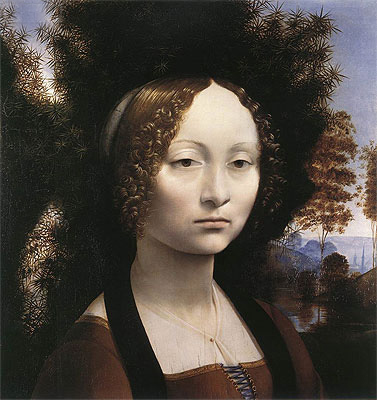
Portrait of Ginevra de' Benci, c.1474/78 Leonardo da Vinci (1452-1519)
Location: National Gallery of Art Washington USAOriginal Size: 38.8 x 36.7 cm
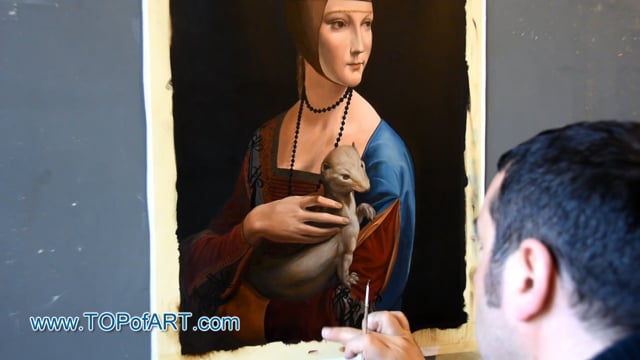
Recreating Leonardo da Vinci: A Video Journey into Museum-Quality Reproductions by TOPofART
Video showcasing the process of hand-painting a Leonardo da Vinci masterpiece with the utmost precision and care for detail.
Oil Painting Reproduction
If you want a different size than the offered
Description
Painted by European Аrtists with Academic Education
Museum Quality
+ 4 cm (1.6") Margins for Stretching
Creation Time: 8-9 Weeks
Creation Process
We create our paintings with museum quality and covering the highest academic standards. Once we get your order, it will be entirely hand-painted with oil on canvas. All the materials we use are the highest level, being totally artist graded painting materials and linen canvas.
We will add 1.6" (4 cm) additional blank canvas all over the painting for stretching.
High quality and detailing in every inch are time consuming. The reproduction of Leonardo da Vinci also needs time to dry in order to be completely ready for shipping, as this is crucial to not be damaged during transportation.
Based on the size, level of detail and complexity we need 8-9 weeks to complete the process.
In case the delivery date needs to be extended in time, or we are overloaded with requests, there will be an email sent to you sharing the new timelines of production and delivery.
TOPofART wants to remind you to keep patient, in order to get you the highest quality, being our mission to fulfill your expectations.
We not stretch and frame our oil paintings due to several reasons:
Painting reproduction is a high quality expensive product, which we cannot risk to damage by sending it being stretched.
Also, there are postal restrictions, regarding the size of the shipment.
Additionally, due to the dimensions of the stretched canvas, the shipment price may exceed the price of the product itself.
You can stretch and frame your painting in your local frame-shop.
Delivery
Once the painting Portrait of Ginevra de' Benci is ready and dry, it will be shipped to your delivery address. The canvas will be rolled-up in a secure postal tube.
We offer free shipping as well as paid express transportation services.
After adding your artwork to the shopping cart, you will be able to check the delivery price using the Estimate Shipping and Tax tool.
Museum Quality
The paintings we create are only of museum quality. Our academy graduated artists will never allow a compromise in the quality and detail of the ordered painting. TOPofART do not work, and will never allow ourselves to work with low quality studios from the Far East. We are based in Europe, and quality is our highest priority.
Additional Information
The juniper in the middle-ground indubitably dominates the portrait of Ginevra and is more than an ornamental accessory, for - like certain other plants - the juniper was a symbol of female virtue. Furthermore, the Italian name 'ginepro' was not unrelated to the name of the sitter, Ginevra. There is a complex sequel to these allusions on the reverse of the portrait which is, unusually, also painted. There, on imitation red porphyry marble, we see laurel, juniper and palm branches linked to each other by a swirling garland with the words VIRTUTEM FORMA DECORAT: 'Beauty adorns Virtue'. The inscription, the plant-attributes and the painted marble all underline the connection between beauty and virtue. With its imitation of red, immensely durable porphyry marble - in itself a remarkable substance - the reverse of the portrait speaks of the resilience of Ginevra's virtue. The laurel branches and palm fronds, framing the garland with its inscription, are associated with Bernardo Bembo who commissioned the painting, for both featured in his own personal arms. The juniper in the centre, growing from the garland, is yet another allusion to Ginevra's name and the virtues of chastity and faithfulness. At the same time the evergreen laurel points to Ginevra's aspirations as a poet, which we know of from Bembo and other writers. The palm frond, too, is a traditional symbol of virtue. The inscription VIRTUTEM FORMA DECORAT, so closely intertwined with the plants as symbols of virtue, makes the connection between beauty and virtue, which was a topos of contemporary literature reflected here on the front of this portrait, where Ginevra's gentle beau*y is also to be understood as an expression of her virtue. The front and the reverse of this portrait could hardly be linked more closely.

Lady with an Ermine (Cecilia Gallerani) 1496
$1695
$51.65
Leonardo da Vinci
Original Size:53.4 x 39.3 cm
Czartoryski Museum, Krakow, Poland
Mona Lisa (La Gioconda) c.1503/06
$2025
$51.16
Leonardo da Vinci
Original Size:77 x 53 cm
Louvre Museum, Paris, France
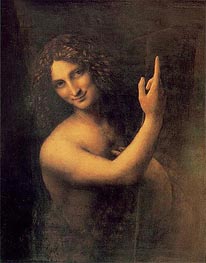
St John the Baptist c.1513/16
$1545
$96.78
Leonardo da Vinci
Original Size:69 x 57 cm
Louvre Museum, Paris, France
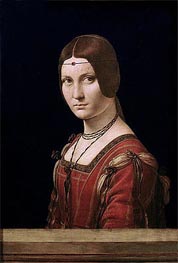
La Belle Ferronniere (Portrait of a Lady from the Court of Milan) c.1490/95
$1439
$51.29
Leonardo da Vinci
Original Size:63 x 45 cm
Louvre Museum, Paris, France
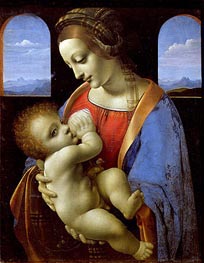
Madonna Litta c.1490/91
$1818
$49.12
Leonardo da Vinci
Original Size:42 x 33 cm
The State Hermitage Museum, St. Petersburg, Russia