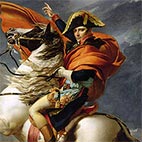
Neoclassicism (sometimes rendered as Neo-Classicism or Neo-classicism) is the name given to quite distinct movements in the visual arts, literature, theatre, music, and architecture. These movements were in effect at various times between the 18th and the 20th centuries.
Neoclassic in architecture and the visual arts
In the visual arts the European movement called "neoclassicism" began after ca 1765, as a reaction against both the surviving
Baroque and
Rococo styles, and as a desire to return to the perceived "purity" of the arts of Rome, the more vague perception ("ideal") of Ancient Greek arts (where almost no western artist had actually been) and, to a lesser extent, 16th century
Renaissance Classicism.
Each "neo"- classicism selects some models among the range of possible classics that are available to it, and ignores others. The neoclassical writers and talkers, patrons and collectors, artists and sculptors of 1765 - 1830 paid homage to an idea of the generation of Pheidias, but the sculpture examples they actually embraced were more likely to be Roman copies of Hellenistic sculptures. They ignored both Archaic Greek art and the works of Late Antiquity. The
Rococo art of ancient Palmyra came as a revelation, through engravings in Wood's The Ruins of Palmyra. Even in all but unvisited Greece, a rough backwater of the Ottoman Empire, dangerous to explore, neoclassicists' appreciation of Greek architecture was mediated through drawings and engravings, which subtly smoothed and regularized, "corrected' and "restored" the monuments of Greece, not always consciously. As for painting, Greek painting was utterly lost: neoclassicist painters imaginatively revived it, partly through bas-relief friezes, mosaics, and pottery painting and partly through the examples of painting and decoration of the
High Renaissance of
Raphael's generation, frescos in Nero's Domus Aurea, Pompeii and Herculaneum and through renewed admiration of
Nicholas Poussin. Much "neoclassical" painting is more classicisizing in subject matter than in anything else.
There is an anti-
Rococo strain that can be detected in some European architecture of the earlier 18th century, most vividly represented in the Palladian architecture of Georgian Britain and Ireland, but also recognizable in a classicizing vein of architecture in Berlin. It is a robust architecture of self-restraint, academically selective now of "the best" Roman models.
A conservative Italian interior translated to Russia: Dressing-Room at the Gatchina palace by Luigi Vanvitelli's pupil Antonio Rinaldi, 1770sNeoclassicism first gained influence in England and France, through a generation of French art students trained in Rome and influenced by the writings of Johann Joachim Winckelmann, and it was quickly adopted by progressive circles in Sweden. At first, classicizing decor was grafted onto familiar European forms, as in the interiors for Catherine II's lover Count Orlov, designed by an Italian architect with a team of Italian stuccadori: only the isolated oval medallions like cameos and the bas-relief overdoors hint of neoclassicism; the furnishings are fully Italian
Rococo.
But a second neoclassic wave, more severe, more studied (through the medium of engravings) and more consciously archaeological, is associated with the height of the Napoleonic Empire. In France, the first phase of neoclassicism is expressed in the "Louis XVI style", the second phase in the styles we call "Directoire" or "Empire." Italy clung to
Rococo until the Napoleonic regimes brought the new archeaological classicism, which was embraced as a political statement by young, progressive, urban Italians with republican leanings.
David's Oath of the Horatii (1784) is not just neoclassical in subject.
The high tide of neoclassicism in painting is exemplified in early paintings by
Jacques-Louis David and
Jean Auguste Dominique Ingres' entire career.
David's
Oath of the Horatii was painted in Rome and made a splash at the Paris Salon of 1784. Its central perspective is perpendicular to the picture plane, made more emphatic by the dim arcade behind, against which the heroic figures are disposed as in a frieze, with a hint of the artificial lighting and staging of opera, and the classical coloring of
Nicholas Poussin.
In sculpture, the most familiar representatives are the Italian Antonio Canova, the Englishman John Flaxman and the Dane Bertel Thorvaldsen.
In the decorative arts, neoclassicism is exemplified in Empire furniture made in Paris, London, New York, Berlin; in Biedermeyer furniture made in Austria; in Karl Friedrich Schinkel's museums in Berlin, Sir John Soane's Bank of England in London and the newly built "capitol" in Washington, DC; and in Wedgwood's bas reliefs and "black basaltes" vases. The Scots architect Charles Cameron created palatial Italianate interiors for the German-born Catherine II the Great in Russian St. Petersburg: the style was international.
Indoors, neoclassicism made a discovery of the genuine classic interior, inspired by the rediscoveries at Pompeii and Herculaneum, which had started in the late 1740s, but only achieved a wide audience in the 1760s, with the first luxurious volumes of tightly-controlled distribution of Le Antichit??? di Ercolano. The antiquities of Herculaneum showed that even the most classicizing interiors of the
Baroque, or the most "Roman" rooms of William Kent were based on basilica and temple exterior architecture, turned outside in: pedimented window frames turned into gilded mirrors, fireplaces topped with temple fronts, now all looking quite bombastic and absurd. The new interiors sought to recreate an authentically Roman and genuinely interior vocabulary, employing flatter, lighter motifs, sculpted in low frieze-like relief or painted in monotones en cama????eu ("like cameos"), isolated medallions or vases or busts or bucrania or other motifs, suspended on swags of laurel or ribbon, with slender arabesques against backgrounds, perhaps, of "Pompeiian red" or pale tints, or stone colors. The style in France was initially a Parisian style, the "go???»t Gr????c" not a court style. Only when the plump, young king acceded to the throne in 1771 did his fashion-loving Queen bring the "Louis XVI" style to court.
At the Royal Scottish Academy, Edinburgh, Playfair employs a Greek Doric octastyle porticoFrom about 1800 a fresh influx of Greek architectural examples, seen through the medium of etchings and engravings, gave a new impetus to neoclassicism that is called the Greek Revival.
Neoclassicism continued to be a major force in
academic art through the 19th century and beyond???‚¬??? a constant antithesis to
Romanticism or Gothic revivals???‚¬??? although from the late 19th century on it had often been considered anti-modern, or even reactionary, in influential critical circles. By the mid-19th century, several European cities - notably St Petersburg and Munich - were transformed into veritable museums of Neoclassical architecture.
In American architecture, neoclassicism was one expression of the American Renaissance movement, ca 1890-1917; its last manifestation was in Beaux-Arts architecture, and its very last, large public projects were the Lincoln Memorial (highly criticised at the time), the National Gallery in Washington, D.C., and the American Museum of Natural History's Roosevelt Memorial. These were white elephants as they were built. In the British Raj, Sir Edwin Lutyens' monumental city planning for New Delhi marks the glorious sunset of neoclassicism. Soon World War II destroyed all illusions.
Literary neoclassicism
The arts do not always march in step, and "neoclassicism" in English literature is associated with the "Augustan" writers of the early 18th century, all the heirs of John Dryden and Milton. The giant among their inspiring Latin classics was Virgil. Major writers of the period have included Daniel Defoe, Jonathan Swift, Alexander Pope. The ensuing period of "
Romantic" writers had its origins at the height of neoclassicism in the visual arts, about 1800.
In France, the hallmark of neoclassicism is the theater of Jean Racine, with his balanced lines of verse, restraint in emotion, refinement in diction, without excesses, his artistic consistency, so that the tragic tone was not offset by moments of realism or humor (as in Shakespeare), and his formal adherence to the "classical unities" extracted from Aristotle's Poetics.
In 1786, the German literary master Goethe ended his proto-Romantic Sturm und Drang period with his trip to Italy (recounted in his 1817 work, Italienische Reise). Afterwards, he and colleague Schiller emulated the themes and sensibility of Greek tragedy in works like Iphigenia auf Tauris (Iphigenia at Tauris), R???¶mische Elegien (Roman Elegies), and Faust. Neo-Classical themes also dominated the work of German poet H???¶lderlin.
with help of wikipedia