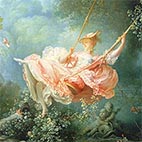
The
Rococo style of art emerged in France in the early 18th century. It is characterized by opulence, grace, playfulness, and lightness in contrast to the heavier themes and darker colors of the earlier Baroque period. Rococo motifs focused on the carefree aristrocratic life and on lighthearted romance rather then heroic battles or religious figures. In the mid-late 18th century, rococo was surpassed by the
Neoclassical style.
The word Rococo was apparently a combination of the French rocaille, or shell, and the Italian barocco, or
Baroque style. Because of Rococo love of shell-like curves and focus on decorative arts, some critics used the term to derogatively imply that the style was frivolous or merely fashion. Since the mid 19th century, though, the term has been accepted by art historians. While there is still some debate about the art historical significance of the style, rococo is now widely recognized as a major period in the development of European art.
Historical Development
Rococo developed first in the decorative arts and interior design. Louis XV's succession brought a change in the court artists and general artistic fashion. By the end of the old king's reign, rich
Baroque designs were giving way to lighter elements with more curves and natural patterns. These elements are evident in the architectural designs of Nicolas Pineau. During the R???©gence, court life moved away from Versailles and this artistic change became well established, first in the royal palace and then throughout French high society. The delicacy and playfulness of Rococo designs is often seen as a reaction to the excesses of Louis XIV's regime.
The 1730s represented the height of Rococo development in France. The style had spread beyond architecture and furniture to painting and sculpture, exemplified by the works of
Antoine Watteau and Fran???§ois Boucher. Rococo still maintained the
Baroque taste for complex forms and intricate patterns. By this point, it had begun to integrate a variety of diverse characteristics, including a taste for Oriental designs and asymmetric compositions.
The Rococo style spread with French artists and engraved publications. It was readily received in the Catholic parts of Germany, Bohemia, and Austria, where it was merged with the lively German
Baroque traditions. Particularly in the south, German Rococo was applied with enthusiasm to churches and palaces. Architects often draped their interiors in clouds of fluffy white stucco. In Italy, the late
Baroque styles of Borromini and Guarini set the tone for Rococo in Turin, Venice, Naples and Sicily, while the arts in Tuscany and Rome remained more wedded to
Baroque.
Rococo in England was always thought of as the "French taste." The architectural stylings never caught on, though silverwork, porcelain, and silks were strongly influenced by the continental style. Thomas Chippendale transformed English furniture design through his adaptation and refinement of the style. William Hogarth helped develop a theoretical foundation for Rococo beauty. Though not intentionally referencing the movement, he argued in his Analysis of Beauty (1753) that the S-curves prominent in Rococo were the basis for grace and beauty in art or nature.
The beginning of the end for Rococo came in the early 1760s as figures like Voltaire and Jacques-Fran???§ois Blondel began to voice their criticism of the superficiality and degeneracy of the art. Blondel decried the "ridiculous jumble of shells, dragons, reeds, palm-trees and plants" in contemporary interiors. By 1780, Rococo had passed out of fashion in France, replaced by the order and seriousness of
Neoclassical artists like
Jacques Louis David. It remained popular in the provinces and in Italy, until the second phase of neoclassicism, "Empire style," arrived with Napoleonic governments and swept Rococo away.
There was a renewed interest in the Rococo style between 1820 and 1870. The English were among the first to revive the "Louis XIV style" as it was miscalled at first, and paid inflated prices for second-hand Rococo luxury goods that could scarcely be sold in Paris. But prominent artists like Delacroix and patrons like Empress Eug???©nie also rediscovered the value of grace and playfulness in art and design.
Painting
Though Rococo originated in the purely decorative arts, the style showed clearly in painting. These painters used delicate colors and curving forms, decorating their canvases with cherubs and myths of love. Portraiture was also popular among Rococo painters. Their landscapes were pastoral and often depicted the leisurely outings of aristocratic couples.
Jean-Antoine Watteau (1684-1721) is generally considered the first great Rococo painter. He had a great influence on later painters, including Francois Boucher (1703-1770) and
Jean-Honore Fragonard (1732-1806), two masters of the late period. Even
Thomas Gainsborough's (1727-1788) delicate touch and sensitivity are reflective of the Rococo spirit.