Startseite / Künstler / Leonardo da Vinci /
Lady with an Ermine (Cecilia Gallarani) - Handgemalte Reproduktion
Technik:
Titel:
Künstler:
Standort:
SKU:
Titel:
Künstler:
Standort:
SKU:
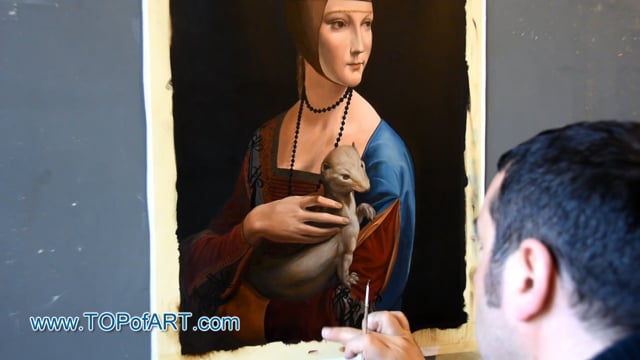
Handgemalte Reproduktion mit Öl auf Leinwand
Lady with an Ermine (Cecilia Gallarani) 1496
Leonardo da VinciCzartoryski Museum Krakow Poland
VIL-1009-1036
Ihre Auswahl ist:
Handgemalte Reproduktion
$$497.00
...:
Alt Ausse: ......
Summe: $0
Alt Ausse: ......
Format Wählen:
Alt Ausse Wählen:
Handgemalten Kunstreproduktionen versandt werden im Post-Röhrchen gerollt.
original-format des gemäldes: 21/15.5 zoll
original-format des gemäldes: 53/39 centimeters
Wie Rahmen Ihre Kunstreproduktion?:
Wir können Ihre Gemälde-Reproduktion wie das Museumsoriginal altaussehend und spröde machen.
Das Effekt der Veralterung verleiht dem Bild eine unvergleichliche Anmut, Autentizität und Adel. Mit diesem Aussehen können die Handgemalte Kunstreproduktionen jedem Interieur einen einzigartigen, neuen Stil geben.
Der Prozess der Veralterung des Bildes ist völlig mit der Technologie der Ölmalerei kompatibel und beschädigt auf keine Weise ihre Oberfläche. Da das Effekt der Veralterung ein Firmengeheimnis ist, hoffen wir, dass Sie die Vorenthaltung weiterer Informationen über die Beschreibung der Technologie verzeihen.
Siehe Beispiele von Gemälde-Reproduktionen in unserem Studio gealtert und spröde.
Das Effekt der Veralterung verleiht dem Bild eine unvergleichliche Anmut, Autentizität und Adel. Mit diesem Aussehen können die Handgemalte Kunstreproduktionen jedem Interieur einen einzigartigen, neuen Stil geben.
Der Prozess der Veralterung des Bildes ist völlig mit der Technologie der Ölmalerei kompatibel und beschädigt auf keine Weise ihre Oberfläche. Da das Effekt der Veralterung ein Firmengeheimnis ist, hoffen wir, dass Sie die Vorenthaltung weiterer Informationen über die Beschreibung der Technologie verzeihen.
Siehe Beispiele von Gemälde-Reproduktionen in unserem Studio gealtert und spröde.
Gemälde Infos
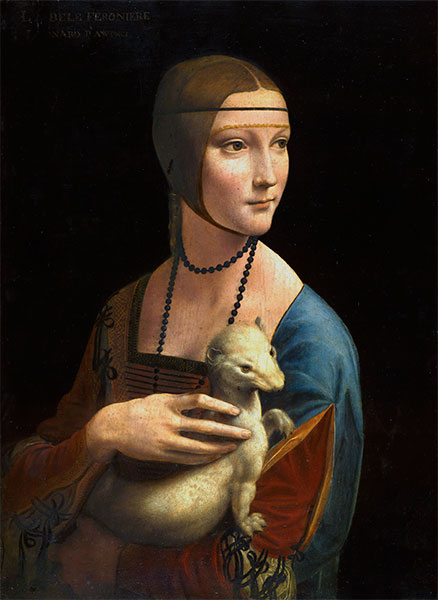
Lady with an Ermine is a painting by Leonardo da Vinci, around 1489-1490. Its subject is identified with reasonable security as Cecilia Gallerani, the mistress of Lodovico Sforza, "Ludovico il Moro", Duke of Milan. The painting is one of only four female portraits Leonardo painted (the other three being the Mona Lisa, the portrait of Ginevra de' Benci and La Belle Ferroniere). Despite sustaining much damage - the surface is much rubbed, the background was lightly overpainted with unmodulated black, the upper left corner has been broken and repaired, a transparent veil on the model's head was turned into an extravagant hairdo and several fingers were grossly retouched it is nonetheless in better condition than many of Leonardo's other paintings.
Leonardo met Cecilia Gallerani in Milan in 1484 while both were living in Castello Sforzesco, the fortress-palace of Duke Lodovico Sforza. She was the Duke's mistress; young and beautiful (she was only 17 years old), Cecilia played music and wrote poetry. Several interpretations of the significance of the ermine in her portrait are possible. Pet ermines were associated with the aristocracy and ermines were emblems of purity that would face death rather than soil their pristine coats and a personal device of Ludovico il Moro, who had been invested with the Order of the Ermine in 1488, so its association with Cecilia could have been multiply intended. Alternatively, it could be a pun on her name (the Greek for ermine is galay). Strictly speaking, the animal in the painting appears to be not an ermine but a white ferret, a type favoured in the Middle Ages because of the ease of seeing the white animal in thick undergrowth.
The sitter's hair is confined tightly to her head under a very fine net veil with a woven border of gold-wound threads.
As in many of Leonardo's portraits, the composition comprises a pyramidic spiral and the sitter is caught in the motion of turning to her left, reflecting Leonardo's life-long preoccupation with the dynamics of movement. The three-quarter profile portrait was one of his many innovations. Il Moro's court poet, Bernardo Bellincioni, was the first to propose that Cecilia is poised as if listening to an unseen speaker.
This work in particular shows da Vinci's expertise in painting the human form. The outstretched hand of Cecilia was painted with great detail. Da Vinci paints every contour of each fingernail, each wrinkle around her knuckles, and even the flexing of the tendon in her bent finger. Da Vinci had practiced drawing portraits of humans with animals in his journals many times in order to perfect his portraits.
The painting was acquired in Italy by Adam Jerzy Czartoryski, the son of Izabela Czartoryska and Adam Kazimierz Czartoryski in 1798 and incorporated into the Czartoryskis’ family collections at Pulawy in 1800. The inscription on the top-left hand corner of the painting, LA BELE FERIONIERE. LEONARD D'AWINCI., was probably added by a restorer shortly after its arrival in Poland and before the background was overpainted. Czartoryski was clearly aware that it was a Leonardo, though the painting had not ever been discussed in print; unfortunately, there is no record of any previous owner. The Belle Ferroniere is the Leonardo portrait in the Louvre, whose sitter bears such a close resemblance that the Czartoryskis considered this sitter to be the same. The painting travelled extensively in the nineteenth century; Princess Czartoryski rescued it in advance of the invading Russian army in 1830, hidden, then sent to Dresden and on to the Czartoryski place of exile in Paris, the Hotel Lambert, returning it to Krakow in 1882. In 1939, almost immediately after the German occupation of Poland, it was seized by the Nazis and sent to the Kaiser Friedrich Museum in Berlin. In 1940 Hans Frank, the Governor General of Poland, requested that it be returned to Krakow, where it hung in his suite of offices. At the end of the Second World War it was discovered by Allied troops in Frank's country home in Bavaria. It has since returned to Poland and is once more on display at the Czartoryski Museum in Krakow.
X-ray and microscopic analysis have revealed the charcoal-pounced outline of the pricked preparatory drawing on the prepared undersurface, a technique Leonardo learned in the studio of Verrocchio. Leonardo's fingerprints on the still-tacky surface show that he used his fingers to soften and further blend his delicate brushstrokes.
Leonardo's painting is the inspiration for the parody Woman Holding Ferret by Leonard of Quirm in the Discworld series of books. The painting is also depicted on the cover of Enigma 2005 box set, 15 Years After. The Polish-made movie Vinci from 2004 revolves around a theft of the painting. The painting was also one of the inspirations for Philip Pullman's device of a "daemon" in the trilogy His Dark Materials. Mike Resnick used the painting as the basis of his biography of Leonardo da Vinci, Lady with an Alien.
Leonardo met Cecilia Gallerani in Milan in 1484 while both were living in Castello Sforzesco, the fortress-palace of Duke Lodovico Sforza. She was the Duke's mistress; young and beautiful (she was only 17 years old), Cecilia played music and wrote poetry. Several interpretations of the significance of the ermine in her portrait are possible. Pet ermines were associated with the aristocracy and ermines were emblems of purity that would face death rather than soil their pristine coats and a personal device of Ludovico il Moro, who had been invested with the Order of the Ermine in 1488, so its association with Cecilia could have been multiply intended. Alternatively, it could be a pun on her name (the Greek for ermine is galay). Strictly speaking, the animal in the painting appears to be not an ermine but a white ferret, a type favoured in the Middle Ages because of the ease of seeing the white animal in thick undergrowth.
The sitter's hair is confined tightly to her head under a very fine net veil with a woven border of gold-wound threads.
As in many of Leonardo's portraits, the composition comprises a pyramidic spiral and the sitter is caught in the motion of turning to her left, reflecting Leonardo's life-long preoccupation with the dynamics of movement. The three-quarter profile portrait was one of his many innovations. Il Moro's court poet, Bernardo Bellincioni, was the first to propose that Cecilia is poised as if listening to an unseen speaker.
This work in particular shows da Vinci's expertise in painting the human form. The outstretched hand of Cecilia was painted with great detail. Da Vinci paints every contour of each fingernail, each wrinkle around her knuckles, and even the flexing of the tendon in her bent finger. Da Vinci had practiced drawing portraits of humans with animals in his journals many times in order to perfect his portraits.
The painting was acquired in Italy by Adam Jerzy Czartoryski, the son of Izabela Czartoryska and Adam Kazimierz Czartoryski in 1798 and incorporated into the Czartoryskis’ family collections at Pulawy in 1800. The inscription on the top-left hand corner of the painting, LA BELE FERIONIERE. LEONARD D'AWINCI., was probably added by a restorer shortly after its arrival in Poland and before the background was overpainted. Czartoryski was clearly aware that it was a Leonardo, though the painting had not ever been discussed in print; unfortunately, there is no record of any previous owner. The Belle Ferroniere is the Leonardo portrait in the Louvre, whose sitter bears such a close resemblance that the Czartoryskis considered this sitter to be the same. The painting travelled extensively in the nineteenth century; Princess Czartoryski rescued it in advance of the invading Russian army in 1830, hidden, then sent to Dresden and on to the Czartoryski place of exile in Paris, the Hotel Lambert, returning it to Krakow in 1882. In 1939, almost immediately after the German occupation of Poland, it was seized by the Nazis and sent to the Kaiser Friedrich Museum in Berlin. In 1940 Hans Frank, the Governor General of Poland, requested that it be returned to Krakow, where it hung in his suite of offices. At the end of the Second World War it was discovered by Allied troops in Frank's country home in Bavaria. It has since returned to Poland and is once more on display at the Czartoryski Museum in Krakow.
X-ray and microscopic analysis have revealed the charcoal-pounced outline of the pricked preparatory drawing on the prepared undersurface, a technique Leonardo learned in the studio of Verrocchio. Leonardo's fingerprints on the still-tacky surface show that he used his fingers to soften and further blend his delicate brushstrokes.
Leonardo's painting is the inspiration for the parody Woman Holding Ferret by Leonard of Quirm in the Discworld series of books. The painting is also depicted on the cover of Enigma 2005 box set, 15 Years After. The Polish-made movie Vinci from 2004 revolves around a theft of the painting. The painting was also one of the inspirations for Philip Pullman's device of a "daemon" in the trilogy His Dark Materials. Mike Resnick used the painting as the basis of his biography of Leonardo da Vinci, Lady with an Alien.
Gemälden im Lager | Innenausstattung | Konfidentialität | Terms & Conditions | Return Policy | Seite-Karte | Links
TOPofART sind in Handgemalten Reproduktionen und Leinwand Kunstdruck spezialisiert und andere Kunstwerke medias: Aquarellpapier, Gravieren Papier, Pastell Papier, Pappe. Stellt interne und externe Rahmung und Strecken für Gemälde-Reproduktion bestellt.