
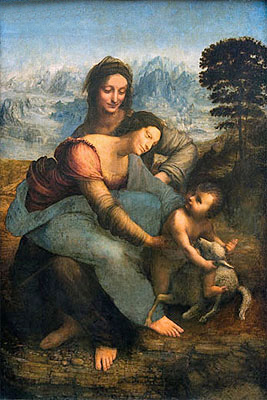
Virgin and Child with St. Anne, c.1502/13 Leonardo da Vinci (1452-1519)
Location: Louvre Museum Paris FranceOriginal Size: 168.5 x 130 cm
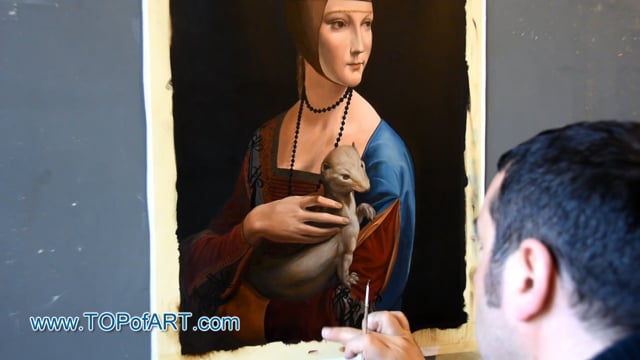
Recreating Leonardo da Vinci: A Video Journey into Museum-Quality Reproductions by TOPofART
Video showcasing the process of hand-painting a Leonardo da Vinci masterpiece with the utmost precision and care for detail.
Oil Painting Reproduction
If you want a different size than the offered
Description
Painted by European Аrtists with Academic Education
Museum Quality
+ 4 cm (1.6") Margins for Stretching
Creation Time: 8-9 Weeks
Creation Process
We create our paintings with museum quality and covering the highest academic standards. Once we get your order, it will be entirely hand-painted with oil on canvas. All the materials we use are the highest level, being totally artist graded painting materials and linen canvas.
We will add 1.6" (4 cm) additional blank canvas all over the painting for stretching.
High quality and detailing in every inch are time consuming. The reproduction of Leonardo da Vinci also needs time to dry in order to be completely ready for shipping, as this is crucial to not be damaged during transportation.
Based on the size, level of detail and complexity we need 8-9 weeks to complete the process.
In case the delivery date needs to be extended in time, or we are overloaded with requests, there will be an email sent to you sharing the new timelines of production and delivery.
TOPofART wants to remind you to keep patient, in order to get you the highest quality, being our mission to fulfill your expectations.
We not stretch and frame our oil paintings due to several reasons:
Painting reproduction is a high quality expensive product, which we cannot risk to damage by sending it being stretched.
Also, there are postal restrictions, regarding the size of the shipment.
Additionally, due to the dimensions of the stretched canvas, the shipment price may exceed the price of the product itself.
You can stretch and frame your painting in your local frame-shop.
Delivery
Once the painting Virgin and Child with St. Anne is ready and dry, it will be shipped to your delivery address. The canvas will be rolled-up in a secure postal tube.
We offer free shipping as well as paid express transportation services.
After adding your artwork to the shopping cart, you will be able to check the delivery price using the Estimate Shipping and Tax tool.
Museum Quality
The paintings we create are only of museum quality. Our academy graduated artists will never allow a compromise in the quality and detail of the ordered painting. TOPofART do not work, and will never allow ourselves to work with low quality studios from the Far East. We are based in Europe, and quality is our highest priority.
Additional Information
History
In 1498, Leonardo probed into incorporating these figures together by drawing the Burlington House Cartoon (National Gallery, London), which included all three figures in addition to an infant St John the Baptist. An earlier cartoon exhibited in Santissima Annunziata in 1501 is now lost.
Ultimately, this painting would emerge during the later years of his life, when he was occupied with an interest in mathematics and other pursuits, its rocky landscape betraying his interest in geology. The demands of his other interests may have forced him to leave this painting incomplete.
In addition to the symbolism of Christ playing with the lamb discussed above, Fra Pietro da Novellara, a Vice General of the Carmelite Order, saw a further layer of symbolic significance to the painting. He believed that St Anne's serene expression, in contrast with Mary's anxiety for her child, "perhaps stands for the Church that does not want to have the Passion of Christ prevented".
The painting's pyramidal structure influenced Raphael and Andrea del Sarto. Its composition inspired two High Renaissance sculptures, one by Andrea Sansovino (S. Agostino, Rome) and another, less successful work by Francesco da Sangallo (Orsanmichele, Florence).
Freud's interpretation
Sigmund Freud undertook a psychoanalytic examination of Leonardo in his essay Leonardo da Vinci, A Memory of His Childhood. According to Freud, the Virgin's garment reveals a vulture when viewed sideways. Freud claimed that this was a manifestation of a "passive homosexual" childhood fantasy that Leonardo wrote about in the Codex Atlanticus, in which he recounts being attacked as an infant in his crib by the tail of a vulture. He translated the passage thus:
It seems that I was always destined to be so deeply concerned with vultures for I recall as one of my very earliest memories that while I was in my cradle a vulture came down to me, and opened my mouth with its tail, and struck me many times with its tail against my lips.
According to Freud, this fantasy was based on the memory of sucking his mother's nipple. He backed up his claim with the fact that Egyptian hieroglyphs represent the mother as a vulture, because the Egyptians believed that there are no male vultures and that the females of the species are impregnated by the wind.
Unfortunately for Freud, the word 'vulture' was a mistranslation by the German translator of the Codex and the bird that Leonardo imagined was in fact a kite. This disappointed Freud because, as he confessed to Lou Andreas-Salome, he regarded Leonardo as 'the only beautiful thing I have ever written'. Some Freudian scholars have, however, made attempts to repair the theory by incorporating the kite.
Another theory proposed by Freud attempts to explain Leonardo's fondness of depicting the Virgin Mary with St Anne. Leonardo, who was illegitimate, was raised by his blood mother initially before being 'adopted' by the wife of his father Ser Piero. The idea of depicting the Mother of God with her own mother was therefore particularly close to Leonardo's heart, because he, in a sense, had 'two mothers' himself. It is worth noting that in both versions of the composition (the Louvre painting and the London cartoon) it is hard to discern whether St Anne is a full generation older than Mary.

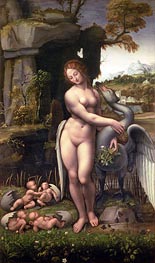
Leda and the Swan c.1505/15
$5035
$72.73
Leonardo da Vinci
Original Size:130 x 78 cm
Galleria degli Uffizi, Florence, Italy
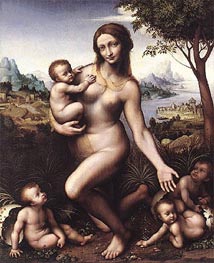
Leda and Her Children c.1508/13
$6049
$102.53
Leonardo da Vinci
Original Size:128 x 105.5 cm
Gemaldegalerie Alte Meister, Kassel, Germany
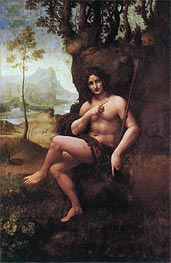
St John the Baptist (with the Attributes of Bacchus) c.1513/19
$1935
$80.80
Leonardo da Vinci
Original Size:177 x 115 cm
Louvre Museum, Paris, France
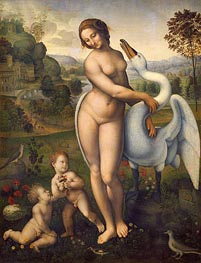
Leda and the Swan a.1510/15
$3235
$94.65
Leonardo da Vinci
Original Size:112 x 86 cm
Galleria Borghese, Rome, Italy
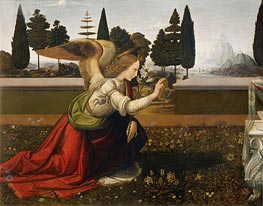
The Annunciation (Detail of Angel) c.1472/75
$93.59
Leonardo da Vinci
Original Size:112 x 86 cm
Galleria degli Uffizi, Florence, Italy