
Akt Painting Reproductions - Page 58
Nude painting is a genre in which the unclothed human body becomes the principal subject, explored through anatomy, posture, light, color, and the relationship between the figure and the viewer. It encompasses male and female figures, individual studies, and complex groups. Across different periods, it overlaps with mythology, religious painting, allegory, and portraiture, acquiring meanings that depend on the culture, setting, and circumstances in which a work was made.
The body presents a painter with a closely connected set of formal problems. A shift of weight changes the alignment of the hips and shoulders; a bent limb can introduce foreshortening; reflected light alters the apparent color of skin. A firm outline can give a figure clarity, while softer transitions make it appear to merge with the surrounding atmosphere. Standing, seated, reclining, and moving figures each organize pictorial space differently. The placement of a hand or the angle of a head can influence the entire balance of a composition.
In the European tradition, ancient Greek and Roman art supplied influential models of proportion and bodily movement. Medieval Christian imagery gave exposed bodies different meanings, including innocence, shame, suffering, and resurrection. During the Renaissance, the renewed study of antiquity developed alongside drawing from life and anatomical inquiry. Artists combined these sources in varying ways. Michelangelo's frescoes in the Sistine Chapel, for example, made the male body a vehicle for concentrated energy, using muscular structure and twisting poses to give figures an exceptional physical force.
Sandro Botticelli's “The Birth of Venus,” painted around 1485 and held in the Uffizi in Florence, presents another approach. The goddess arrives at the shore on a shell, her upright figure surrounded by windblown hair and fabric. Her elongated proportions and gently inclined head belong to a composition governed by flowing lines. The rhythm of the outline carries across the body, the flying figures, and the approaching cloak. Here, the ideal nude takes shape through the coordination of silhouette, gesture, and decorative movement.
Venetian painting gave particular importance to color and the material presence of flesh. In Titian's “Venus of Urbino” of 1538, also in the Uffizi, the reclining figure occupies the foreground of a furnished interior. White bedding, red fabric, and darker passages establish relationships that make the illuminated skin appear warm and substantial. The horizontal body is set against the vertical divisions of the room beyond. Her direct gaze connects the foreground to the viewer, while the distant servants give the composition another scale of space and activity.
Baroque painters expanded the expressive possibilities of bodily weight and movement. Peter Paul Rubens built energetic compositions from turning torsos, interlocking limbs, and richly varied flesh tones. Rembrandt's “Bathsheba at Her Bath” of 1654, in the Louvre in Paris, concentrates attention on a seated figure holding King David's letter as an attendant tends her foot. The lowered head and stillness of the pose can be read as a moment of reflection within the biblical narrative. Light across the torso, the weight of the pose, and the surrounding textiles give the body a strongly individual presence.
The study of the nude also became central to academic training. Drawing from antique casts and living models taught artists to observe proportion, balance, and the articulation of joints. Quick studies could establish a gesture, while longer sessions allowed close attention to volume and illumination. Such practice supported ambitious compositions in which figures might ultimately appear clothed. The prestige of the nude was therefore connected both to the discipline of the studio and to the demands of historical, religious, and allegorical painting.
Jean-Auguste-Dominique Ingres explored the expressive freedom of idealization in “La Grande Odalisque” of 1814, now in the Louvre. The unusually long back and extended curves give the reclining figure a continuity that takes precedence over anatomical proportion. Blue drapery, a turban, and a feather fan frame the pale body within an imagined harem setting. These details belong to the conventions of European Orientalism. The painting makes visible how a highly finished surface and precise contour can coexist with substantial transformations of the human form.
Édouard Manet's “Olympia,” painted in 1863 and held in the Musée d'Orsay in Paris, brought the reclining nude into an explicitly contemporary social world. Its presentation at the Salon of 1865 caused a scandal. The association with prostitution, the figure's direct gaze, and the abrupt handling of light and dark all challenged established expectations. The composition recalls Titian, but Manet organized the body through broad, sharply bounded passages. A servant carrying flowers and a black cat contribute to the scene's particular character. Its reception reveals how judgments about nudity involved subject, social convention, and painting technique together.
Later in the nineteenth century, bathers offered artists further possibilities. Pierre-Auguste Renoir explored rounded forms through warm color and supple transitions. Edgar Degas used unusual viewpoints and cropped compositions to examine bodies engaged in washing or drying themselves. Paul Cézanne developed groups of bathers in which limbs, tree trunks, and intervals of sky form a shared structure. Across these approaches, the nude became a means of reconsidering how a figure inhabits a picture and how bodily forms relate to their surroundings.
Twentieth-century painting multiplied these possibilities. Amedeo Modigliani emphasized elongated proportions and continuous contours, while Egon Schiele used angular poses and tense lines. Suzanne Valadon used firm outlines and unidealized poses in her paintings of male and female bodies. Later, Lucian Freud made dense, worked paint convey the weight and texture of resting flesh. Such different treatments invite attention to the choices behind each image: how the body occupies space, how it returns or avoids the viewer's gaze, and how painting gives visible form to an individual presence.
page 58 of 76


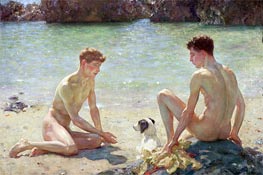
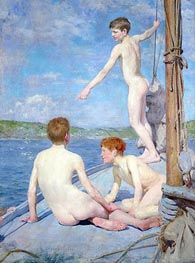
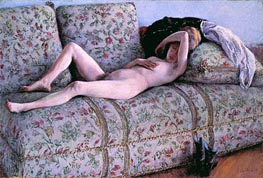
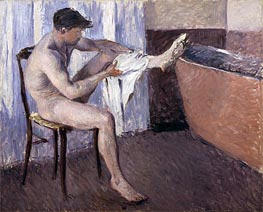
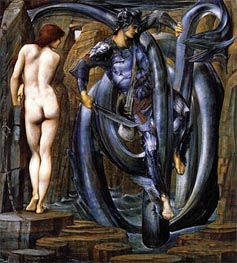
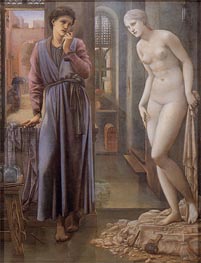
SKU: BJS-6567
Sir Edward Burne-Jones
Original Size: 99 x 76.3 cm
Birmingham Museum and Art Gallery, UK
Sir Edward Burne-Jones
Original Size: 99 x 76.3 cm
Birmingham Museum and Art Gallery, UK
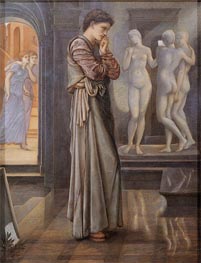
SKU: BJS-6566
Sir Edward Burne-Jones
Original Size: 99 x 76.3 cm
Birmingham Museum and Art Gallery, UK
Sir Edward Burne-Jones
Original Size: 99 x 76.3 cm
Birmingham Museum and Art Gallery, UK

SKU: BJS-6557
Sir Edward Burne-Jones
Original Size: 70.3 x 48.3 cm
Yale Center for British Art, New Haven, USA
Sir Edward Burne-Jones
Original Size: 70.3 x 48.3 cm
Yale Center for British Art, New Haven, USA

SKU: BJS-6533
Sir Edward Burne-Jones
Original Size: 34.3 x 32.3 cm
Fogg Art Museum at Harvard University, Cambridge, USA
Sir Edward Burne-Jones
Original Size: 34.3 x 32.3 cm
Fogg Art Museum at Harvard University, Cambridge, USA
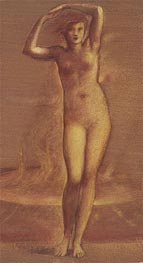
SKU: BJS-6532
Sir Edward Burne-Jones
Original Size: 26.8 x 14.7 cm
Fogg Art Museum at Harvard University, Cambridge, USA
Sir Edward Burne-Jones
Original Size: 26.8 x 14.7 cm
Fogg Art Museum at Harvard University, Cambridge, USA
