
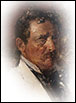
Antonino Leto Painting Reproductions 1 of 1
1844-1913
Italian Realist Painter
A gust bends the trees, clouds darken above the fields, and the familiar Sicilian landscape becomes suddenly unstable. Such moments of movement and changing light lay at the heart of Antonio Leto’s art. Antonio Leto, also known as Antonino Leto, was an Italian painter born in Monreale on 14 June 1844 and active until his death on 31 May 1913. Working across landscape, genre painting and coastal subjects, he developed a distinctly modern naturalism shaped by the Scuola di Resina and by the looser, light-sensitive painting of the late nineteenth century.
His formal education began in 1861, when financial support from an uncle enabled him to leave Monreale for Palermo. There he studied with L. Barba and Luigi Lojacono, entering an artistic culture in which close observation of the countryside was beginning to challenge the conventions of academic landscape. Filippo Palizzi provided an important model. Rather than treating nature as an ideal arrangement of trees, rocks and distant horizons, Palizzi approached rural life directly, giving animals, labourers and weather the same seriousness traditionally reserved for grand historical subjects. Leto adopted both this method and its democratic choice of motifs.
Moving to Naples in 1864 widened his ambitions. Around Portici and Resina, a small circle of painters was working outdoors and responding rapidly to local colour, atmospheric change and everyday life. Giuseppe De Nittis had helped to foster this experimental environment, later known as the Scuola di Resina. Leto also received instruction from Adriano Cecioni, whose association with the Macchiaioli encouraged a firm construction of form through tonal contrasts rather than laborious academic finish. Oil remained central to Leto’s practice, but he also worked in tempera and watercolour. That flexibility matters. It suggests an artist less concerned with maintaining a single public manner than with finding the medium best suited to a particular effect.
Recognition came early. In 1870 Il Ritorno dal Pascolo received a silver medal at an art exhibition in Palermo, while La Bufera won a gold medal at the Regional Exhibition in Syracuse. The titles reveal the two poles of his developing art. One presents the measured rhythm of rural labour as animals return from pasture; the other centres on violent weather. Human activity and natural forces were already inseparable. In 1872 he sent A Winter’s Day in Sicily to the Brera Exhibition in Milan, bringing the climate and terrain of the island before a wider Italian audience.
During 1873 Leto rejoined painters connected with the Scuola di Resina at Portici, then travelled to Rome, where he met Francesco Paolo Michetti. Rome offered subjects very different from the open spaces of Sicily and Campania. In 1874 he painted Alla Villa Borghese and Un contadino romano, both shown at the tenth Promotrice exhibition in Naples. The first turned toward cultivated urban landscape; the second brought the Roman peasant into the exhibition world. Between 1874 and 1875, La Raccolta delle Olive secured him a Sicilian stipend for further study in Rome. Again, agricultural work became the basis of artistic advancement, but without being transformed into picturesque anecdote.
A second stipend took him to Florence from 1876 to 1878. There his attention shifted toward livelier urban views and modern leisure. Case a Viareggio, Ponte di Santa Trinita and Passeggiata alle Cascine recorded streets, architecture, promenades and the social life of public space. His brushwork became more responsive, while figures and buildings were increasingly integrated into broad atmospheric effects. Florence also gave him access to a stronger commercial network. Many works were sold through the Galleria Pisani, evidence that his paintings had begun to attract buyers beyond the official exhibition system.
In 1879 the dealer Adolphe Goupil invited Leto to Paris. Few destinations could have offered a sharper test of an Italian landscape painter. Paris was then a centre of international dealing, ambitious public exhibitions and competing forms of realism. Among Leto’s contemporaries there were Giuseppe De Nittis, Domenico Morelli, Antonio Mancini, Vincenzo Gemito, Alphonse de Neuville, Édouard Manet and Jean-Louis-Ernest Meissonier. Their approaches differed radically, from precise narrative painting to the direct notation of modern life, yet all belonged to a culture in which finish, immediacy and market appeal were being renegotiated.
Painted in 1880, Vecchia Parigi and Le Bois de Boulogne indicate how quickly Leto absorbed the city’s visual possibilities. One looked toward an older urban fabric; the other addressed a fashionable landscape of movement and recreation. Yet Paris did not sever his connection with Sicily. By the same year he had returned to Palermo, where he decorated a room in the Villa ai Colli, now the Opera Pia Istituto Pignatelli. The scheme combined animated vedute with genre scenes. Often overlooked beside his easel paintings, this decorative commission reveals his ability to organise multiple views within an architectural setting while retaining the vivacity of observed life.
Increasing problems with his health restricted travel after the beginning of the 1880s, although they did not diminish his productivity. He continued to send paintings to exhibitions and settled on Capri in 1882. The island, with its cliffs, harbours, changing skies and working shoreline, offered a concentrated field of observation. Perhaps the narrowing of his physical world sharpened his attention to the coast. Over the following decade, seascapes and scenes of labour beside the water occupied an increasingly important place in his work.
I funari di Torre del Greco brought this phase exceptional public recognition. Exhibited at the National Exhibition of Fine Arts in Rome in 1883, the painting depicts the rope-makers of Torre del Greco and was praised for its treatment of working life. It later entered the collection of the Italian Chamber of Deputies. In this work we see Leto’s characteristic balance: labour is specific, the setting is tangible, and atmosphere remains active rather than decorative. The figures belong to the landscape, but they are never dissolved into it. Rope, sand, sea air and bodily effort are held together by a controlled yet mobile surface.
Within Sicilian art, Antonio Leto eventually came to be grouped with Francesco Lojacono and Michele Catti as the canonical triad of Belle Époque landscape painters. Each approached the island differently. Lojacono often sought breadth and luminous clarity; Catti could turn toward a more intimate, melancholy atmosphere. Leto brought the lessons of Naples, Florence, Rome and Paris back to Sicilian experience, combining structural discipline with a livelier perception of weather and movement.
His importance rests not on a single dramatic break with tradition, but on sustained openness. Rural naturalism, urban modernity, decorative painting and maritime labour all entered his field of vision. Antonio Leto’s best pictures retain the freshness of something closely witnessed, yet they are never casual records. They remind us that modern painting did not develop only in Parisian boulevards or northern studios. It also emerged in Sicilian pastures, on Neapolitan beaches and beside the working waters of Torre del Greco. More than a century after his death, that attentive meeting of place, light and ordinary life remains quietly persuasive.
His formal education began in 1861, when financial support from an uncle enabled him to leave Monreale for Palermo. There he studied with L. Barba and Luigi Lojacono, entering an artistic culture in which close observation of the countryside was beginning to challenge the conventions of academic landscape. Filippo Palizzi provided an important model. Rather than treating nature as an ideal arrangement of trees, rocks and distant horizons, Palizzi approached rural life directly, giving animals, labourers and weather the same seriousness traditionally reserved for grand historical subjects. Leto adopted both this method and its democratic choice of motifs.
Moving to Naples in 1864 widened his ambitions. Around Portici and Resina, a small circle of painters was working outdoors and responding rapidly to local colour, atmospheric change and everyday life. Giuseppe De Nittis had helped to foster this experimental environment, later known as the Scuola di Resina. Leto also received instruction from Adriano Cecioni, whose association with the Macchiaioli encouraged a firm construction of form through tonal contrasts rather than laborious academic finish. Oil remained central to Leto’s practice, but he also worked in tempera and watercolour. That flexibility matters. It suggests an artist less concerned with maintaining a single public manner than with finding the medium best suited to a particular effect.
Recognition came early. In 1870 Il Ritorno dal Pascolo received a silver medal at an art exhibition in Palermo, while La Bufera won a gold medal at the Regional Exhibition in Syracuse. The titles reveal the two poles of his developing art. One presents the measured rhythm of rural labour as animals return from pasture; the other centres on violent weather. Human activity and natural forces were already inseparable. In 1872 he sent A Winter’s Day in Sicily to the Brera Exhibition in Milan, bringing the climate and terrain of the island before a wider Italian audience.
During 1873 Leto rejoined painters connected with the Scuola di Resina at Portici, then travelled to Rome, where he met Francesco Paolo Michetti. Rome offered subjects very different from the open spaces of Sicily and Campania. In 1874 he painted Alla Villa Borghese and Un contadino romano, both shown at the tenth Promotrice exhibition in Naples. The first turned toward cultivated urban landscape; the second brought the Roman peasant into the exhibition world. Between 1874 and 1875, La Raccolta delle Olive secured him a Sicilian stipend for further study in Rome. Again, agricultural work became the basis of artistic advancement, but without being transformed into picturesque anecdote.
A second stipend took him to Florence from 1876 to 1878. There his attention shifted toward livelier urban views and modern leisure. Case a Viareggio, Ponte di Santa Trinita and Passeggiata alle Cascine recorded streets, architecture, promenades and the social life of public space. His brushwork became more responsive, while figures and buildings were increasingly integrated into broad atmospheric effects. Florence also gave him access to a stronger commercial network. Many works were sold through the Galleria Pisani, evidence that his paintings had begun to attract buyers beyond the official exhibition system.
In 1879 the dealer Adolphe Goupil invited Leto to Paris. Few destinations could have offered a sharper test of an Italian landscape painter. Paris was then a centre of international dealing, ambitious public exhibitions and competing forms of realism. Among Leto’s contemporaries there were Giuseppe De Nittis, Domenico Morelli, Antonio Mancini, Vincenzo Gemito, Alphonse de Neuville, Édouard Manet and Jean-Louis-Ernest Meissonier. Their approaches differed radically, from precise narrative painting to the direct notation of modern life, yet all belonged to a culture in which finish, immediacy and market appeal were being renegotiated.
Painted in 1880, Vecchia Parigi and Le Bois de Boulogne indicate how quickly Leto absorbed the city’s visual possibilities. One looked toward an older urban fabric; the other addressed a fashionable landscape of movement and recreation. Yet Paris did not sever his connection with Sicily. By the same year he had returned to Palermo, where he decorated a room in the Villa ai Colli, now the Opera Pia Istituto Pignatelli. The scheme combined animated vedute with genre scenes. Often overlooked beside his easel paintings, this decorative commission reveals his ability to organise multiple views within an architectural setting while retaining the vivacity of observed life.
Increasing problems with his health restricted travel after the beginning of the 1880s, although they did not diminish his productivity. He continued to send paintings to exhibitions and settled on Capri in 1882. The island, with its cliffs, harbours, changing skies and working shoreline, offered a concentrated field of observation. Perhaps the narrowing of his physical world sharpened his attention to the coast. Over the following decade, seascapes and scenes of labour beside the water occupied an increasingly important place in his work.
I funari di Torre del Greco brought this phase exceptional public recognition. Exhibited at the National Exhibition of Fine Arts in Rome in 1883, the painting depicts the rope-makers of Torre del Greco and was praised for its treatment of working life. It later entered the collection of the Italian Chamber of Deputies. In this work we see Leto’s characteristic balance: labour is specific, the setting is tangible, and atmosphere remains active rather than decorative. The figures belong to the landscape, but they are never dissolved into it. Rope, sand, sea air and bodily effort are held together by a controlled yet mobile surface.
Within Sicilian art, Antonio Leto eventually came to be grouped with Francesco Lojacono and Michele Catti as the canonical triad of Belle Époque landscape painters. Each approached the island differently. Lojacono often sought breadth and luminous clarity; Catti could turn toward a more intimate, melancholy atmosphere. Leto brought the lessons of Naples, Florence, Rome and Paris back to Sicilian experience, combining structural discipline with a livelier perception of weather and movement.
His importance rests not on a single dramatic break with tradition, but on sustained openness. Rural naturalism, urban modernity, decorative painting and maritime labour all entered his field of vision. Antonio Leto’s best pictures retain the freshness of something closely witnessed, yet they are never casual records. They remind us that modern painting did not develop only in Parisian boulevards or northern studios. It also emerged in Sicilian pastures, on Neapolitan beaches and beside the working waters of Torre del Greco. More than a century after his death, that attentive meeting of place, light and ordinary life remains quietly persuasive.
11 Antonino Leto Paintings
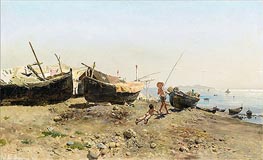
On the Mergellina Shore 1880
Oil Painting
$1176
$1176
Canvas Print
$63.85
$63.85
SKU: LEA-16585
Antonino Leto
Original Size: 50 x 82.5 cm
Private Collection
Antonino Leto
Original Size: 50 x 82.5 cm
Private Collection
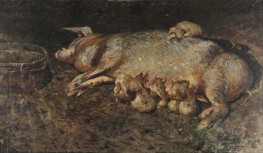
Sow with Piglets c.1885/90
Oil Painting
$1261
$1261
Canvas Print
$63.85
$63.85
SKU: LEA-22961
Antonino Leto
Original Size: 105 x 171.5 cm
Public Collection
Antonino Leto
Original Size: 105 x 171.5 cm
Public Collection

Sea Stacks in Capri c.1890/00
Oil Painting
$1420
$1420
Canvas Print
$63.85
$63.85
SKU: LEA-22962
Antonino Leto
Original Size: 44 x 75 cm
Public Collection
Antonino Leto
Original Size: 44 x 75 cm
Public Collection

Town's Street with Staircase c.1882/85
Oil Painting
$1097
$1097
Canvas Print
$63.85
$63.85
SKU: LEA-22963
Antonino Leto
Original Size: 41.3 x 27.2 cm
Public Collection
Antonino Leto
Original Size: 41.3 x 27.2 cm
Public Collection

Trapani Salt Pads 1881
Oil Painting
$1371
$1371
Canvas Print
$63.85
$63.85
SKU: LEA-22964
Antonino Leto
Original Size: 50.3 x 84 cm
Public Collection
Antonino Leto
Original Size: 50.3 x 84 cm
Public Collection

White Houses, the Great Sea View of Capri 1882
Oil Painting
$1240
$1240
Canvas Print
$65.26
$65.26
SKU: LEA-22965
Antonino Leto
Original Size: 41 x 61 cm
Public Collection
Antonino Leto
Original Size: 41 x 61 cm
Public Collection

The Olive Harvest 1874
Oil Painting
$1537
$1537
Canvas Print
$66.67
$66.67
SKU: LEA-22966
Antonino Leto
Original Size: 71 x 102 cm
Public Collection
Antonino Leto
Original Size: 71 x 102 cm
Public Collection

Seaview of Ischia with Stacks 1880
Oil Painting
$1074
$1074
Canvas Print
$63.85
$63.85
SKU: LEA-22967
Antonino Leto
Original Size: 75 x 44 cm
Public Collection
Antonino Leto
Original Size: 75 x 44 cm
Public Collection

Grotta Rossa 1882
Oil Painting
$1123
$1123
Canvas Print
$66.85
$66.85
SKU: LEA-22968
Antonino Leto
Original Size: unknown
Public Collection
Antonino Leto
Original Size: unknown
Public Collection

Country Landscape With Figure 1867
Oil Painting
$1480
$1480
Canvas Print
$83.21
$83.21
SKU: LEA-22969
Antonino Leto
Original Size: unknown
Public Collection
Antonino Leto
Original Size: unknown
Public Collection

Country Landscape With Prickly Pears 1867
Oil Painting
$937
$937
Canvas Print
$79.17
$79.17
SKU: LEA-22970
Antonino Leto
Original Size: unknown
Public Collection
Antonino Leto
Original Size: unknown
Public Collection