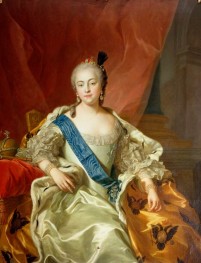
Charles-Andre van Loo Painting Reproductions 1 of 2
1705-1765
French Rococo Painter
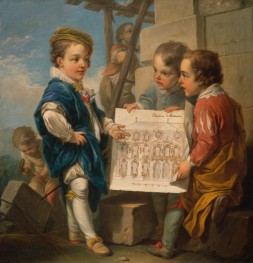
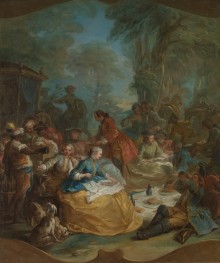
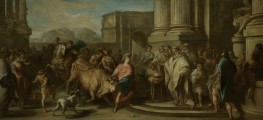
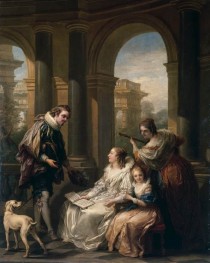
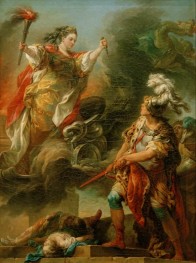
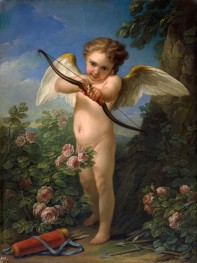
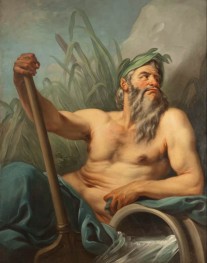
At the height of his career, Charles-André van Loo stood close to the centre of Louis XV's artistic establishment, yet his path to the French court had begun far from Paris, passing through Turin and Rome before returning to France. Born in Nice on 15 February 1705 and dead in Paris on 15 July 1765, Charles-André van Loo was a French painter of Dutch family origins whose remarkably broad practice encompassed religious subjects, history painting, mythology, allegory, portraiture and scenes of everyday life. Few painters of his generation moved so confidently between these categories.
Painting was embedded in his family history. His father, Louis-Abraham van Loo, was a painter; his elder brother Jean-Baptiste van Loo pursued the same profession, while his grandfather Jacob van Loo belonged to an earlier generation of the dynasty. Nice, where Charles-André was born, then formed part of the Savoyard state rather than France. Following Jean-Baptiste first to Turin and then to Rome, the younger van Loo arrived in the Italian capital in 1712. There he studied with the painter Benedetto Luti and also with the sculptor Pierre Le Gros. That combination mattered. Training shaped by both painting and sculpture encouraged an attention to firm contours, bodily structure and disciplined composition that remained important in his later history pictures.
After leaving Italy in 1723, van Loo worked in Paris and entered the orbit of the Académie royale de peinture et de sculpture, the institution that largely governed professional advancement in official French painting. Success came quickly. In 1723 he received first prize for drawing, and in 1724 he won the Prix de Rome. Three years later, in 1727, he obtained first prize for history painting - an honour also achieved by François Boucher, who would become both a contemporary and a formidable rival within the artistic culture of Louis XV's reign.
Yet Paris did not immediately become permanent. Returning to Turin in 1727, van Loo entered the service of Victor Amadeus II, King of Sardinia. For the king he produced a sequence of paintings based on subjects from Torquato Tasso. Such commissions suited an artist trained to organize complex narratives through gesture, costume and carefully distributed groups of figures. They also placed him within the international court culture in which French and Italian artistic languages overlapped. His Italian education was not merely an episode of youth; it gave his mature work much of its compositional order and its concern for correct draughtsmanship.
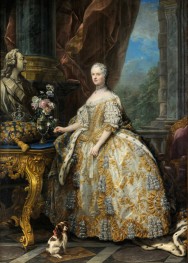
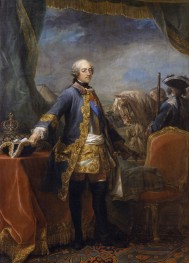
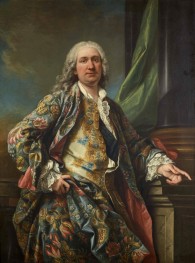
By 1734 van Loo had settled in Paris. The following year he was admitted to the Académie royale de peinture et de sculpture, beginning a rapid ascent through its hierarchy. His range made him particularly useful in a culture where painters depended upon several overlapping systems of patronage. Court circles employed him, but so did private collectors, churches and the Gobelins Manufactory. Madame de Pompadour and the royal establishment also supported his career. Rather than defining himself through a single speciality, he worked across the principal genres recognized by academic theory, adapting his manner to ceremonial portraiture, religious devotion, mythological invention and historical narrative.
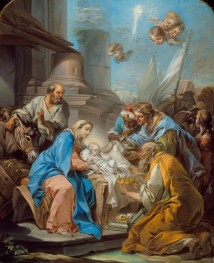
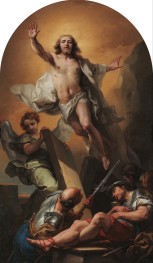
A work such as The Virgin of 1738 belongs to the religious side of this extensive production. Here, as elsewhere, van Loo's reputation rested less on eccentricity than on control. Drawing remains lucid; forms are intelligible; the arrangement seeks clarity before sensation. His Marriage of the Virgin, now preserved in the Louvre, similarly represents the serious academic ambitions that underpinned his career. In such paintings, narrative is built through figure placement and carefully articulated gesture rather than through visual disorder. Looking at them today, one senses how strongly eighteenth-century official taste valued coherence, finish and decorum.
Van Loo's professional success continued beyond France. His portraits and history paintings found admiration across Europe, while his ability to move between sacred, mythological and secular subjects made him one of the most versatile painters of his dynasty. That versatility can also obscure him. Boucher, for example, became more readily identified with a particular vision of the French Rococo, whereas van Loo's identity is distributed among several genres. Perhaps the very adaptability that helped secure his contemporary success later made his artistic personality harder to summarize.
Recognition at court reached its formal peak late in his life. Van Loo was decorated with the Order of Saint Michael, and in 1762 he was appointed First Painter to King Louis XV. The title placed him at the summit of the official artistic hierarchy. It was an extraordinary destination for a painter whose formation had crossed Nice, Turin, Rome and Paris and whose career had grown from academic competitions into royal service. Three years later, on 15 July 1765, he died in Paris at the age of sixty.
Posterity proved less generous than his contemporaries. The admiration once lavished on Charles-André van Loo diminished considerably in later centuries, and his position within eighteenth-century French art became less prominent than that of several painters who had once stood beside him. Yet this reversal can itself be revealing. His paintings preserve the values of an academic and courtly culture that prized sound drawing, legible composition, versatility and command of established pictorial language. They also show an artist capable of negotiating the demands of church, monarchy, manufactory and private patronage without surrendering technical discipline. For viewers today, there is something quietly compelling in that professionalism. Van Loo may no longer occupy the commanding reputation he enjoyed in the 1740s and 1750s, but the scale and variety of his achievement still demand attention. His career reminds us that artistic history is shaped not only by innovation, but also by the difficult art of doing many things exceptionally well.