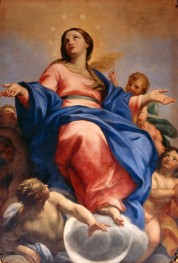
Carlo Maratta (1625-1713) was an Italian Baroque painter and draftsman whose altarpieces, mythological scenes, and portraits combined classical order with rich color and animated drapery. Working chiefly in Rome, he became a favorite of popes and collectors across Europe. He came from Camerano in the Marche, then within the Papal States. Encouraged by the painter Andrea Camassei, who had seen his drawings, he reached Rome in 1636 and entered Andrea Sacchi’s workshop the following year. Sacchi became more than a teacher: their close association continued long after Maratta began accepting commissions of his own.
Training meant copying ancient sculpture and studying Renaissance paintings, but Sacchi’s studio also offered conversation and debate. Artists gathered there to draw from life and discuss the principles of painting. Sacchi favored compositions with relatively few figures, each contributing clearly to the subject, rather than the abundant episodes preferred by Pietro da Cortona. Raphael and Annibale Carracci provided important models for Maratta, alongside Guido Reni and other Bolognese painters. A visit to the Marche during the later 1640s brought him into direct contact with Titian’s paintings in Ancona. In 1650, his Adoration of the Shepherds for San Giuseppe dei Falegnami established him publicly in Rome and brought further church commissions.
During the 1650s, Maratta expanded the expressive range of his painting without abandoning Sacchi’s discipline. For the Alaleona Chapel in Sant’Isidoro, he painted episodes from the lives of Mary and Joseph, combining canvases with frescoes in the lunettes and dome. Moving figures and pronounced contrasts of light and shadow gave these religious narratives greater dramatic force. Pope Alexander VII became an important patron. Maratta supplied the Visitation for Santa Maria della Pace in 1656 and worked under Cortona on the decoration of the Quirinal Palace. There, his fresco of the shepherds’ adoration introduced the lighter palette that became characteristic of his later work. Bernini’s example also encouraged fuller draperies and more expansive gestures.
By the early 1660s, Maratta had attracted wealthy private clients beyond Italy, and his workshop grew into one of Rome’s busiest centers of painting. Sacchi died in 1661; Maratta continued the series of Apostles his teacher had begun for Cardinal Antonio Barberini. Collaboration with Bernini brought commissions for the Chigi Chapel in Siena Cathedral. Elected head of the Accademia di San Luca in 1664, Maratta promoted drawing after ancient art and sought to strengthen the standing of artists. Portraiture extended his clientele further, including English travelers visiting Italy on the Grand Tour. In his portrait of Pope Clement IX, dated 1669, richly painted fabrics frame an attentive, individualized face rather than overwhelming it.
Maratta’s admiration for earlier painting also led him to undertake restoration. In 1672, he traveled to Loreto to work on pictures by Annibale Carracci, Federico Barocci, and Lorenzo Lotto. Two years later, he painted The Triumph of Clemency on the ceiling of the principal reception room in Palazzo Altieri. His friend Giovanni Pietro Bellori, the art historian who would become his biographer, devised the allegorical program honoring Pope Clement X and the Altieri family. The central figure of Clemency alludes to the pope’s name. Unlike the illusionistic ceiling painting then developing elsewhere in Rome, Maratta’s scene stays within its architectural frame; the figures do not seem to spill into the spectator’s space.
Around 1680, Francesca Gommi, with whom Maratta had a relationship outside his marriage, gave birth to their daughter Faustina. Her features later appeared in several of his paintings. That period also brought a change in Rome’s artistic hierarchy: after Bernini’s death in 1680, Maratta occupied the foremost position among the city’s artists. His Apollo and Daphne, completed in 1681 for Louis XIV, won particular admiration and earned him the title of painter to the French king. Bellori devoted a separate publication to the picture. Alongside such mythological commissions, Maratta continued supplying major religious paintings, including the large altarpiece for the Cybo Chapel in Santa Maria del Popolo.
Family arrangements acquired formal recognition only much later. Maratta legally acknowledged Faustina in 1698. When his wife died in 1700, he married Gommi. Faustina became a poet and a member of the Academy of Arcadia, and married the poet Giambattista Felice Zappi. Maratta’s own ambitions extended beyond painting: he supplied designs for sculpture and funerary monuments. His design for the tomb of Pope Innocent XI in Saint Peter’s was executed by Pierre-Étienne Monnot. Around 1695, he also began preparing his own monument for Santa Maria degli Angeli; Francesco Moratti carried it out, completing it in 1704. Maratta thus helped determine how he would be commemorated while he was still directing an active workshop.
As patronage contracted around the beginning of the eighteenth century, restoration became a larger part of his activity. In 1702, Pope Clement XI entrusted him with work on Raphael’s frescoes in the Vatican rooms. Maratta also worked on the painted decoration of the Villa Farnesina and on Carracci’s frescoes in Palazzo Farnese. Official honors continued: Clement XI knighted him in 1704, and in 1706 his leadership of the Accademia di San Luca was made permanent, an unprecedented distinction. Even after he could no longer paint, he continued supervising his studio. He died in Rome in 1713, aged eighty-eight, and was buried in Santa Maria degli Angeli. Members of the academy carried his coffin.
After Maratta’s death, the many painters trained in his workshop carried his approach into eighteenth-century Italian art. His reputation nevertheless declined as later critics challenged the artistic ideals he had represented; twentieth-century scholarship renewed attention to his achievement. Bellori’s biography, published posthumously in 1732, remained a central record of his career and friendships. Many of Maratta’s religious paintings still occupy the Roman churches for which they were made. His portrait of Sacchi is in the Prado, the Clement IX portrait is in the Vatican Pinacoteca, and Apollo and Daphne is in the Royal Museums of Fine Arts of Belgium in Brussels.