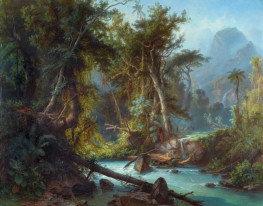
Ferdinand Konrad Bellermann (1814-1889) was a German landscape painter and naturalist whose Venezuelan scenes combined botanical observation with the traditions of European landscape painting. His forests, mountains, harbors, and city views recorded a country he explored for more than three years. He came from Erfurt, where his father worked as a tanner. After his father’s early death, the family struggled financially, and Bellermann, the eldest child, helped support his mother and siblings by tending sheep. An uncle, the merchant Johann Christian Bellermann, also provided assistance. Drawing offered the boy a possible livelihood beyond this precarious beginning.
In 1828, at fourteen, Bellermann entered the drawing school in Weimar to train in porcelain decoration. The intended destination was a porcelain factory belonging to relatives in Volkstedt, but difficulties with his eyesight apparently forced him to abandon that course and return to Erfurt. His studies nevertheless introduced him to landscape composition. A surviving drawing made when he was fifteen shows Erfurt’s cathedral and St. Severus Church framed by trees: closely observed buildings arranged within a traditional pictorial setting. Weimar also brought him into contact with Friedrich Preller, who became an important teacher and lasting friend. In 1833, Bellermann moved to Berlin, studying under Wilhelm Schirmer and Carl Blechen.
Sketching journeys through Thuringia and on Rügen gave Bellermann opportunities to study plants as well as scenery. He developed substantial botanical knowledge, an interest that later shaped both his travels and his painting. In 1840, he accompanied Preller and two other students to Norway, traveling through Belgium and the Netherlands. Rough roads and rudimentary lodgings made the journey demanding. Back in Germany, he turned his observations into a large landscape whose precise rendering of natural features, including rock formations, attracted attention. Frederick William IV of Prussia bought the painting. It also helped convince Alexander von Humboldt that Bellermann could depict South American vegetation with both artistic sensitivity and scientific accuracy.
Humboldt recommended Bellermann for a journey to Venezuela organized through a Hamburg merchant. This was not an expedition led by Humboldt, nor did its initiative come from the Prussian king. Humboldt’s support and recommendations nevertheless helped the painter gain access to people and places abroad. Bellermann reached the port of La Guaira in July 1842. There he drew inhabitants, streets, and buildings still damaged by the earthquake of 1812. He also worked in the nearby heights around Galipán, studying the vegetation and waterfalls. In Caracas, he witnessed the ceremonies accompanying the return of Simón Bolívar’s remains, recording a public event alongside the landscapes that were his principal concern.
His travels extended across substantial parts of Venezuela. He worked in coastal towns, visited Angostura and Maracaibo, and reached the Andean region around Mérida. Humboldt had suggested destinations of particular scientific interest. Among them was the Cueva del Guácharo, which Bellermann visited in May 1843 with the naturalists Karl Moritz and Nikolaus Fünck. Traveling with researchers deepened his knowledge of the plants he depicted. In November 1844, he arrived in Mérida, where the snowy mountains and Andean flora offered subjects quite different from the tropical coast. His accumulating studies included pencil drawings, colored sketches, and oil paintings, with urban buildings and local activities appearing alongside vegetation and terrain.
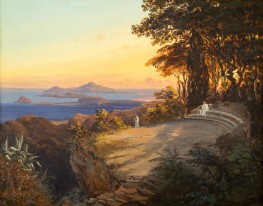
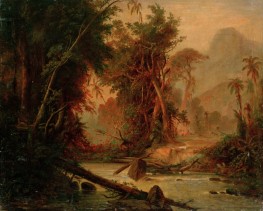
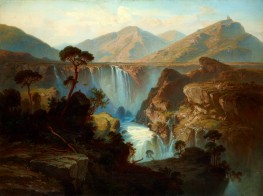
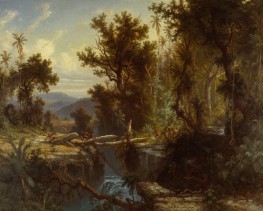
Bellermann’s precision did not mean that he abandoned the compositional habits learned in Europe. Dark trees often frame his landscapes, while evening light organizes distant mountains and dense foliage into a carefully ordered scene. These devices belonged to an older landscape tradition, even when the plants themselves were unfamiliar to European viewers. He worked with color in oil and tempera as well as drawing in pencil, gathering material that could support more elaborate studio compositions. His Venezuelan studies also preserved evidence of the country’s built environment: earthquake ruins, harbor structures, and streets received the same attentive scrutiny as palms and mountain slopes.
Bellermann left Venezuela in September 1845 and reached Germany that November. His drawings and painted studies continued to supply subjects for decades. In 1849, he became a drawing professor at the Prussian Academy of Arts in Berlin; in 1866, he succeeded his former teacher Schirmer in the landscape painting professorship. As a teacher, he supported Humboldt’s belief that knowledge of tropical vegetation could broaden European landscape painting. He also returned to places he had visited through later compositions: in 1879, he painted Humboldt’s visit to the Cueva del Guácharo. Rather than depicting an encounter between the two men there, the subject looked back to the explorer’s earlier journey.
Bellermann died in Berlin on August 11, 1889. His Venezuelan paintings had helped encourage support for further journeys of exploration, including that of Karl Ferdinand Appun. Long after his death, his work received renewed attention in his native Erfurt. The Angermuseum mounted a major retrospective from October 2014 to January 2015, marking the bicentenary of his birth and bringing his European and South American landscapes before a new public.