Few Renaissance painters inherited a more complicated artistic legacy than Filippino Lippi. Probably born in Prato in 1457 and dead in Florence on 18 April 1504, this Italian painter worked at the point where the measured clarity of the Early Renaissance began to give way to something more restless, elaborate and psychologically charged. Florence remained the centre of his career, but Rome, Spoleto, Prato, Pavia and Bologna all left their mark on an artist whose religious paintings could move from quiet devotion to almost theatrical unease.
His parentage was itself extraordinary. Filippino Lippi was the illegitimate son of the Carmelite friar and painter Fra Filippo Lippi and Lucrezia Buti, both of whom had broken vows of celibacy. A papal dispensation permitting them to marry was later obtained through Lorenzo de' Medici, although Vasari maintained that no marriage took place. Filippino had a younger sister, Alessandra, born in 1465. His first education as a painter came in his father's workshop. The family moved to Spoleto, where the boy assisted during the decoration of Spoleto Cathedral. When Fra Filippo died in 1469, Filippino was only about twelve. He nevertheless belonged to the group of assistants who brought the cathedral fresco cycle of the Life of the Virgin to completion.
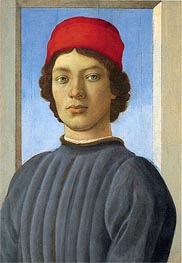
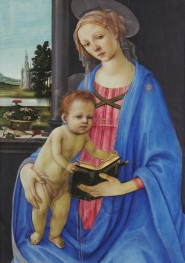
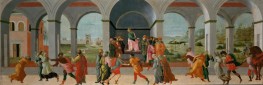
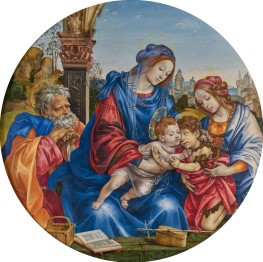
After his father's death, Lippi entered the workshop of Sandro Botticelli, himself a former pupil of Fra Filippo. Records of the Florentine painters' guild from 1472 describe Filippino as Botticelli's sole assistant and place him in the master's household. Their proximity was more than administrative. During the 1470s their pictorial languages became so closely intertwined that attribution has often proved difficult, especially among paintings of the Madonna and Child. They also collaborated on panels originally belonging to a pair of cassoni, later dispersed among collections including the Louvre, the National Gallery of Canada, the Musée Condé at Chantilly and the Galleria Pallavicini in Rome.
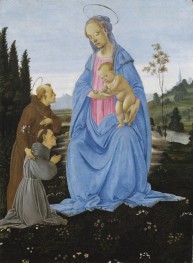
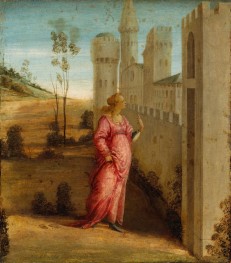
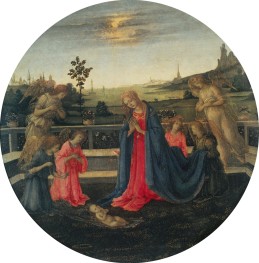
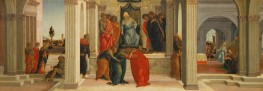
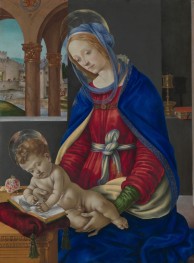
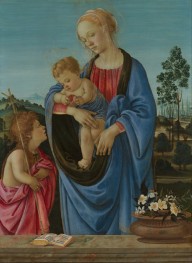
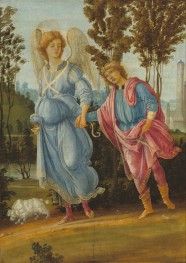
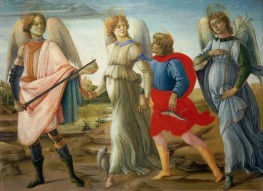
Beginning around 1475, Filippino produced independent pictures that still carried Botticelli's imprint. Their authorship was once sufficiently uncertain for Bernard Berenson, writing in 1899, to group a number of them under the invented personality "Amico di Sandro", or "Friend of Sandro"; Berenson later reassigned most to Lippi himself. Between about 1480 and 1485 the younger painter became increasingly distinct. The Madonnas now in Berlin, London and Washington, the Journeys of Tobias in Turin, the Madonna of the Sea in Florence and the Histories of Esther belong to this formative phase. Linear grace remained important, but his figures and settings gradually acquired a more personal nervous energy.
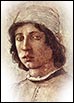
Prestigious Florentine commissions soon followed. Alongside Perugino, Ghirlandaio and Botticelli, Lippi participated in the decoration of Lorenzo de' Medici's villa at Spedaletto. A commission of 31 December 1482 for the Sala dell'Udienza in the Palazzo Vecchio was never begun, yet another opportunity would place him in direct dialogue with one of the foundational achievements of Florentine painting. Around 1483-84 he was asked to complete Masaccio's unfinished frescoes in the Brancacci Chapel at Santa Maria del Carmine. There he painted episodes from the life of Saint Peter, including the Disputation with Simon Magus, the Resurrection of the Son of Theophilus, Saint Peter in Prison, his Liberation and the Crucifixion of Saint Peter. Working beside Masaccio's surviving frescoes demanded restraint as well as invention. Lippi respected the existing narrative world while inserting his own generation into it - even placing his self-portrait, aged about twenty-five, within the scene of the disputation and crucifixion.
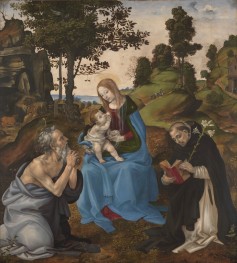
By 20 February 1486 he had completed a work for the Sala degli Otto di Pratica in the Palazzo Vecchio, now in the Uffizi. Around the same time Piero di Francesco del Pugliese commissioned the Apparition of the Virgin to St. Bernard, today in the Badia Fiorentina. It became one of Lippi's best-known paintings. Here the devotional encounter takes place in an improbable environment of rock formations, twisting vegetation and elongated figures. Nature seems almost sentient. Without abandoning Christian narrative, the painter makes the physical world participate in the vision, giving the scene an unsettling intensity that distinguishes him sharply from the serene balance often associated with fifteenth-century Florence.
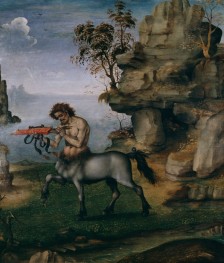
In 1487 Filippo Strozzi entrusted Lippi with the decoration of his family chapel in Santa Maria Novella. The commission would occupy the artist intermittently until 1503. Before it was finished, however, Rome transformed his visual imagination. In 1488 Lorenzo de' Medici recommended him to Cardinal Oliviero Carafa, who commissioned the decoration of his chapel in Santa Maria sopra Minerva. Lippi remained engaged with the project until the early 1490s, completing the fresco series by 1493. Encountering ancient Roman ornament encouraged a fascination with grotesque decoration, archaeological detail and fantastic forms. Rather than treating antiquity merely as a repertory of noble poses, he allowed it to become strange.
That Roman experience reached its most dramatic expression in the Strozzi Chapel. Returning to the Stories of Saint John the Evangelist and Saint Philip, Lippi reconstructed the pagan world with elaborate architecture, ornament and imagined ritual. The conflict between Christianity and paganism had acquired particular resonance in Florence during the political and religious upheavals associated with Girolamo Savonarola. In Lippi's frescoes, hostile figures grimace, executioners threaten and statues seem to awaken. In Saint Philip Expelling the Monster from the Temple, the pagan deity confronts the saint almost as a living antagonist. Decoration no longer behaves as a passive setting; it appears animated by the same tension as the human drama. Perhaps this capacity to make beauty slightly disturbing explains why these late frescoes still feel unexpectedly immediate.
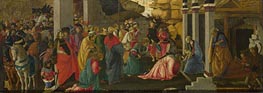
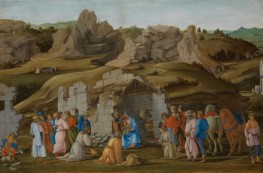
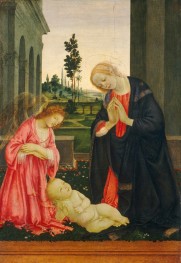
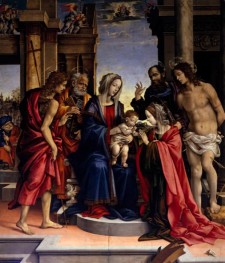
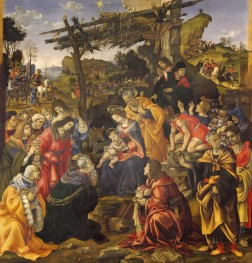
Lippi returned to Florence sometime between 1491 and 1494 and continued to work for important patrons and religious institutions. The Apparition of Christ to the Virgin dates from about 1493. In 1496 he painted the Adoration of the Magi for San Donato in Scopeto, a work now in the Uffizi. Other commissions included the Sacrifice of Laocoön for Lorenzo de' Medici's villa at Poggio a Caiano and paintings of Saint John the Baptist and Mary Magdalene for the Valori Chapel in San Procolo, where his response to Luca Signorelli became apparent. His activity also extended beyond Florence. He worked at the Certosa di Pavia, returned to his native Prato, and in 1501 painted the Mystic Wedding of St. Catherine for the Basilica of San Domenico in Bologna. In 1503 he completed the Tabernacle of the Christmas Song in Prato and finally brought the long Strozzi Chapel project to its conclusion, including designs for its musically themed windows.
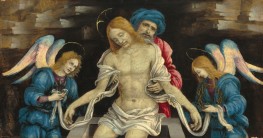
Death interrupted another important commission. Lippi's Deposition for Santissima Annunziata in Florence remained unfinished when he died on 18 April 1504, aged about forty-seven. The response of Florence was striking: on the day of his burial, the city's workshops closed in his honour. His career had begun in the shadow of Fra Filippo Lippi and Botticelli and beside the monumental precedent of Masaccio, yet it ended with a language unmistakably his own. Filippino Lippi carried Renaissance linear elegance into a world of fantastic architecture, agitated gesture, archaeological curiosity and spiritual anxiety. In that transformation lies his particular fascination today. His paintings remind us that the Renaissance was not only an age of harmony and rediscovered order, but also one of uncertainty, competing beliefs and vivid imaginative excess.