At eight years old, with both parents gone and an aunt too poor to support him, Filippo Lippi entered the Carmelite convent of Santa Maria del Carmine in Florence. The cloister would give him a religious identity, but the painted walls of the Brancacci Chapel offered another vocation. Filippo Lippi, born in Florence around 1406 and dead in Spoleto in 1469, became one of the distinctive Italian painters of the Quattrocento - a Carmelite priest whose art joined the grave monumentality of early Renaissance Florence to a new tenderness in the human figure.
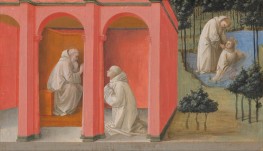
His father, Tommaso, was a butcher. Orphaned at two, Lippi was first taken in by his aunt Mona Lapaccia and then placed in the Carmelite convent. In 1420 he entered the novitiate of the Order of the Brothers of the Blessed Virgin Mary of Mount Carmel, took vows the following year at sixteen, and was ordained a priest around 1425. He remained at Santa Maria del Carmine until 1432. There, according to Giorgio Vasari, the young friar filled his books with drawings rather than lessons. More important was what stood close at hand: Masaccio's recently painted Brancacci Chapel. Lippi returned to it repeatedly, absorbing its weighty figures, spatial conviction, and direct emotional force.
That debt is especially visible in his early work. The Tarquinia Madonna, now in Palazzo Barberini in Rome, carries something of Masaccio's solidity and seriousness. Yet Lippi did not remain a follower. Gradually, his figures became more supple, faces more intimate, and sacred scenes more responsive to domestic feeling. He developed a pictorial language in which religious subjects could retain dignity while becoming psychologically accessible - a balance that would prove important for painters formed in his workshop.
In 1432 he left the monastery, though he was never released from his vows. His subsequent life quickly acquired the mixture of patronage, difficulty, and anecdote that would cling to his reputation. Vasari claimed that Lippi travelled to Ancona and Naples, was captured by Barbary pirates, and won his freedom through his skill as a portrait draughtsman. Later writers doubted the story, and it is safer to treat it as part of the legend surrounding him rather than established biography. What is documented is an artist frequently short of money. In a letter of 1439 he called himself the poorest friar in Florence and said that he was responsible for six marriageable nieces.
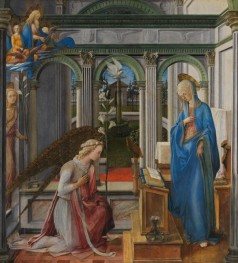
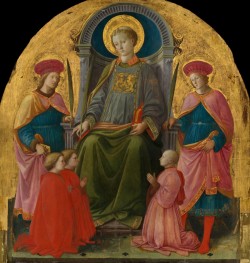
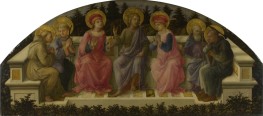
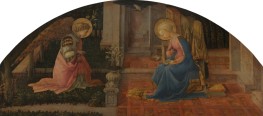
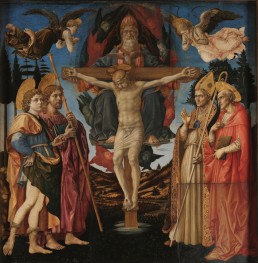
By the 1430s his paintings were sufficiently admired to attract Medici patronage. The family commissioned works including an Annunciation and Seven Saints. Stories about Cosimo de' Medici locking him up to force him to work, only for Lippi to escape down a rope made from bed sheets, belong to the same lively body of anecdotes about his indiscipline. Lawsuits, complaints, debts, and broken promises repeatedly complicated his career. Yet commissions continued, suggesting how valuable his gifts were to patrons who were prepared to tolerate an unreliable temperament.
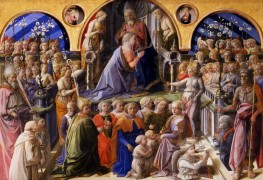
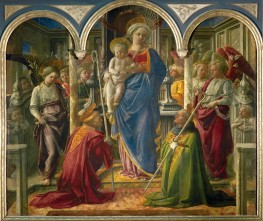
In 1441 Lippi painted the Coronation of the Virgin for the nuns of Sant'Ambrogio. The crowded altarpiece sets the Virgin's coronation among saints, angels, and members of the Bernardine order, turning a devotional image into a richly populated sacred assembly. A half-length figure on the right was once identified as Lippi himself because of the nearby inscription is perfecit opus, although it was later interpreted as the benefactor responsible for the commission. Centuries afterwards, the painter's unruly reputation would enter literature through Robert Browning's 1855 poem Fra Lippo Lippi.
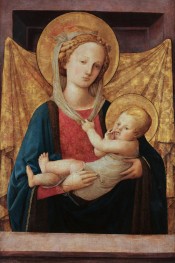
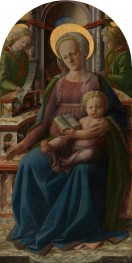
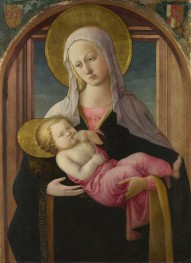
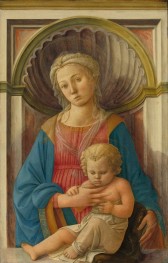
During the 1440s and 1450s his art increasingly revealed a sensibility for grace, beauty, and expressive contour. A Madonna and Child of about 1440-1445, now in the National Gallery of Art in Washington, shows how readily he could soften monumental form without sacrificing structure. In 1452 he was appointed chaplain to the nuns of Santa Maria Maddalena in Florence. Four years later he was living in nearby Prato, where the great fresco cycle in the cathedral choir became the central monumental undertaking of his mature career.
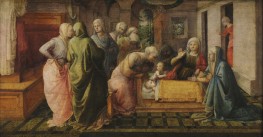
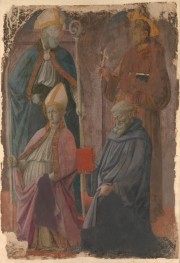
The Prato frescoes recount episodes from the lives of Saint Stephen and Saint John the Baptist. Their scale demanded complex figure groupings and a command of narrative movement. Especially memorable is the Feast of Herod, where Salome dances with an elegance that anticipates the linear rhythms later associated with Lippi's pupil Sandro Botticelli. On the opposite wall, the ceremonial mourning over Saint Stephen unfolds with equal attention to gesture and human presence. The choir also includes Saint John Gualbert, Saint Alberto, and monumental representations of the four Evangelists in the vault. These frescoes became his most substantial statement as a public painter.
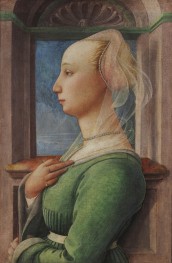
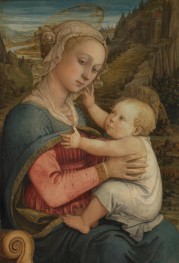
Prato also brought the decisive personal relationship of his later life. In 1458, while working there, Lippi was making a picture for the chapel of Santa Margherita when he met Lucrezia Buti, a boarder or novice and the daughter of Caterina Ciacchi and Francesco Buti. He asked permission for her to pose, apparently as the Virgin or Saint Margaret. A sexual relationship followed, and Lucrezia left the convent to live with him despite attempts to bring her back. Their son, Filippino Lippi, was born in 1457 and later became an important painter; their daughter Alessandra was born in 1465. Lucrezia is traditionally identified as the model for several of Lippi's Madonnas and for Salome in the Prato frescoes.
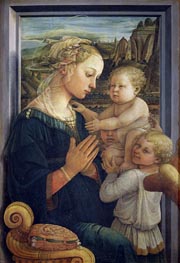
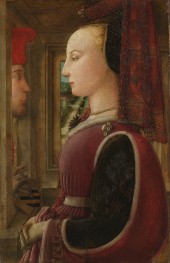
Perhaps nowhere is the meeting of devotion and personal observation more affecting than in the Uffizi Madonna and Child with Two Angels, often called the Lippina. The Virgin appears not as a remote emblem but as a young woman of refined, almost private beauty, while the angels possess the immediacy of living children. The painting remains sacred in subject, yet its emotional register is unmistakably human. Such images help explain why Lippi's workshop mattered so much: Sandro Botticelli and Francesco di Pesello, known as Pesellino, were among his most distinguished pupils, and his son Filippino later learned and worked beside him.
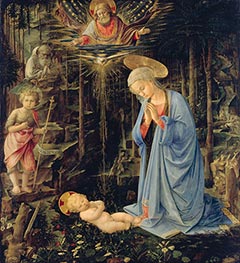
Lippi continued to struggle financially even after his appointment in 1457 as commendatory rector of San Quirico in Legnaia, a position from which he sometimes received considerable income. His final major commission took him away from Florence and Prato to Spoleto. There, beginning in 1467, he worked on frescoes from the Life of the Virgin in the cathedral apse - the Annunciation, the Funeral of the Virgin, the Adoration of the Christ Child, and the Coronation of the Virgin. Filippino assisted in the workshop, and the Funeral includes a group traditionally identified as Lippi himself with Fra Diamante, Pier Matteo d'Amelia, and his son.
Filippo Lippi died in Spoleto on or about 8 October 1469 before the cycle was complete. Fra Diamante and other assistants finished the work. Tales that he was poisoned, or that a papal dispensation permitting him to marry Lucrezia arrived too late, remain disputed. He was buried in Spoleto Cathedral, where Lorenzo de' Medici later commissioned a monument for him. His legacy rests less on the scandals that fascinated biographers than on the bridge his painting created between Masaccio's early Renaissance gravity and the lyrical line, feminine beauty, and emotional refinement that emerged in the next Florentine generation. Looking at his Madonnas today, one senses how closely observation and devotion could coexist. Perhaps that tension - between rule and impulse, cloister and workshop, sacred office and human attachment - gave his art its enduring vitality.