
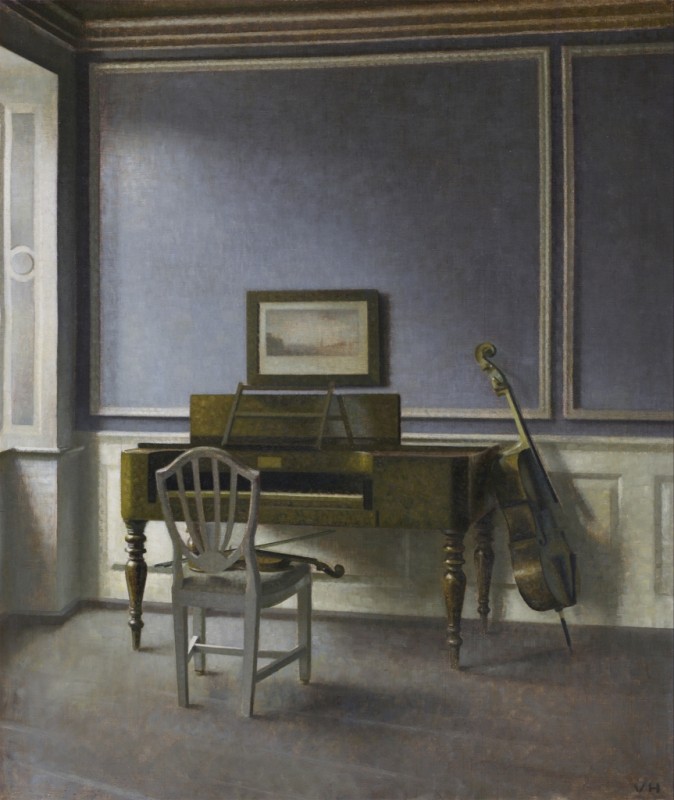
Interior. The Music Room, Strandgade 30, 1907 Vilhelm Hammershøi (1864-1916)
Location: Art Institute of Chicago, USAOriginal Size: 70 x 59 cm
Own a museum-quality reproduction of Interior. The Music Room, Strandgade 30 by Hammershøi (1907), exclusively hand-painted in oils on linen canvas by European artists with academic training. Each masterpiece is created with meticulous craftsmanship, capturing the exceptional quality and authentic brushwork of the original painting.

Oil Painting Reproduction
If you want a different size than the offered
Description
Painted by European Artists with Academic Education
Museum Quality
+ 4 cm (1.6") Margins for Stretching
Creation Time: 8-9 Weeks
Creation Process
We create our paintings with museum quality and covering the highest academic standards. Once we get your order, it will be entirely hand-painted with oil on canvas. All the materials we use are the highest level, being totally artist graded painting materials and linen canvas.
We will add 1.6" (4 cm) additional blank canvas all over the painting for stretching.
High quality and detailing in every inch are time consuming. The reproduction of Vilhelm Hammershøi also needs time to dry in order to be completely ready for shipping, as this is crucial to not be damaged during transportation.
Based on the size, level of detail and complexity we need 8-9 weeks to complete the process.
In case the delivery date needs to be extended in time, or we are overloaded with requests, there will be an email sent to you sharing the new timelines of production and delivery.
TOPofART wants to remind you to keep patient, in order to get you the highest quality, being our mission to fulfill your expectations.
We not stretch and frame our oil paintings due to several reasons:
Painting reproduction is a high quality expensive product, which we cannot risk to damage by sending it being stretched.
Also, there are postal restrictions, regarding the size of the shipment.
Additionally, due to the dimensions of the stretched canvas, the shipment price may exceed the price of the product itself.
You can stretch and frame your painting in your local frame-shop.
Delivery
Once the painting Interior. The Music Room, Strandgade 30 is ready and dry, it will be shipped to your delivery address. The canvas will be rolled-up in a secure postal tube.
We offer free shipping as well as paid express transportation services.
After adding your artwork to the shopping cart, you will be able to check the delivery price using the Estimate Shipping and Tax tool.
Museum Quality
The paintings we create are only of museum quality. Our academy graduated artists will never allow a compromise in the quality and detail of the ordered painting. TOPofART do not work, and will never allow ourselves to work with low quality studios from the Far East. We are based in Europe, and quality is our highest priority.
Additional Information
The arrangement occupies the lower half of the picture. Above it, a broad blue-gray wall gives the room an unexpected spaciousness, despite the close grouping of the instruments. Pale moldings divide this surface into large rectangles, echoed on a smaller scale by the framed landscape above the piano. The dark cornice closes off the top of the composition. These firm horizontal and vertical lines make the cello’s slant and curved outline particularly distinct.
Daylight enters from the left, through a window beyond the picture’s edge. It brightens the pale woodwork and spreads unevenly across the wall, leaving the right side cooler and darker. The piano’s subdued golden-brown wood provides warmth within the surrounding grays. Its turned legs and the chair’s open, shield-shaped back are carefully distinguished, but nothing has the hard finish of a polished showroom. Small touches of paint give even the bare wall a softly changing surface.
The artist and his wife, Ida, lived at Strandgade 30 from 1898 until 1909, years that included his most sustained exploration of domestic interiors. He returned repeatedly to this part of their drawing room, sometimes including Ida and sometimes leaving it empty. Furniture was not simply recorded where daily use happened to place it: he shifted household belongings to find different pictorial relationships. Here, the unoccupied chair both suggests a player’s place and partially blocks access to the keyboard.
The instruments remain separate, recognizable objects rather than merging into a dark group. The violin lies across the chair seat, its neck projecting to the right; the cello rises beside it, its scroll silhouetted against the bare wall. Their contrasting positions give the still arrangement its few decisive diagonals.
