
Judith Leyster Painting Reproductions 1 of 1
1609-1660
Dutch Baroque Painter
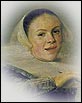
A young woman turns from her easel and meets the viewer with an open, assured smile, her brush poised as if the interruption has lasted only a second. That vivid Self-Portrait captures the unusual confidence of Judith Jans Leyster, a Dutch Golden Age painter of genre scenes, portraits, and still lifes, baptised in Haarlem on July 28, 1609, and dead near the same city on February 10, 1660. Celebrated in her own lifetime, she later disappeared beneath the names of Frans Hals and her husband, Jan Miense Molenaer, until scholarship restored her identity in the late nineteenth century.
Leyster was the eighth child of Jan Willemsz Leyster, a Haarlem cloth maker who later became a brewer. In 1618 he acquired a brewery called the Leistar, a name that would eventually become inseparable from his daughter’s artistic persona. “Leister” referred to the leading star, or North Star, familiar to Dutch sailors. Appropriately, she signed her pictures with an interlaced JL and a small star - a compact emblem of authorship, family history, and professional ambition.
Little is certain about her training. Her father’s bankruptcy may have made painting an economic necessity, although the evidence remains incomplete. She may have studied in the respected Haarlem workshop of Frans Pietersz de Grebber, while a family move toward Utrecht may have brought her within sight of the dramatic lighting and half-length figures favoured by the Utrecht Caravaggisti. By 1628, however, her reputation was already public: the Haarlem poet Samuel Ampzing mentioned her in his description and praise of the city. Such recognition came before she was twenty.
In 1629, Judith Leyster signed Serenade and Jolly Toper, her earliest known dated works. Both reveal the world she would make her own - musicians, drinkers, children, and sociable figures brought close to the picture plane against uncluttered backgrounds. Their animation recalls the Haarlem circle around Frans and Dirck Hals, yet Leyster’s scenes possess a distinct alertness. Faces turn suddenly. Hands enter the light. A song, joke, or interruption seems about to continue beyond the frame. In Serenade, now in the Rijksmuseum, the musician is isolated rather than absorbed into a crowded tavern, and the plain setting sharpens the encounter between performer and spectator.
By 1633 she had entered the Haarlem Guild of St. Luke. Whether she was the first woman recorded there as a painter remains disputed, since Sara van Baalbergen had been registered in 1631 and guild records did not always specify artistic medium. Even so, Leyster’s membership marked a genuine professional standing. Her Self-Portrait of about 1633, now in the National Gallery of Art in Washington, D.C., may have served as a presentation piece. Dressed in a dark formal gown and an elaborate lace collar, she appears in clothing wholly impractical for oil painting. The costume was deliberate. Artists increasingly claimed the social rank of learned professionals, and Leyster presents herself not as an artisan at work but as a cultivated painter in command of her craft. On the easel beside her sits a finished fiddler, proof of her ability in the genre field for which she was known.
Within two years, she had taken three male apprentices. Workshop records also show how firmly she defended her position. When one pupil left for Frans Hals without the Guild’s permission, Leyster sued. The student’s mother paid four guilders in damages, Hals paid a fine of three guilders, and Leyster herself was penalised because the apprentice had not been formally registered. The episode is small but revealing. She was not merely painting in private; she ran a workshop, trained assistants, negotiated guild rules, and challenged one of Haarlem’s most prominent artists.
Her domestic scenes deepen this picture of independence. The Proposition, now in the Mauritshuis in The Hague, departs sharply from the bawdy conventions often attached to similar subjects. A man stands behind a sewing woman and offers coins, while she remains absorbed in her work. Warm light from the foot warmer and concentrated shadow organise the drama. Some scholars read the scene as unwanted solicitation, others as an honest marriage proposal, but its tension lies in the woman’s composure. She neither performs for the viewer nor abandons her task. Perhaps that quiet concentration mattered to Leyster because she understood how easily a woman’s labour could be misread.
In 1636 she married Jan Miense Molenaer, a prolific painter whose subjects overlapped with her own. Seeking stronger markets, the couple moved to Amsterdam, where he already had clients, and remained there for eleven years. They later returned to the Haarlem region and settled in Heemstede, sharing a studio in a small house on land now associated with Groenendaal Park. Five children were born to them, though only two reached adulthood. Most of Leyster’s dated paintings belong to the years 1629 to 1635. After marriage, her documented independent production became sparse: two tulip illustrations appeared in 1643, a portrait in 1652, and a still life dated 1654 later surfaced in a private collection. Collaboration with Molenaer is possible, but the surviving evidence does not define its extent.
Leyster died in 1660 at the age of fifty and was buried at a farm outside Haarlem. For nearly two centuries, none of her pictures was publicly recognised under her own name. Estate descriptions that referred simply to “the wife of Molenaer” encouraged the erosion of her identity, while works were assigned to Molenaer or, more often, to Frans Hals. The confusion became public in 1893, when a painting sold as a Hals was found to carry Leyster’s star monogram beneath a false signature. The discovery led to litigation, and the Louvre’s identification of the hidden mark helped reopen her case. That same year Cornelis Hofstede de Groot published the first major article devoted to her and attributed seven paintings to Judith Leyster.
Her recovery was not immediately generous. Critics continued to measure her against Hals, sometimes treating resemblance as proof of dependency and difference as weakness. Later scholarship has judged the matter more intelligently. Leyster belonged to the competitive visual culture of Haarlem, Amsterdam, and the wider Dutch Republic, but she shaped its genre vocabulary through quick psychological exchanges, controlled chiaroscuro, and an unusually attentive view of women at work. Today, the star in her monogram seems more than a clever signature. It marks an artist who had once been visible, was deliberately or carelessly obscured, and has returned to the history of Dutch painting with her energy intact.
Leyster was the eighth child of Jan Willemsz Leyster, a Haarlem cloth maker who later became a brewer. In 1618 he acquired a brewery called the Leistar, a name that would eventually become inseparable from his daughter’s artistic persona. “Leister” referred to the leading star, or North Star, familiar to Dutch sailors. Appropriately, she signed her pictures with an interlaced JL and a small star - a compact emblem of authorship, family history, and professional ambition.
Little is certain about her training. Her father’s bankruptcy may have made painting an economic necessity, although the evidence remains incomplete. She may have studied in the respected Haarlem workshop of Frans Pietersz de Grebber, while a family move toward Utrecht may have brought her within sight of the dramatic lighting and half-length figures favoured by the Utrecht Caravaggisti. By 1628, however, her reputation was already public: the Haarlem poet Samuel Ampzing mentioned her in his description and praise of the city. Such recognition came before she was twenty.
In 1629, Judith Leyster signed Serenade and Jolly Toper, her earliest known dated works. Both reveal the world she would make her own - musicians, drinkers, children, and sociable figures brought close to the picture plane against uncluttered backgrounds. Their animation recalls the Haarlem circle around Frans and Dirck Hals, yet Leyster’s scenes possess a distinct alertness. Faces turn suddenly. Hands enter the light. A song, joke, or interruption seems about to continue beyond the frame. In Serenade, now in the Rijksmuseum, the musician is isolated rather than absorbed into a crowded tavern, and the plain setting sharpens the encounter between performer and spectator.
By 1633 she had entered the Haarlem Guild of St. Luke. Whether she was the first woman recorded there as a painter remains disputed, since Sara van Baalbergen had been registered in 1631 and guild records did not always specify artistic medium. Even so, Leyster’s membership marked a genuine professional standing. Her Self-Portrait of about 1633, now in the National Gallery of Art in Washington, D.C., may have served as a presentation piece. Dressed in a dark formal gown and an elaborate lace collar, she appears in clothing wholly impractical for oil painting. The costume was deliberate. Artists increasingly claimed the social rank of learned professionals, and Leyster presents herself not as an artisan at work but as a cultivated painter in command of her craft. On the easel beside her sits a finished fiddler, proof of her ability in the genre field for which she was known.
Within two years, she had taken three male apprentices. Workshop records also show how firmly she defended her position. When one pupil left for Frans Hals without the Guild’s permission, Leyster sued. The student’s mother paid four guilders in damages, Hals paid a fine of three guilders, and Leyster herself was penalised because the apprentice had not been formally registered. The episode is small but revealing. She was not merely painting in private; she ran a workshop, trained assistants, negotiated guild rules, and challenged one of Haarlem’s most prominent artists.
Her domestic scenes deepen this picture of independence. The Proposition, now in the Mauritshuis in The Hague, departs sharply from the bawdy conventions often attached to similar subjects. A man stands behind a sewing woman and offers coins, while she remains absorbed in her work. Warm light from the foot warmer and concentrated shadow organise the drama. Some scholars read the scene as unwanted solicitation, others as an honest marriage proposal, but its tension lies in the woman’s composure. She neither performs for the viewer nor abandons her task. Perhaps that quiet concentration mattered to Leyster because she understood how easily a woman’s labour could be misread.
In 1636 she married Jan Miense Molenaer, a prolific painter whose subjects overlapped with her own. Seeking stronger markets, the couple moved to Amsterdam, where he already had clients, and remained there for eleven years. They later returned to the Haarlem region and settled in Heemstede, sharing a studio in a small house on land now associated with Groenendaal Park. Five children were born to them, though only two reached adulthood. Most of Leyster’s dated paintings belong to the years 1629 to 1635. After marriage, her documented independent production became sparse: two tulip illustrations appeared in 1643, a portrait in 1652, and a still life dated 1654 later surfaced in a private collection. Collaboration with Molenaer is possible, but the surviving evidence does not define its extent.
Leyster died in 1660 at the age of fifty and was buried at a farm outside Haarlem. For nearly two centuries, none of her pictures was publicly recognised under her own name. Estate descriptions that referred simply to “the wife of Molenaer” encouraged the erosion of her identity, while works were assigned to Molenaer or, more often, to Frans Hals. The confusion became public in 1893, when a painting sold as a Hals was found to carry Leyster’s star monogram beneath a false signature. The discovery led to litigation, and the Louvre’s identification of the hidden mark helped reopen her case. That same year Cornelis Hofstede de Groot published the first major article devoted to her and attributed seven paintings to Judith Leyster.
Her recovery was not immediately generous. Critics continued to measure her against Hals, sometimes treating resemblance as proof of dependency and difference as weakness. Later scholarship has judged the matter more intelligently. Leyster belonged to the competitive visual culture of Haarlem, Amsterdam, and the wider Dutch Republic, but she shaped its genre vocabulary through quick psychological exchanges, controlled chiaroscuro, and an unusually attentive view of women at work. Today, the star in her monogram seems more than a clever signature. It marks an artist who had once been visible, was deliberately or carelessly obscured, and has returned to the history of Dutch painting with her energy intact.
12 Judith Leyster Paintings
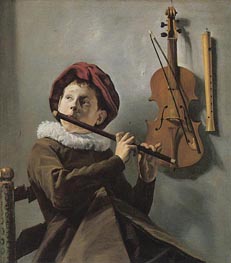
The Young Flute Player c.1630/35
Oil Painting
$1707
$1707
Canvas Print
$83.21
$83.21
SKU: LEJ-3135
Judith Leyster
Original Size: 73 x 62 cm
National Museum, Stockholm, Sweden
Judith Leyster
Original Size: 73 x 62 cm
National Museum, Stockholm, Sweden
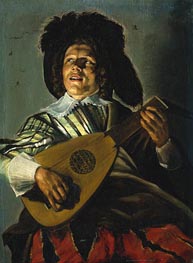
The Serenade 1629
Oil Painting
$2529
$2529
Canvas Print
$63.85
$63.85
SKU: LEJ-3136
Judith Leyster
Original Size: 45.5 x 35 cm
Rijksmuseum, Amsterdam, Netherlands
Judith Leyster
Original Size: 45.5 x 35 cm
Rijksmuseum, Amsterdam, Netherlands
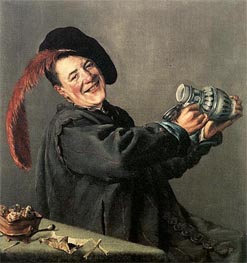
The Jolly Toper 1629
Oil Painting
$2775
$2775
Canvas Print
$92.36
$92.36
SKU: LEJ-3138
Judith Leyster
Original Size: 89 x 85 cm
Rijksmuseum, Amsterdam, Netherlands
Judith Leyster
Original Size: 89 x 85 cm
Rijksmuseum, Amsterdam, Netherlands
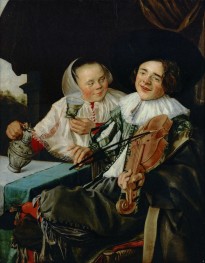
The Merry Company 1630
Oil Painting
$4231
$4231
Canvas Print
$75.48
$75.48
SKU: LEJ-23002
Judith Leyster
Original Size: 68 x 57 cm
Louvre Museum, Paris, France
Judith Leyster
Original Size: 68 x 57 cm
Louvre Museum, Paris, France

Young Woman Being Accosted by a Man 1631
Oil Painting
$2083
$2083
Canvas Print
$63.85
$63.85
SKU: LEJ-23003
Judith Leyster
Original Size: 30.8 x 24.2 cm
Mauritshuis Royal Picture Gallery, The Hague, Netherlands
Judith Leyster
Original Size: 30.8 x 24.2 cm
Mauritshuis Royal Picture Gallery, The Hague, Netherlands

A Boy and a Girl with a Cat and an Eel 1635
Oil Painting
$4159
$4159
Canvas Print
$79.87
$79.87
SKU: LEJ-23004
Judith Leyster
Original Size: 59.4 x 48.8 cm
National Gallery, London, UK
Judith Leyster
Original Size: 59.4 x 48.8 cm
National Gallery, London, UK

Two Children with a Cat 1630
Oil Painting
$3026
$3026
Canvas Print
$81.63
$81.63
SKU: LEJ-23005
Judith Leyster
Original Size: 61 x 52 cm
Rijksmuseum, Amsterdam, Netherlands
Judith Leyster
Original Size: 61 x 52 cm
Rijksmuseum, Amsterdam, Netherlands

The Last Drop (The Gay Cavalier) 1629
Oil Painting
$5547
$5547
Canvas Print
$77.76
$77.76
SKU: LEJ-23006
Judith Leyster
Original Size: 89.1 x 73.5 cm
Philadelphia Museum of Art, Pennsylvania, USA
Judith Leyster
Original Size: 89.1 x 73.5 cm
Philadelphia Museum of Art, Pennsylvania, USA

Still Life with a Basket of Fruit c.1635/40
Oil Painting
$3103
$3103
Canvas Print
$87.79
$87.79
SKU: LEJ-23007
Judith Leyster
Original Size: 68 x 62.5 cm
The Kremer Collection, Amsterdam, Netherlands
Judith Leyster
Original Size: 68 x 62.5 cm
The Kremer Collection, Amsterdam, Netherlands

Self-Portrait 1630
Oil Painting
$3142
$3142
Canvas Print
$84.80
$84.80
SKU: LEJ-23008
Judith Leyster
Original Size: 74.6 x 65.1 cm
National Gallery of Art, Washington, USA
Judith Leyster
Original Size: 74.6 x 65.1 cm
National Gallery of Art, Washington, USA

The Concert 1633
Oil Painting
$5476
$5476
Canvas Print
$67.20
$67.20
SKU: LEJ-23009
Judith Leyster
Original Size: 61 x 87 cm
Public Collection
Judith Leyster
Original Size: 61 x 87 cm
Public Collection

Girl with a Straw Hat c.1630/40
Oil Painting
$1674
$1674
Canvas Print
$63.85
$63.85
SKU: LEJ-23010
Judith Leyster
Original Size: 36.2 x 31 cm
Private Collection
Judith Leyster
Original Size: 36.2 x 31 cm
Private Collection