Léon-Augustin Lhermitte Painting Reproductions 1 of 2
1844-1925
French Realist Painter
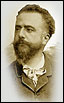
In the fields around Mont-Saint-Père, work was measured less by clocks than by seasons, light, and physical endurance. Léon Augustin Lhermitte, born there in Picardy on 31 July 1844, turned that world into the central subject of a long career. A French Naturalist painter, pastellist, and etcher, Léon Lhermitte became especially associated with peasants at work - harvesters, gleaners, labourers, and market people whose daily routines he treated with unusual seriousness.
His circumstances were modest but intellectually encouraging. Lhermitte's father was a schoolteacher who recognized his son's ability to draw and supported its development. The rural landscape surrounding the village supplied another kind of education. Agricultural labour, village rhythms, and the social structures of country life remained embedded in Lhermitte's imagination even after he moved into the sophisticated artistic world of Paris. Rather than becoming merely picturesque memories of childhood, these experiences provided him with subjects that could sustain a lifetime of observation.
In 1863, he entered the École Spéciale de Dessin et de Mathématiques in Paris, commonly called the Petite École and later known as the École Nationale Supérieure des Arts Décoratifs. There he studied under Horace Lecoq de Boisbaudran, whose teaching formed part of Lhermitte's professional training before he continued at the École des Beaux-Arts. Such instruction placed drawing at the foundation of his practice. Even when colour became increasingly important, the firmness of his draughtsmanship remained evident in the construction of figures, gestures, tools, and interiors.
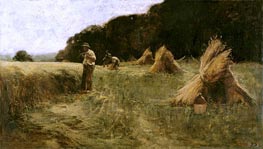
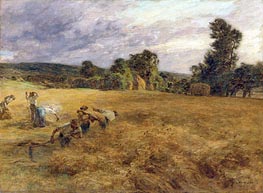
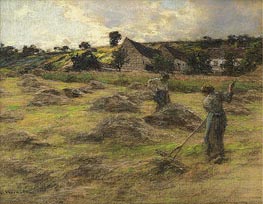
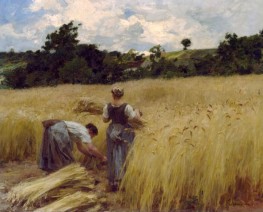
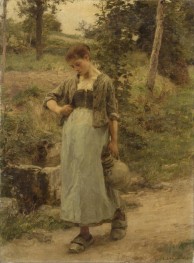
Paris provided opportunity, but Lhermitte did not abandon rural France as his principal subject. Instead, he carried its people into the Salon. His paintings recorded agricultural work without reducing it to anecdote. Labourers occupy real pictorial space and possess physical weight; bodies bend because work requires them to bend. Hands, baskets, sheaves, worn clothing, and the measured arrangement of figures become essential elements of composition. For this persistent attention to harvesting scenes he acquired the informal reputation of being a "painter of harvesters."
His career soon developed beyond France. In 1869 Lhermitte travelled to England for the first time, an important step toward the international recognition he later enjoyed. There he met the French-born artist Alphonse Legros and formed friendships with Henri Fantin-Latour and James McNeill Whistler. London became a recurring destination. Returning regularly, Lhermitte found a market for his work through dealers including Paul Durand-Ruel and Edwin Edwards, connections that helped place his rural subjects before collectors outside the French Salon system.
Printmaking formed another substantial part of his activity. Between 1874 and 1881 he produced six etchings for the album series L'Eau forte en…, published by Alfred Cadart. Etching suited an artist whose visual language depended so strongly upon line, tonal structure, and close observation. It also broadened the circulation of his imagery at a period when reproductive and original prints played an important role in spreading contemporary French art beyond the walls of exhibitions.
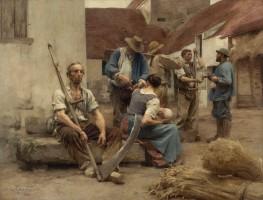
Recognition grew steadily, but one painting changed the scale of his reputation. The Harvesters' Pay, exhibited in 1882, brought Léon Lhermitte considerable notice and the respect of fellow artists. Its subject was characteristic: agricultural workers gathered at the moment when labour becomes payment. Yet the picture's significance lies in precisely that concentration on an ordinary transaction. Rural life is neither sentimentalized into pastoral fantasy nor transformed into heroic allegory. Instead, social reality enters large-scale painting through posture, fatigue, expectation, and exchange. Perhaps this restraint explains part of Lhermitte's continuing force - he allowed dignity to emerge from observation rather than imposing it upon his figures.
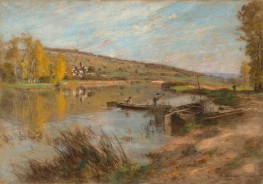
By the 1880s, his reputation extended across several media. Pastel proved particularly important. Lhermitte's handling of the medium attracted admiration among contemporaries, allowing him to combine strong draughtsmanship with softer transitions of light and atmosphere. Vincent van Gogh followed his work with exceptional enthusiasm. Writing to his brother Theo, Van Gogh placed Lhermitte beside Jean-François Millet when thinking about the expressive power of modern art, comparing their achievement in spirit with that of Michelangelo and Rembrandt. On another occasion, he became so absorbed by a reproduced composition by Lhermitte that he wished illustrated journals would publish such works regularly. Few testimonies reveal more clearly how strongly Lhermitte's images of labour could affect another painter.
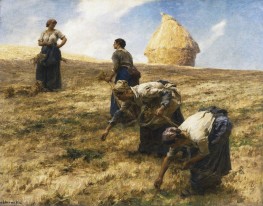
The Gleaners of 1887 belongs naturally within this mature period. Gleaning already carried powerful associations in nineteenth-century French art, yet Lhermitte approached the subject through his own sustained engagement with agricultural life. Across such compositions, movement is restrained rather than theatrical. Figures stoop, gather, carry, pause. The repetition of these gestures gives labour its visual rhythm. Naturalism here does not mean photographic imitation; it means fidelity to bodily experience, social circumstance, and the material environment in which the work occurs.
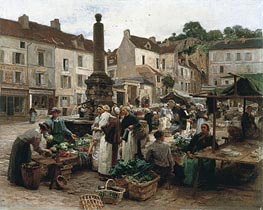
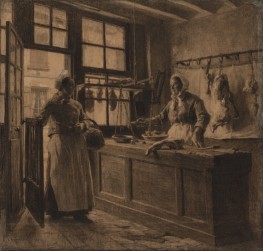
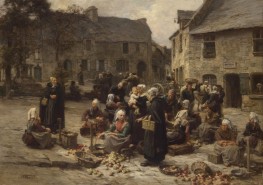
Lhermitte's concern with labour was not confined to the countryside. Les Halles, shown at the Salon of 1895, transported his observational method into the commercial heart of Paris. The painting depicts stalls within the old Les Halles market, turning urban work into a subject worthy of monumental attention. Initially kept at the Hôtel de Ville in Paris, it was transferred to the Petit Palais in 1904. During the Second World War it went into storage in 1942, first at the municipal depot in Auteuil and later in Ivry. After restoration supported by the Rungis market, the work eventually returned to the Petit Palais.
Institutional honours accompanied this mature success. Lhermitte served on the jury of the second Exposition Internationale de Blanc et Noir in 1886, working in the charcoal section, and later participated in the Paris Exposition Universelle of 1900. From 1901 until 1905 he belonged to the delegation of the Société Nationale des Beaux-Arts. On 28 October 1905 he was elected a full member of the Académie des Beaux-Arts in the painting section, confirming his position within the French artistic establishment. He was named an honorary Rosati in 1902 and, in 1910, promoted to Commander of the Legion of Honour.
Léon Augustin Lhermitte died in Paris on 28 July 1925, only three days before his eighty-first birthday. By then the art world had changed radically, yet his central subject had not become obsolete. His peasants and market workers still ask the viewer to look at labour as both a social condition and a human experience. What remains striking is his refusal to make work picturesque merely because it takes place in fields or markets. He found structure in repetition, gravity in ordinary gestures, and beauty without denying fatigue. In an age increasingly distant from the agricultural society he knew, Léon Lhermitte preserves not nostalgia but attention - an attentive record of people whose work formed the visible and invisible framework of everyday life.