
The Angelus, c.1857/59 Jean-François Millet (1814-1875)
Location: Musée d'Orsay, Paris, FranceOriginal Size: 56 x 66 cm
Own a museum-quality reproduction of The Angelus by Millet (c.1857/59), exclusively hand-painted in oils on linen canvas by European artists with academic training. Each masterpiece is created with meticulous craftsmanship, capturing the exceptional quality and authentic brushwork of the original painting.

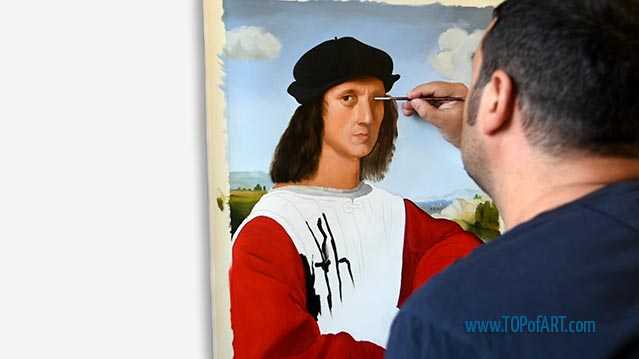
Oil Painting Reproduction
If you want a different size than the offered
Description
Painted by European Artists with Academic Education
Museum Quality
+ 4 cm (1.6") Margins for Stretching
Creation Time: 8-9 Weeks
Creation Process
We create our paintings with museum quality and covering the highest academic standards. Once we get your order, it will be entirely hand-painted with oil on canvas. All the materials we use are the highest level, being totally artist graded painting materials and linen canvas.
We will add 1.6" (4 cm) additional blank canvas all over the painting for stretching.
High quality and detailing in every inch are time consuming. The reproduction of Jean-François Millet also needs time to dry in order to be completely ready for shipping, as this is crucial to not be damaged during transportation.
Based on the size, level of detail and complexity we need 8-9 weeks to complete the process.
In case the delivery date needs to be extended in time, or we are overloaded with requests, there will be an email sent to you sharing the new timelines of production and delivery.
TOPofART wants to remind you to keep patient, in order to get you the highest quality, being our mission to fulfill your expectations.
We not stretch and frame our oil paintings due to several reasons:
Painting reproduction is a high quality expensive product, which we cannot risk to damage by sending it being stretched.
Also, there are postal restrictions, regarding the size of the shipment.
Additionally, due to the dimensions of the stretched canvas, the shipment price may exceed the price of the product itself.
You can stretch and frame your painting in your local frame-shop.
Delivery
Once the painting The Angelus is ready and dry, it will be shipped to your delivery address. The canvas will be rolled-up in a secure postal tube.
We offer free shipping as well as paid express transportation services.
After adding your artwork to the shopping cart, you will be able to check the delivery price using the Estimate Shipping and Tax tool.
Museum Quality
The paintings we create are only of museum quality. Our academy graduated artists will never allow a compromise in the quality and detail of the ordered painting. TOPofART do not work, and will never allow ourselves to work with low quality studios from the Far East. We are based in Europe, and quality is our highest priority.
Additional Information
Their equipment makes the interruption tangible. A digging fork stands planted in the soil beside the man, and a basket of potatoes rests between the two figures. Behind the woman, sacks lie on a wheelbarrow whose handles extend toward the center. Nothing has been put away. The harvest is still underfoot, and the tools remain ready for work to resume. This practical setting gives the bowed heads and joined hands their particular weight: the prayer occupies a brief interval in physical labor.
The colors stay close to the earth: brown soil, muted green vegetation, blue trousers, and the woman’s dusty pink sleeves beneath a darker upper garment. Above them, a pale yellow sky warms toward peach near the horizon. Their faces are too shaded for individual expressions to carry the scene. Instead, the man’s lowered head and the woman’s bent neck make their concentration legible. Against the broad, low horizon, their upright bodies have a solidity that makes this small painting feel much larger.
The subject grew from a childhood recollection. Explaining the picture in 1865, the artist remembered his grandmother insisting that fieldwork stop when the bell sounded, so the family could pray for the dead. He was not himself a regular churchgoer. That background helps explain the attention given to a recurring custom, where devotion belongs within the daily pattern of work and rest.
The church is only a small shape on the distant skyline, just to the right of the woman’s head. Its slender tower connects the foreground prayer with a village far beyond the field. The bell cannot be heard, but its effect is visible in the two motionless figures and the fork left standing in the ground.

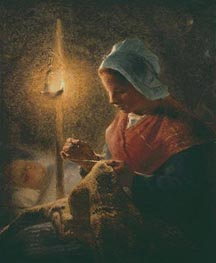
Woman Sewing by Lamplight c.1870/72
$1057
$74.81
Jean-François Millet
Original Size:100.6 x 81.9 cm
Frick Collection, New York, USA
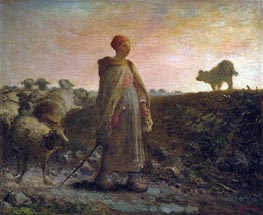
Shepherdess Returning with Her Flock n.d.
$1141
$73.32
Jean-François Millet
Original Size:44.4 x 53.9 cm
Private Collection
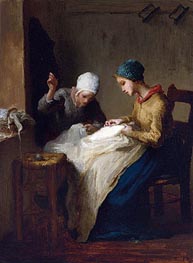
The Young Seamstresses 1850
$820
$61.15
Jean-François Millet
Original Size:32.7 x 24.4 cm
Private Collection
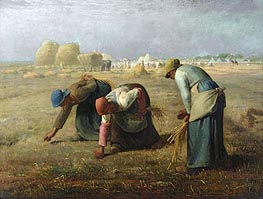
The Gleaners 1857
$1383
$69.25
Jean-François Millet
Original Size:83.5 x 110 cm
Musée d'Orsay, Paris, France
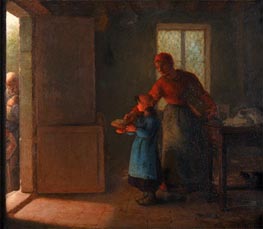
Charity c.1858/59
$830
Jean-François Millet
Original Size:40 x 45 cm
Private Collection