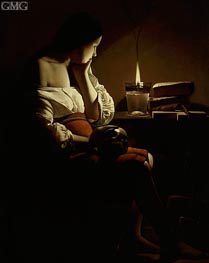
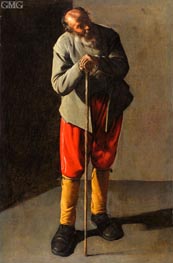
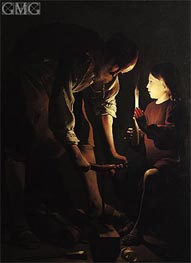
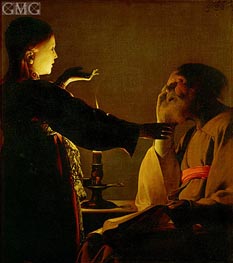
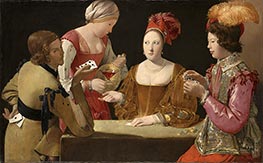
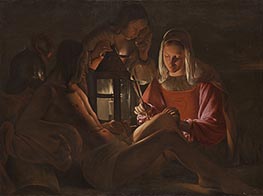
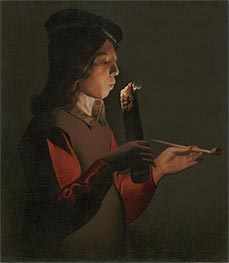
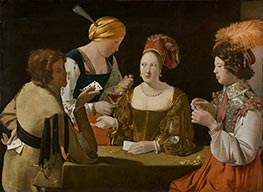
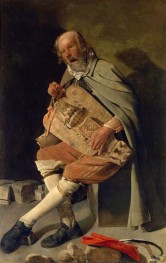
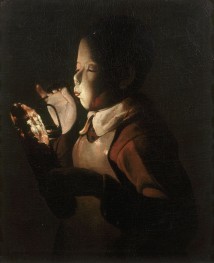
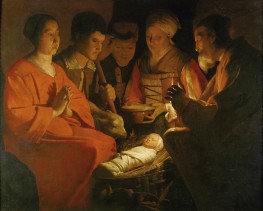
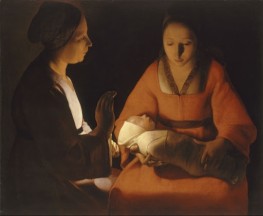
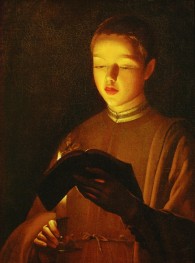
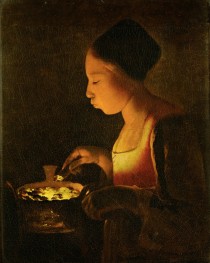
A flame - steady, ordinary, and merciless - is often all Georges de La Tour needs. In that narrow light, the world becomes quieter and more exacting: a hand cupping a candle, a cheek emerging from darkness, a silence that feels chosen. Georges de La Tour (13 March 1593 - 30 January 1652) was a French Baroque painter who spent most of his working life in the Duchy of Lorraine, a borderland that briefly became, in political terms, part of France between 1641 and 1648. The paintings that survive are few, but their concentration is startling: religious scenes and occasional genre subjects shaped by chiaroscuro and the intimate authority of candlelight.
Vic-sur-Seille, where he was born, lay in the Diocese of Metz - technically within the Holy Roman Empire, yet ruled by France since 1552. That tension between jurisdictions matters, because it hints at the artist’s wider condition: living at a confluence of Nordic, Italian, and French cultures while remaining rooted in provincial streets and local patrons. Baptism documentation identifies him as the son of Jean de La Tour, a baker, and Sybille de La Tour, née Molian; later writers have suggested Sybille may have had partly noble origins. Seven children filled the household, and Georges was the second-born - a detail that does not explain his later restraint, but makes it easier to imagine how early life could have trained his eye toward ordinary faces and the small negotiations of everyday existence.
Records keep his education indistinct. That gap has tempted scholars to propose an early journey to Italy or the Netherlands, and the proposal has a certain logic: the particular kind of Baroque naturalism found in La Tour’s art relates to Caravaggio, yet not in a direct, theatrical manner. Caravaggio’s approach may have reached him through Northern channels - the Dutch Caravaggisti of the Utrecht School and other French and Dutch contemporaries - rather than through Roman apprenticeship. Comparisons with Hendrick Terbrugghen arise for good reason: not because the paintings look alike in surface, but because both painters understand how realism and staging can coexist without rhetorical excess. La Tour has also been linked, more tentatively, to Jacques Bellange in Nancy, the capital of Lorraine; the two styles differ sharply, but the suggestion places the young painter in a plausible orbit of training and ambition.
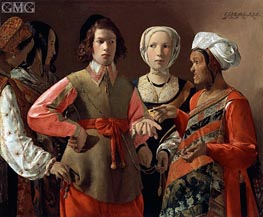
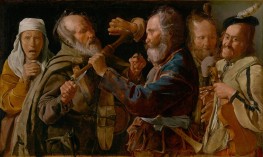
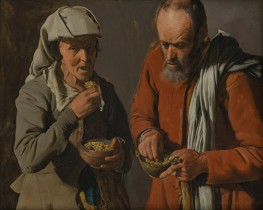
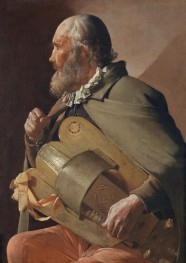
In 1617 he married Diane Le Nerf, from a minor noble family. Three years later, in 1620, he established his studio in her provincial home-town of Lunéville, within the independent Duchy of Lorraine - a place politically vulnerable yet culturally busy, and for La Tour commercially practical. Work for the Dukes of Lorraine in 1623-4 shows he could secure high connections, but the local bourgeoisie formed his main market, and the evidence suggests a measure of affluence. Seen against that social setting, his early paintings make particular sense: scenes of cheats, fighting beggars, and street-level drama that observe vice without melodrama. The Fortune Teller belongs here, as do brawling groups such as The Musicians’ Brawl (Hurdy-gurdy group), dated around 1625-1630 and now associated with the Getty Museum. Nothing in these pictures needs grand architecture; bodies, gestures, and watchful eyes supply the structure. Notice how the moral lesson - if there is one - stays oddly matter-of-fact, as if La Tour trusted the viewer to draw conclusions without being pushed.
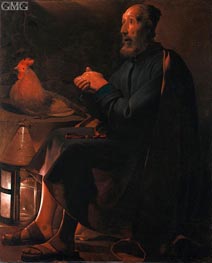
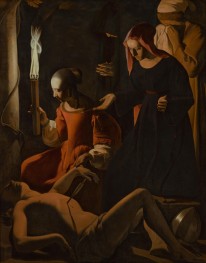
Then the light changes - or, more precisely, the painter decides to make light the subject. La Tour became best known for nocturnal effects developed far beyond what his artistic predecessors had attempted, and he redirected those effects from genre subjects into religious painting. Unlike Caravaggio, he avoids overt drama in sacred scenes; the charge is slower, inward, and often geometrically controlled. Begin with the candle, and the composition follows: planes simplify, contours settle, and forms are painted with a severe economy. In the second phase of his style, perhaps beginning in the 1640s, chiaroscuro becomes less a theatrical device than a method of thinking - a way to weigh presence against absence, and to let the painting breathe through what it withholds.
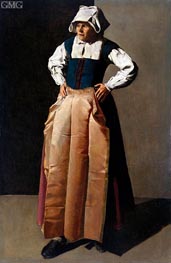
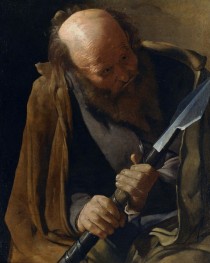
Recognition came while he was alive. In 1638 he received the title “Painter to the King” of France, a distinction that sits intriguingly beside his provincial base and his reliance on local clients. Yet La Tour is not recorded in Lunéville between 1639 and 1642, and the silence in the archive opens the possibility of travel or renewed contact with other painters. Anthony Blunt detected the influence of Gerrit van Honthorst in paintings from after this point - not a matter of imitation, but of how candlelight can sculpt a face and organise a group. Meanwhile Lorraine experienced a Franciscan-led religious revival, and La Tour’s own subjects moved increasingly toward religious imagery, though his treatment often borrows the immediacy of genre painting: saints appear with the weight and fatigue of real bodies, and sacred narratives unfold as if in a quiet room rather than a public stage. Magdalene with Two Flames, dated around 1640 and now in the Metropolitan Museum of Art, exemplifies this: two small flames double the meditation, turning the scene into a controlled experiment in attention. Another work, the Education of the Virgin, survives in versions whose authorship can be complex - the Frick Collection in New York has acknowledged the difficulty of attribution within this circle of related compositions.
He often returned to the same motifs, producing several variations on a subject as if testing how little could change while the meaning shifts. That habit, combined with a relatively small surviving output and an active workshop, made later connoisseurship difficult. His son Étienne (1621-1692) was his pupil, and distinctions between their hands can blur, especially when a composition exists in multiple forms. Matters grow more tangled with the group of paintings attributed to an unknown “Hurdy-gurdy Master” - works of strong skill, yet claimed by some to diverge in style from La Tour’s accepted paintings. Here, scholarship becomes part of the artist’s afterlife: the uncertainty does not diminish what is secure, but it reminds us how fragile artistic identity can be when records thin and fashions shift.
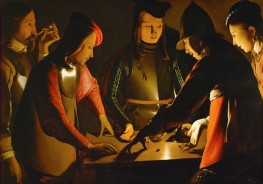
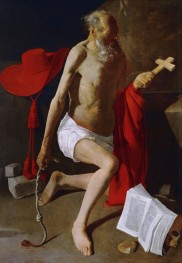
By the end of his life, stillness becomes almost the point. La Tour took from Caravaggio a commitment to naturalism and the moral intensity of light, but he rejected the tenebrist appetite for heightened violence found in painters such as Jusepe de Ribera and his followers. Saint Jerome reading offers a model of concentrated solitude, with the saint reduced to mind, page, and the body’s quiet perseverance. Dice-players, dated around 1651 and often considered among his last works (now in Preston Hall Museum, Stockton-on-Tees), returns to the world of ordinary deception, yet with a gravity that feels earned rather than imposed. Perhaps solitude gave his brush its clarity - not romantic solitude, but the practical isolation of a painter who chose to make a whole universe out of a candle and a face.
In 1652 an epidemic swept Lunéville, and Georges de La Tour and his family died there. The speed with which he vanished from common memory after that is striking: recognised in his lifetime, then quickly forgotten, his paintings drifting into misattribution and neglect. In 1915 the German art historian Hermann Voss rediscovered him for the modern eye, and the story of revival has its own irony: some of La Tour’s works had been confused with Vermeer during the Dutch painter’s nineteenth-century rediscovery. Today the candlelit rooms of La Tour feel uncannily contemporary - not because they flatter modern taste, but because they resist noise. Writers as different as René Char, André Malraux, Pascal Quignard, and Charles Juliet have found in him a language of hush and witness. Georges de La Tour remains a painter of attention: he invites the viewer to slow down, to accept darkness as a form of knowledge, and to recognise how much human truth can be carried by the smallest flame.