Painting Reproductions of Animals - Page 99
Animal painting is a genre in which animals are the principal subjects, portrayed for their appearance, movement, behavior, or expressive presence, either individually or within a wider setting. It includes portraits of horses and pets, pastoral scenes with livestock, hunting pictures, and representations of wildlife. These subjects connect the genre with landscape, everyday life, and the history of relationships between people and other living creatures.
A convincing animal depends on the relationship between structure and surface. The placement of feet, the angle of a shoulder, and the distribution of weight establish how a body stands or moves. Fur, feathers, and smooth hide require different rhythms of brushwork, but each must follow the underlying form. Since animals rarely maintain a chosen pose, painters have relied on repeated observation, sketches, anatomical study, and the combination of separate impressions. An apparently spontaneous movement may therefore result from a carefully constructed composition.
Animal subjects developed within different artistic traditions. In Tang-dynasty China, Han Gan became celebrated for horse painting during the eighth century, giving particular attention to the individuality and vitality of his subjects. Chinese bird-and-flower painting also established close relationships between animals, vegetation, and seasonal change. Within these traditions, observation could work alongside symbolic meaning and expressive brushwork. The balance of a bird on a branch, the turn of its head, or the curve of a horse's neck offered opportunities to convey life through the movement of a line.
In European Renaissance art, Albrecht Dürer demonstrated the pictorial possibilities of sustained attention to an individual creature. His “Young Hare” of 1502, in the Albertina in Vienna, combines watercolor and bodycolor on paper. Fine strokes describe the changing direction and texture of the fur, while broader tonal relationships establish the compact weight of the crouching animal. The ears, alert eye, and shadow beneath the body contribute to its presence. The surrounding space allows these small differences of texture and posture to become the main events of the image.
During the seventeenth century, animal painting became a prominent specialty in the Dutch Republic and Flanders. Frans Snyders and Jan Fyt developed ambitious compositions involving hunting, animals in conflict, and game. Snyders also collaborated with Peter Paul Rubens, contributing animals to works that drew on the skills of several specialists. In hunting scenes, intersecting diagonals and compressed groups could organize pursuit and resistance into a forceful pictorial rhythm. Pictures of dead game connected animal subjects with still life, where feathers, fur, and the arrangement of bodies carried much of the visual interest.
Paulus Potter gave livestock remarkable prominence in “The Bull” of 1647, now in the Mauritshuis in The Hague. The large canvas places the standing animal within a rural setting shared with a farmer, a cow, and sheep. Its broad body and turned head establish a commanding presence, while smaller details encourage close inspection. Light across the coat, the texture of the ground, and the open sky connect the animal to its surroundings. The scale changes the encounter: a familiar farm animal occupies the viewer's attention with the visual authority of a monumental subject.
Eighteenth-century patronage encouraged portraits of prized animals. In France, Alexandre-François Desportes and Jean-Baptiste Oudry painted animals associated with royal hunting and court life. In Britain, George Stubbs brought extensive anatomical knowledge to equine painting. His “Whistlejacket,” painted around 1762 and held in London's National Gallery, presents a rearing horse against a plain background. The lifted forelegs, arched neck, and sweep of the tail give the figure an expansive rhythm. With the setting reduced to a neutral field, the relationships between silhouette, muscle, and light become especially clear. The portrait preserves the recognizable features of a particular horse within an exceptionally concentrated composition.
Nineteenth-century painters explored the emotional and dramatic possibilities of animal subjects. Edwin Landseer made posture and gesture central to pictures that invited viewers to recognize loyalty, grief, or vigilance in animals. Such readings belong partly to the human stories constructed around them. Eugène Delacroix approached lions and tigers through muscular tension, twisting movement, and energetic color. His animal imagery allowed concentrated encounters between powerful bodies. These approaches gave animal painting a range extending from domestic intimacy to the restless energy associated with Romantic visions of nature.
Rosa Bonheur's “The Horse Fair,” painted in 1852-1855 and held in the Metropolitan Museum of Art in New York, brought animal painting to the scale of a major public spectacle. Repeated sketching visits to a Paris horse market supplied material for the work. Across the broad canvas, handlers and horses move in a sweeping procession, with changes of direction creating alternating passages of resistance and momentum. Raised heads, planted hooves, and turning bodies distinguish individual actions within the group. The carefully organized movement gives the animals physical force while keeping the entire scene legible.
Later in the nineteenth century, the Swedish painter Bruno Liljefors developed a close connection between wildlife and habitat. His birds, foxes, and hares inhabit landscapes whose grasses, branches, snow, and water actively shape what can be seen. Camouflage makes the discovery of an animal part of the experience of looking. A patterned coat may almost disappear into vegetation, while a sudden change of direction reveals a moving body. Such painting asks the viewer to attend to the whole environment, including the relationships between shelter, visibility, pursuit, and escape.
In the early twentieth century, Franz Marc used animals to explore expressive color and a spiritual understanding of nature. His “Yellow Cow” of 1911, in the Solomon R. Guggenheim Museum in New York, transforms a familiar animal through brilliant color and a buoyant leap. The curve of the back, the thrust of the legs, and the colored shapes of the landscape create a continuous rhythm across the canvas. The cow remains recognizable as its body becomes part of a larger arrangement of lines and planes. Color conveys an imagined quality of life and energy, extending the genre's possibilities beyond the description of outward appearance.
page 99 of 146
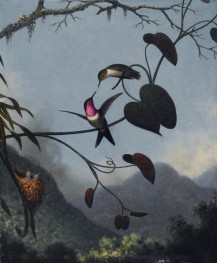
SKU: HMJ-9358
Martin Johnson Heade
Original Size: 47 x 41.9 cm
Crystal Bridges Museum of American Art, Bentonville, USA
Martin Johnson Heade
Original Size: 47 x 41.9 cm
Crystal Bridges Museum of American Art, Bentonville, USA


Two Thorn-Tails (Langsdorff's Thorn-Tail, Brazil) c.1864/65
Martin Johnson HeadeOil Painting
$881
$881
Canvas Print
$60.81
$60.81
SKU: HMJ-9351
Martin Johnson Heade
Original Size: 32.4 x 27.9 cm
Private Collection
Martin Johnson Heade
Original Size: 32.4 x 27.9 cm
Private Collection


SKU: HMJ-9346
Martin Johnson Heade
Original Size: 56.5 x 36.5 cm
Memorial Art Gallery at the University of Rochester, USA
Martin Johnson Heade
Original Size: 56.5 x 36.5 cm
Memorial Art Gallery at the University of Rochester, USA

Cattleya Orchid, Two Hummingbirds and a Beetle c.1875/90
Martin Johnson HeadeOil Painting
$1170
$1170
Canvas Print
$62.31
$62.31
SKU: HMJ-9344
Martin Johnson Heade
Original Size: 36.2 x 56.5 cm
Crystal Bridges Museum of American Art, Bentonville, USA
Martin Johnson Heade
Original Size: 36.2 x 56.5 cm
Crystal Bridges Museum of American Art, Bentonville, USA


Two Humming Birds: 'Copper-tailed Amazili' c.1865/75
Martin Johnson HeadeOil Painting
$1013
$1013
Canvas Print
$60.81
$60.81
SKU: HMJ-9339
Martin Johnson Heade
Original Size: 29.3 x 21.5 cm
Brooklyn Museum of Art, New York, USA
Martin Johnson Heade
Original Size: 29.3 x 21.5 cm
Brooklyn Museum of Art, New York, USA

SKU: HMJ-9337
Martin Johnson Heade
Original Size: 25.1 x 51.4 cm
North Carolina Museum of Art, Raleigh, USA
Martin Johnson Heade
Original Size: 25.1 x 51.4 cm
North Carolina Museum of Art, Raleigh, USA


Orchids and Spray Orchids with Hummingbirds c.1875/90
Martin Johnson HeadeOil Painting
$1136
$1136
Canvas Print
$60.81
$60.81
SKU: HMJ-9326
Martin Johnson Heade
Original Size: 50.8 x 30.5 cm
Boston Museum of Fine Arts, USA
Martin Johnson Heade
Original Size: 50.8 x 30.5 cm
Boston Museum of Fine Arts, USA


SKU: HMJ-9312
Martin Johnson Heade
Original Size: 45.7 x 58.4 cm
New-York Historical Society, New York, USA
Martin Johnson Heade
Original Size: 45.7 x 58.4 cm
New-York Historical Society, New York, USA
SKU: HMJ-9309
Martin Johnson Heade
Original Size: 33 x 66 cm
Butler Institute of American Art, Youngstown, USA
Martin Johnson Heade
Original Size: 33 x 66 cm
Butler Institute of American Art, Youngstown, USA
SKU: HMJ-9308
Martin Johnson Heade
Original Size: 31 x 35.9 cm
Metropolitan Museum of Art, New York, USA
Martin Johnson Heade
Original Size: 31 x 35.9 cm
Metropolitan Museum of Art, New York, USA

SKU: HMJ-9306
Martin Johnson Heade
Original Size: 50.8 x 30.5 cm
Metropolitan Museum of Art, New York, USA
Martin Johnson Heade
Original Size: 50.8 x 30.5 cm
Metropolitan Museum of Art, New York, USA