
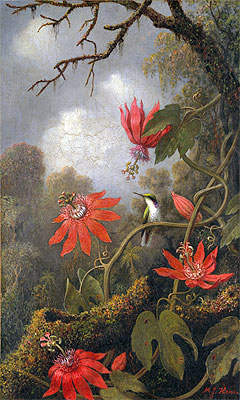
Hummingbird and Passionflowers, c.1875/85 Martin Johnson Heade (1819-1904)
Location: Metropolitan Museum of Art New York USAOriginal Size: 50.8 x 30.5 cm
Own a museum-quality reproduction of Hummingbird and Passionflowers by Martin Johnson Heade (c.1875/85), exclusively hand-painted in oils on linen canvas by European artists with academic training. Each masterpiece is created with meticulous craftsmanship, capturing the exceptional quality and authentic brushwork of the original painting.
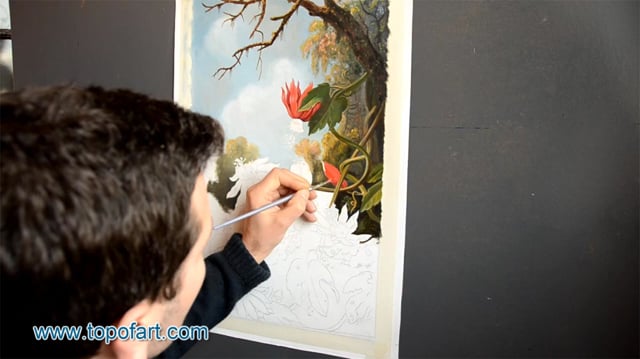 Hummingbird and Passionflowers - Video
A Glimpse into Our Studio: Creating Museum-Quality Oil Painting Reproductions
Watch a video showcasing the creation of a hand-painted reproduction of Hummingbird and Passionflowers by Martin Johnson Heade in our TOPofART studio. Witness the step-by-step process as our artists bring this masterpiece to life.
Oil Painting Reproduction
If you want a different size than the offered
Description
Painted by European Аrtists with Academic Education
Museum Quality
+ 4 cm (1.6") Margins for Stretching
Creation Time: 8-9 Weeks
Creation Process
We create our paintings with museum quality and covering the highest academic standards. Once we get your order, it will be entirely hand-painted with oil on canvas. All the materials we use are the highest level, being totally artist graded painting materials and linen canvas.
We will add 1.6" (4 cm) additional blank canvas all over the painting for stretching.
High quality and detailing in every inch are time consuming. The reproduction of Martin Johnson Heade also needs time to dry in order to be completely ready for shipping, as this is crucial to not be damaged during transportation.
Based on the size, level of detail and complexity we need 8-9 weeks to complete the process.
In case the delivery date needs to be extended in time, or we are overloaded with requests, there will be an email sent to you sharing the new timelines of production and delivery.
TOPofART wants to remind you to keep patient, in order to get you the highest quality, being our mission to fulfill your expectations.
We not stretch and frame our oil paintings due to several reasons:
Painting reproduction is a high quality expensive product, which we cannot risk to damage by sending it being stretched.
Also, there are postal restrictions, regarding the size of the shipment.
Additionally, due to the dimensions of the stretched canvas, the shipment price may exceed the price of the product itself.
You can stretch and frame your painting in your local frame-shop.
Delivery
Once the painting Hummingbird and Passionflowers is ready and dry, it will be shipped to your delivery address. The canvas will be rolled-up in a secure postal tube.
We offer free shipping as well as paid express transportation services.
After adding your artwork to the shopping cart, you will be able to check the delivery price using the Estimate Shipping and Tax tool.
Museum Quality
The paintings we create are only of museum quality. Our academy graduated artists will never allow a compromise in the quality and detail of the ordered painting. TOPofART do not work, and will never allow ourselves to work with low quality studios from the Far East. We are based in Europe, and quality is our highest priority.
Additional Information
Martin Johnson Heade paints humidity as much as he paints feathers. Grey, cloud-thick sky dissolves into a sfumato haze, while the jungle recedes in veils of olive and umber. Scarlet dominates, yet never shouts; the red of Passiflora racemosa is tempered by cool leaf-greens and the opalescent breast of the black-eared fairy (Heliothryx aurita). Notice the quiet punctuation of celadon veins, the dusky maroons in shadow, the faint cerulean chill where light thins near the horizon. Color here calibrates mood: sultry but lucid, sensual yet measured.
With patient layering, Heade builds forms through thin glazing and minute stippling. No bravura impasto; instead, an almost botanical fastidiousness. Each tendril is traced as if with a single hair, then softened where it dips behind a leaf. One petal shows a delicate double-edge—two strokes set fractionally apart—suggesting both translucency and the slight torque of a living surface. The bird’s throat is flicked with short, directional strokes that accumulate into the suggestion of iridescence rather than literal sparkle.
Composition operates like a quiet engine. The vine loops in a gentle S-curve, creating a diagonal procession of blooms from bottom left to upper right. Against this rhythm, the bird perches at a hinge point, where stalk and blossom nearly meet. From the top, a skeletal branch creates a counter-thrust that brackets the space, keeping the eye within the humid amphitheatre of foliage and sky. Negative spaces—those cool, clouded wedges—give the red flowers room to flare.
Historical context matters. In Gilded Age America, natural history and art were close companions; Heade knew Charles Darwin’s writings and pursued the reciprocal choreography of flora and fauna. Here that reciprocity becomes compositional law: the passionflower’s architecture mirrors the bird’s poised beak, mutual instruments in a single ecology. One might imagine, almost, the faint whirr of wings and the damp vegetal scent rising from the moss.
Comparable pictures—such as Heade’s various Orchids and Hummingbirds canvases—share this disciplined theater of observation, yet this picture is more intimate, less panoramic. Perhaps the cloud bank acts like a stage scrim, flattening depth so that the drama of pollination takes precedence over grand topography. At the Metropolitan Museum of Art, New York, the painting reads like a field note refined into poetry.
Hummingbird and Passionflowers, ca. 1875–85 names an encounter, but Heade offers an argument: beauty emerges where attention intensifies. Adroitly, he sets science and sensuality in concert. In our own century of strained ecosystems, the picture feels newly current—precise, attentive, unsentimental. Heade shows that looking—truly looking—can be an ethical act.

Approaching Thunder Storm 1859
$1352
$63.85
Martin Johnson Heade
Original Size:71.1 x 111.8 cm
Metropolitan Museum of Art, New York, USA
Hummingbird and Apple Blossoms 1875
$1049
$63.85
Martin Johnson Heade
Original Size:31 x 35.9 cm
Metropolitan Museum of Art, New York, USA
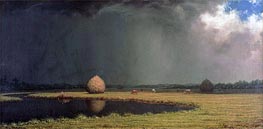
Salt Marsh Hay c.1865
$962
Martin Johnson Heade
Original Size:33 x 66 cm
Butler Institute of American Art, Youngstown, USA
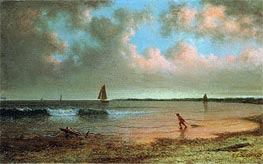
New England Coastal Scene n.d.
$699
$63.85
Martin Johnson Heade
Original Size:33 x 66 cm
Private Collection
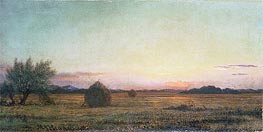
Jersey Meadows n.d.
$953
Martin Johnson Heade
Original Size:31 x 61.4 cm
Private Collection