Alessandro Bonvicino, known as Moretto da Brescia (c. 1498-1554), was an Italian Renaissance painter whose reputation rested on religious paintings and a smaller, influential body of portraits. Brescia remained the center of his career: its churches, religious associations, and prosperous citizens supplied many of his commissions. The city belonged to the Venetian territories, but its painting also drew on Lombard traditions. Moretto worked between these two cultures, combining close observation of people and materials with the rich color of Venetian art.
Little is securely known about his training. Suggestions that he studied with Vincenzo Foppa or Titian have not established a documented apprenticeship. His early commissions offer firmer evidence. In 1514 he received work decorating a chapel at Santa Croce in Brescia with episodes from the life of Mary Magdalene, now lost. Between 1515 and 1518 he collaborated with Floriano Ferramola on organ shutters for the city's Old Cathedral. Moretto painted the saints Faustinus and Giovita on the inner faces. These were substantial responsibilities for a painter still in his teens; a document already described him as a master in 1516.
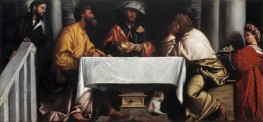
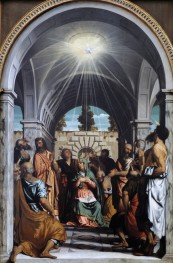
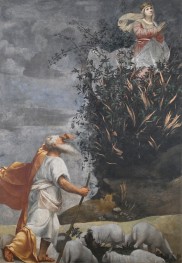
In 1521 Moretto and Girolamo Romanino began working on the Sacrament Chapel at San Giovanni Evangelista in Brescia. Moretto's contributions included the Last Supper, the gathering of manna, Elijah with the angel, evangelists, and prophets. The subjects connected biblical accounts of miraculous nourishment with the Eucharist, giving the chapel a coherent religious purpose rather than simply a sequence of separate pictures. The collaboration placed two distinct local painters within a shared commission. Moretto also undertook an Assumption of the Virgin for the Old Cathedral between 1524 and 1526, extending his standing among the city's church patrons.
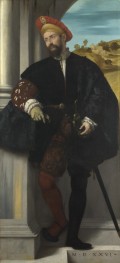
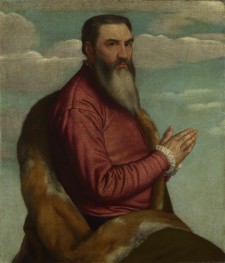
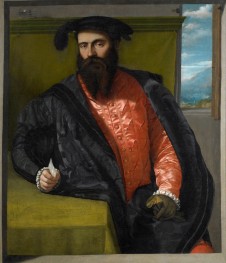
His Portrait of a Man of 1526 introduced a different kind of ambition. The sitter appears from head to foot, leaning against a column, with the architectural setting largely enclosing the space around him. His identity remains unknown. Although his clothes indicate wealth and rank, nothing identifies him as a ruling prince. The painting is among the earliest independent, full-length portraits in Italian art, making its imposing format especially striking. Moretto painted comparatively few portraits, but this combination of bodily presence, restrained gesture, and substantial architectural surroundings offered an important model for Giovanni Battista Moroni, his most significant pupil.
Commissions occasionally took Moretto beyond Brescia. Lorenzo Lotto invited him in December 1528 to work at Santa Maria Maggiore in Bergamo; payment the following month recorded both his journey and work in the choir, although the paintings concerned have not been identified. He also maintained professional ties with the organ builder Giovanni Giacomo Antegnati, meeting him in Milan in 1530 over the restoration of the cathedral organ at Salò. In 1536 Moretto supplied paintings for a new organ in Brescia's Old Cathedral. Such assignments made the painted furnishings of churches as important to his working life as their altars.
By 1533 Moretto could afford to purchase a house in the San Clemente district. His position in Brescia was civic as well as professional: he belonged to prominent religious confraternities and participated in meetings of the cathedral school. His faith also entered the later accounts of his working habits. The nineteenth-century writer Stefano Fenaroli reported that Moretto prepared through fasting and prayer before painting the Madonna for the sanctuary at Paitone. This is a biographical tradition rather than a directly observed studio routine. The commission followed a reported Marian apparition to a shepherd boy during the plague of 1533.
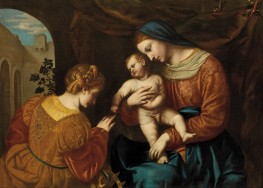
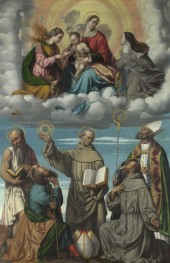
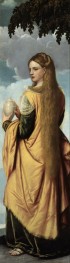
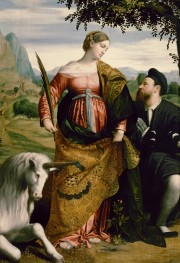
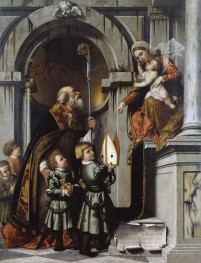
During the 1530s, Moretto developed the cool, silvery coloring associated with his mature work. Venetian richness remained important, but he tempered it with gray tones and measured arrangements of figures. Raphael's compositions, probably encountered through prints, offered another point of reference. His Saint Justina with a Unicorn and a Donor belongs to this period. In 1539 he completed the Rovelli Altarpiece, in which Saint Nicholas introduces the pupils of Galeazzo Rovelli to the Virgin and Child. The inclusion of the schoolchildren gave a particular local community a place within a sacred encounter. A further commission took his work to San Giorgio in Braida in Verona, for which he painted an altarpiece in 1540.
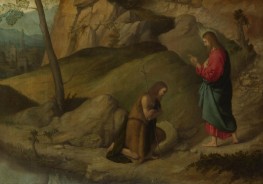
The following decade brought paintings for San Clemente in Brescia, including the Madonna di San Clemente of 1548. Moretto also worked outside church settings: in 1543 he painted frescoes in the palace now known as Palazzo Salvadego. His portraits of these years included the young nobleman represented in London's Portrait of a Young Man, whose head rests on his hand amid costly clothing and furnishings. Around 1550 Moretto married Maria Moreschini. They had two daughters, Caterina and Isabella, and a son, Pietro Vincenzo. Among his late religious paintings was Christ and the Angel. Moretto made his will on November 9, 1554, and died before December 22, when his executors sold one of his houses.
After his death, Luca Mombello completed the unfinished Melchizedek and Abraham in 1555. Moretto's example continued most consequentially in Moroni's portraits, with their attentive rendering of individual appearance and commanding full-length figures. Many of Moretto's religious paintings remain in churches in Brescia and the surrounding area, preserving their connection with the settings for which they were commissioned. The Pinacoteca Tosio Martinengo in Brescia holds the Rovelli Altarpiece and Christ and the Angel; his portraits can be seen in London's National Gallery, and Saint Justina with a Unicorn and a Donor is in Vienna's Kunsthistorisches Museum.