
The Betrayal of Christ (Taking of Christ), 1602 Michelangelo Merisi da Caravaggio (1571-1610)
Location: National Gallery Dublin IrelandOriginal Size: 135.5 x 169.5 cm
Own a museum-quality reproduction of The Betrayal of Christ (Taking of Christ) by Caravaggio (1602), exclusively hand-painted in oils on linen canvas by European artists with academic training. Each masterpiece is created with meticulous craftsmanship, capturing the exceptional quality and authentic brushwork of the original painting.
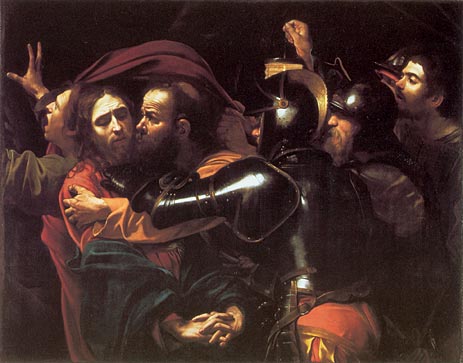
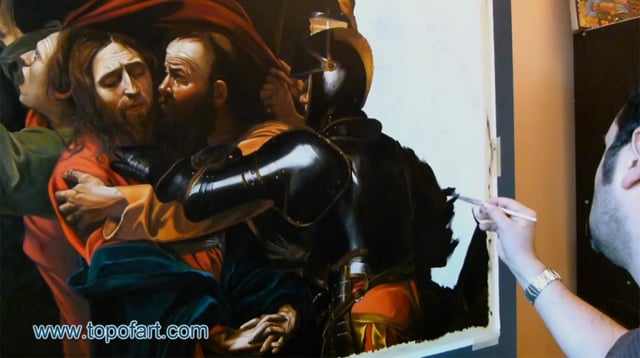 The Betrayal of Christ (Taking of Christ) - Video
A Glimpse into Our Studio: Creating Museum-Quality Oil Painting Reproductions
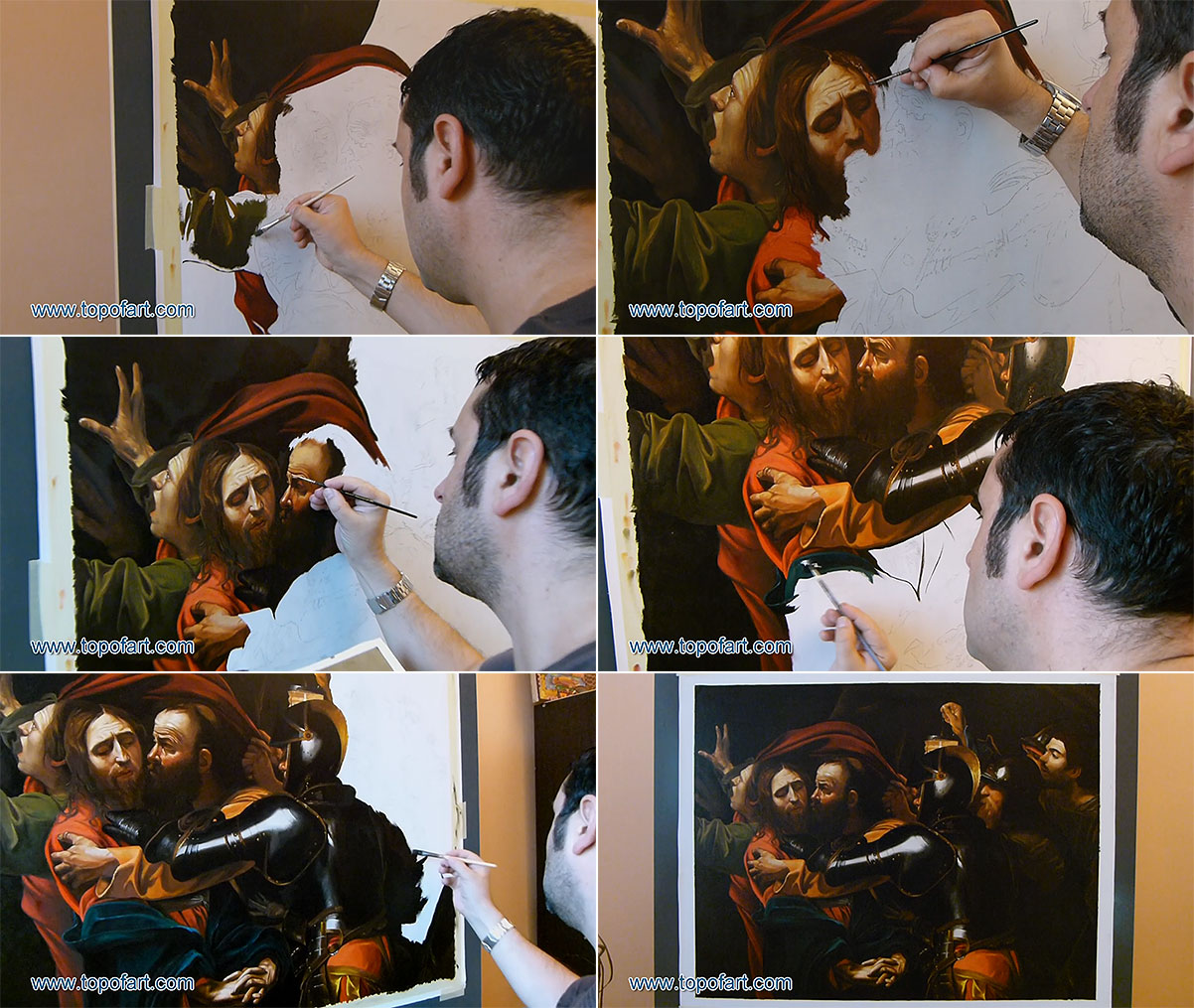
Watch a video showcasing the creation of a hand-painted reproduction of The Betrayal of Christ (Taking of Christ) by Caravaggio in our TOPofART studio. Witness the step-by-step process as our artists bring this masterpiece to life.
Oil Painting Reproduction
If you want a different size than the offered
Description
Painted by European Аrtists with Academic Education
Museum Quality
+ 4 cm (1.6") Margins for Stretching
Creation Time: 8-9 Weeks
Creation Process
We create our paintings with museum quality and covering the highest academic standards. Once we get your order, it will be entirely hand-painted with oil on canvas. All the materials we use are the highest level, being totally artist graded painting materials and linen canvas.
We will add 1.6" (4 cm) additional blank canvas all over the painting for stretching.
High quality and detailing in every inch are time consuming. The reproduction of Michelangelo Merisi da Caravaggio also needs time to dry in order to be completely ready for shipping, as this is crucial to not be damaged during transportation.
Based on the size, level of detail and complexity we need 8-9 weeks to complete the process.
In case the delivery date needs to be extended in time, or we are overloaded with requests, there will be an email sent to you sharing the new timelines of production and delivery.
TOPofART wants to remind you to keep patient, in order to get you the highest quality, being our mission to fulfill your expectations.
We not stretch and frame our oil paintings due to several reasons:
Painting reproduction is a high quality expensive product, which we cannot risk to damage by sending it being stretched.
Also, there are postal restrictions, regarding the size of the shipment.
Additionally, due to the dimensions of the stretched canvas, the shipment price may exceed the price of the product itself.
You can stretch and frame your painting in your local frame-shop.
Delivery
Once the painting The Betrayal of Christ (Taking of Christ) is ready and dry, it will be shipped to your delivery address. The canvas will be rolled-up in a secure postal tube.
We offer free shipping as well as paid express transportation services.
After adding your artwork to the shopping cart, you will be able to check the delivery price using the Estimate Shipping and Tax tool.
Museum Quality
The paintings we create are only of museum quality. Our academy graduated artists will never allow a compromise in the quality and detail of the ordered painting. TOPofART do not work, and will never allow ourselves to work with low quality studios from the Far East. We are based in Europe, and quality is our highest priority.
Additional Information
Caravaggio restricts the palette to earthen reds, deep greens, ochres and jet blacks, punctuated by icy flesh tones and the mirrored silver of armour. The chromatic economy heightens emotional intensity: the red of Judas’s cloak bleeds into Christ’s mantle, visually fusing treachery and sacrifice. Dark grounds swallow ancillary detail, so that the few lit zones—faces, hands, armour—flare with almost sculptural clarity. Colour is less descriptive than atmospheric; it turns light into a protagonist, isolating motives and psychology with surgical precision.
Technically, the painting exemplifies Caravaggio’s audacious handling of oil. Wet passages coalesce with brisk, loaded strokes, yet the surface remains restrained, devoid of flourish. Recent examination reveals pentimenti—ghost contours of repositioned hands and altered armour—tracing the artist’s method of staging live models, then revising on the canvas itself. Pigment sits thin in shadows, thicker in lit forms, the grain of the weave occasionally exposed, imparting a raw immediacy that belies the scene’s theological gravitas.
Compositionally, the canvas reads as a compressed frieze, a single horizontal charge frozen mid‑surge. Lines of force radiate from Christ’s downturned gaze: St John’s splayed hand arcs upward; the soldier’s gauntleted arm thrusts inward; Judas’s bent elbow forms a hinge at centre. Even Christ’s bound hands, clasped low, echo a silent prayer, anchoring the turmoil above. The viewer’s eye ricochets along these vectors, only to return to the understated expression of spiritual acceptance.
Painted in 1602 for Ciriaco Mattei at the height of Rome’s Counter‑Reformation, the work answers the Church’s call for visceral immediacy in sacred art. Yet its modernity lies in its psychological candour: salvation and sin are enacted not in celestial space but in the fugitive torchlight of ordinary men. The canvas’s subsequent disappearance, misattribution, and twentieth‑century rediscovery form a narrative almost as dramatic as the subject itself, underscoring its magnetic reputation among contemporaries and successors alike.
Today the painting stands as testament to Caravaggio’s short Roman epoch, where radical naturalism, uncompromising chiaroscuro, and acute human insight coalesced. Its power stems less from spectacular incident than from the palpable contradiction it stages: divine narrative articulated in the language of flawed flesh and mortal dread, rendered with a painter’s eye that refuses consolation, yet compels engagement.

2 Reviews
5.00 Overall rating

The Incredulity of Saint Thomas (Doubting Thomas) c.1601
$4738
$71.96
Michelangelo Merisi da Caravaggio
Original Size:108.5 x 145 cm
Sanssouci Palace, Potsdam, Germany
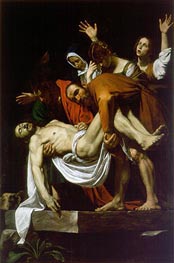
The Entombment (Deposition) c.1602/04
$6910
$64.04
Michelangelo Merisi da Caravaggio
Original Size:300 x 203 cm
Pinacoteca, Vatican, Vatican City

The Sacrifice of Isaac c.1603
$5619
$75.12
Michelangelo Merisi da Caravaggio
Original Size:104 x 135 cm
Galleria degli Uffizi, Florence, Italy
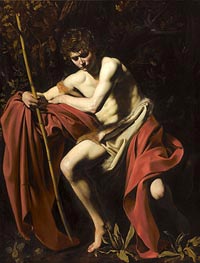
Saint John the Baptist c.1603/04
$4485
$122.64
Michelangelo Merisi da Caravaggio
Original Size:173.4 x 132.1 cm
Nelson-Atkins Museum of Art, Kansas City, USA

Saint Jerome Writing c.1604/06
$3819
$70.55
Michelangelo Merisi da Caravaggio
Original Size:112 x 157 cm
Galleria Borghese, Rome, Italy