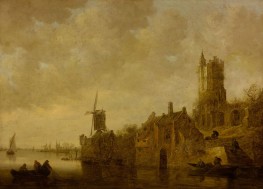
Jan Josephszoon van Goyen (1596-1656) was a Dutch landscape painter whose river views, dunes, and expansive skies helped establish tonal landscape painting in the seventeenth century. With a restrained range of browns, grays, and muted greens, he gave ordinary waterways and sandy roads a remarkable sense of atmosphere. Fishermen, travelers, and villagers occupied these landscapes alongside ferries, windmills, and distant church towers. His professional success, however, did not bring financial security: alongside painting, he pursued property deals and tulip speculation that contributed to debts he could not clear.
Van Goyen was born in Leiden on January 13, 1596, the son of a shoemaker. His training involved several changes of teacher rather than a single uninterrupted apprenticeship. According to the Leiden chronicler Jan Jansz. Orlers, he began studying painting at ten, passed through several local workshops, and resisted the prospect of becoming a glassworker. He subsequently trained with Willem Gerritz. in Hoorn and traveled to France around the age of nineteen. The decisive apprenticeship came afterward in Haarlem, where he spent about a year with Esaias van de Velde. From this landscape specialist, he learned to organize countryside scenes around roads, groups of figures, and carefully measured distances.
In 1618, van Goyen married Annetje van Raelst and entered Leiden’s Guild of Saint Luke as an independent master. His early paintings remained close to van de Velde’s example, with distinct local colors and conspicuous groups of people. During the following decade, he began reducing contrasts between individual colors, bringing the landscape together through related tones. The marine painter Jan Porcellis contributed to this development. Instead of separating every tree, bank, and building with a different hue, van Goyen increasingly used light and atmosphere to distinguish them. Winter scenes, beaches, dunes, and rivers offered different settings for this exploration.
By the early 1630s, van Goyen had moved to The Hague, where he obtained citizenship in 1634. His paintings drew on canals and villages around Leiden, Delft, Rotterdam, and Gouda, but his working material extended beyond his immediate surroundings. On journeys he filled sketchbooks with observations, using pen and later black chalk. These studies supplied buildings, shorelines, and other motifs that he could rearrange in the studio. A recognizable landmark did not necessarily mean an exact record of its setting. His landscapes combined observed details with invented arrangements, allowing a town or riverbank to serve the needs of the composition.
Van Goyen developed a rapid, economical handling of paint, often applying thin passages over a warm-colored ground. Ochers, earth colors, and grays could suggest wet air or sunlit distance without a broad assortment of pigments. More opaque lights stood against transparent shadows, while alternating dark and light areas carried the eye into depth. This method also suited a market in which his individual pictures generally brought modest sums. Whether financial calculation or artistic experiment came first cannot be established. He supplemented his painting income by dealing in art and working as an appraiser, and he bought land and commissioned houses. In 1637, he also purchased tulip bulbs shortly before the collapse of the speculative market, leaving unpaid obligations. His standing among fellow painters nevertheless remained substantial: in 1638, he became a headman of The Hague’s Guild of Saint Luke.
During the 1640s, van Goyen repeatedly returned to particular places without simply repeating a composition. The Valkhof at Nijmegen became a recurring subject, while river views around Dordrecht gave him scope for broad water surfaces beneath extensive skies. In Landscape with Two Oaks, the trees command the foreground rather than disappearing into a distant panorama; the subject shows how strongly he could build a landscape around a few substantial forms. His travels continued, including a visit to Antwerp in 1648. The following year, Jan Steen moved into his household and married his daughter Grietje. Another daughter, Maria, married the painter Jacques de Claeuw in the same year. The animal painter Paulus Potter also rented a house from van Goyen.
A major public commission arrived in 1651, when van Goyen painted View of The Hague from the Southeast for the city authorities. At approximately 4.6 meters wide, the canvas differed greatly in scale from his more intimate landscapes. The foreground includes the Trekvliet canal and a mill, with the city spread across the distance. He received 650 guilders for the painting that August. Yet the commission did not resolve his finances: he sought a postponement of payments during the same year. His property investments, rather than the tulip losses alone, were a principal source of his mounting difficulties.
Sales of his own work and his collection became part of the effort to meet his obligations. An auction in 1652 brought in 3,750 guilders, but further sales followed. In 1654, he rented out his house on the Dunne Bierkade and moved to the Wagenstraat. Steen left The Hague that year. Van Goyen continued painting during these difficult final years, producing marine and river scenes with increasingly free arrangements of water, sky, and vessels. He died in The Hague on April 27, 1656, leaving debts of about 18,000 guilders.
After his death, his widow accepted the estate only on terms that protected her from responsibility for debts remaining after its assets were sold. Steen and his father assisted her. Van Goyen’s influence extended through painters such as Anthony van der Croos and through the many artists who adopted his tonal approach. His reputation also reached beyond the Dutch seventeenth century. In 1833, J. M. W. Turner paid tribute with Van Goyen Looking Out for a Subject; decades later, Vincent van Gogh compared the view from his asylum window to a van Goyen perspective. Today, paintings in Madrid’s Thyssen-Bornemisza Museum and Leiden’s Museum De Lakenhal offer opportunities to examine the variety he achieved within his deliberately limited palette.