
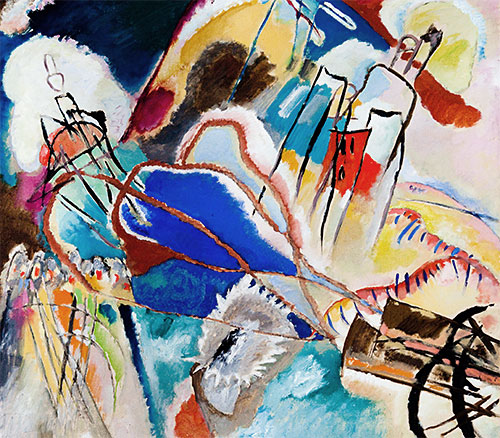
Improvisation No. 30 (Cannons), 1913 Wassily Kandinsky (1866-1944)
Location: Art Institute of Chicago Illinois USAOriginal Size: 111 x 111.3 cm
Own a museum-quality reproduction of Improvisation No. 30 (Cannons) by Kandinsky (1913), exclusively hand-painted in oils on linen canvas by European artists with academic training. Each masterpiece is created with meticulous craftsmanship, capturing the exceptional quality and authentic brushwork of the original painting.
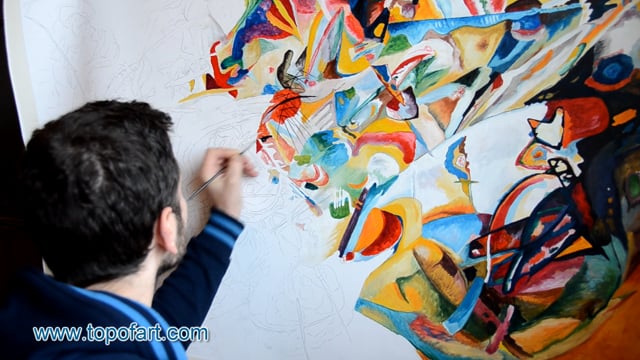
Recreating Kandinsky: A Video Journey into Museum-Quality Reproductions by TOPofART
Video showcasing the process of hand-painting a Kandinsky masterpiece with the utmost precision and care for detail.
Oil Painting Reproduction
If you want a different size than the offered
Description
Painted by European Аrtists with Academic Education
Museum Quality
+ 4 cm (1.6") Margins for Stretching
Creation Time: 8-9 Weeks
Creation Process
We create our paintings with museum quality and covering the highest academic standards. Once we get your order, it will be entirely hand-painted with oil on canvas. All the materials we use are the highest level, being totally artist graded painting materials and linen canvas.
We will add 1.6" (4 cm) additional blank canvas all over the painting for stretching.
High quality and detailing in every inch are time consuming. The reproduction of Wassily Kandinsky also needs time to dry in order to be completely ready for shipping, as this is crucial to not be damaged during transportation.
Based on the size, level of detail and complexity we need 8-9 weeks to complete the process.
In case the delivery date needs to be extended in time, or we are overloaded with requests, there will be an email sent to you sharing the new timelines of production and delivery.
TOPofART wants to remind you to keep patient, in order to get you the highest quality, being our mission to fulfill your expectations.
We not stretch and frame our oil paintings due to several reasons:
Painting reproduction is a high quality expensive product, which we cannot risk to damage by sending it being stretched.
Also, there are postal restrictions, regarding the size of the shipment.
Additionally, due to the dimensions of the stretched canvas, the shipment price may exceed the price of the product itself.
You can stretch and frame your painting in your local frame-shop.
Delivery
Once the painting Improvisation No. 30 (Cannons) is ready and dry, it will be shipped to your delivery address. The canvas will be rolled-up in a secure postal tube.
We offer free shipping as well as paid express transportation services.
After adding your artwork to the shopping cart, you will be able to check the delivery price using the Estimate Shipping and Tax tool.
Museum Quality
The paintings we create are only of museum quality. Our academy graduated artists will never allow a compromise in the quality and detail of the ordered painting. TOPofART do not work, and will never allow ourselves to work with low quality studios from the Far East. We are based in Europe, and quality is our highest priority.
Additional Information
Colour carries the emotional burden. Kandinsky deploys high-pitched primaries—imperious blues, yellows edging into acid, reds tinged with cochineal—then tempers them with bruised greens and smoky mauves. The resulting chords hum rather than harmonise; they oscillate, like unresolved cadences, between alarm and exaltation. Patches of exposed ground—the raw linen stained by thin washes—keep the eye attentive to the work’s construction, echoing the silences between musical phrases.
Technique underscores that sensibility. The paint ranges from translucent veils to dense, trowelled swathes; brittle dry-brush scumbles bite against swift, liquefied drags. Black contour lines—sometimes lifted directly from the tube—behave less as drawing than as dynamic conductors, orchestrating pulses of hue. Though titled an “Improvisation,” the picture reveals a practised control: liberties of gesture are corralled by a rigorous internal rhythm.
Composition pivots on diagonals. A steep axis runs from the upper left cloudburst to the cannon’s muzzle, cleaving the field into converging currents. Triangular flashes of lemon in the lower right accelerate the gaze upward, while the concentric wheel pins the energy, a visual fermata before the eye loops back into the maelstrom. Spatial depth is suggested not by perspective but by temperature: cool blues recede, hot crimsons thrust forward, achieving a breathing, elastic space.
Painted in Munich in 1913, the work belongs to Kandinsky’s sequence of “Improvisations,” created as Europe edged toward catastrophe. Contemporary rhetoric of war, he wrote to the collector Arthur Jerome Eddy, seeped into the motif of cannons, yet the painting’s “true contents” lie in the spectator’s response—a spiritual vibration rather than a literal record. Rooted in the Blaue Reiter circle, nourished by Wagnerian synaesthesia and Theosophical speculation, the canvas stands as visual prophecy: a psychic weather-map of a continent on the brink, rendered through colour and line liberated from representation. Its resonance is undiminished, just as the artillery’s rumble—imagined or remembered—still echoes across the painted surface.

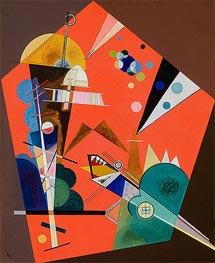
Tension in Red 1926
$1354
$79.17
Wassily Kandinsky
Original Size:111 x 111.3 cm
Public Collection
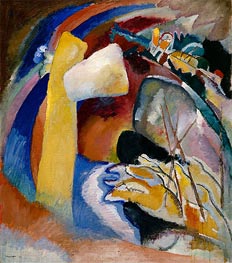
Study for Painting with White Form 1913
$1257
$85.71
Wassily Kandinsky
Original Size:100 x 88.3 cm
Detroit Institute of Arts, Michigan, USA
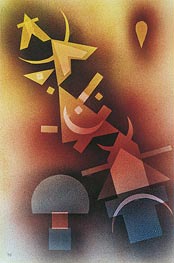
From Cool Depths 1928
$60.73
Wassily Kandinsky
Original Size:48.3 x 32 cm
Norton Simon Museum, Pasadena, USA
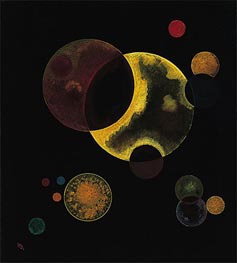
Heavy Circles 1927
$845
$87.48
Wassily Kandinsky
Original Size:57.2 x 52 cm
Norton Simon Museum, Pasadena, USA
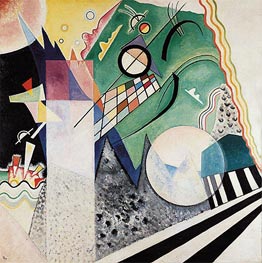
Open Green 1923
$1288
$80.01
Wassily Kandinsky
Original Size:97.2 x 97.2 cm
Norton Simon Museum, Pasadena, USA