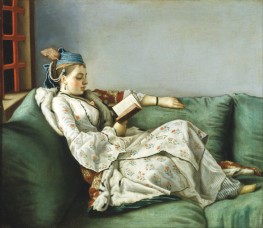
Jean Etienne Liotard Painting Reproductions 1 of 4
1702-1789
Swiss Rococo Painter
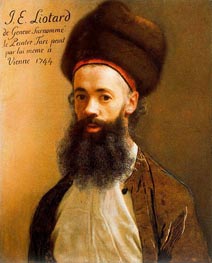
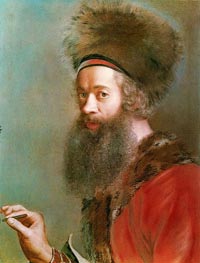
By the time Jean-Étienne Liotard returned from Constantinople, he had acquired more than new subjects and patrons. He had also acquired a public identity, continuing to wear Turkish dress in Europe until the costume became inseparable from his reputation as "the Turkish painter." Jean-Étienne Liotard (1702-1789), a Genevan painter, pastellist, printmaker, theorist and art dealer, built an unusually international career across Rome, Istanbul, Vienna, Paris, London and Amsterdam, while making naturalistic portraiture and pastel his most distinctive fields.
Born in Geneva on 22 December 1702, Liotard was the son of Antoine Liotard, a merchant and citizen of Geneva, and Anne Sauvage. His parents were French Protestants who had fled France after 1685, and his twin brother, Jean-Michel, later became a draughtsman and engraver. In Geneva, Jean-Étienne first studied with the miniature painter Daniel Gardelle, learning enamel and miniature painting in a workshop where precision mattered more than grand gesture. The training lasted only about four months, but the discipline of small-scale observation remained fundamental to his later art.
In 1725 he left Geneva for Paris and entered the workshop of the miniaturist Jean-Baptiste Massé. For three years the arrangement was closer to paid placement than formal apprenticeship, and Liotard spent much of the period making copies. Around 1728 he established his own workshop. Ambition soon pushed him toward the official arena of French art: in 1732 he submitted a history painting to the Académie royale de peinture et de sculpture for its prize competition, on the prescribed subject of the high priest Achimelech giving David the sword of Goliath. The work failed to win. At this stage he made more enamels than pastels and also produced portrait prints of Voltaire and Fontenelle, advertising them in the local press.
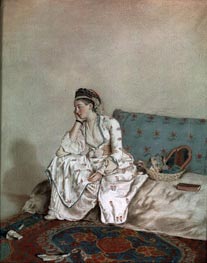
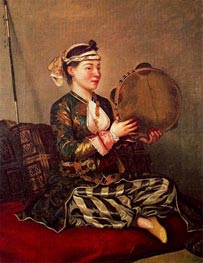
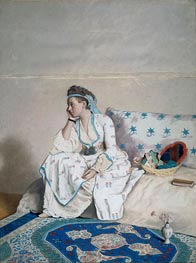
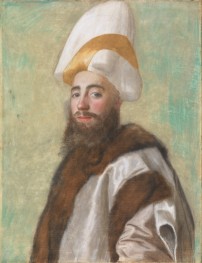
Travel altered both his opportunities and his artistic language. In 1735 Liotard accompanied the French diplomat Louis Philogène Brûlart to Naples and Rome, where he portrayed Pope Clement XII and several cardinals. Two years later he made now-lost pastels of James Francis Edward Stuart and his sons. Then, in 1738, he travelled with Lord Duncannon to Constantinople and remained there for about four years. Istanbul became decisive. He portrayed Europeans in local dress and painted Turkish domestic scenes at a moment when contemporary costume was considered unsuitable for elevated history painting. By accepting the visual facts of dress, gesture and domestic setting rather than translating them into heroic convention, Liotard found a territory in which close observation could become the subject itself.
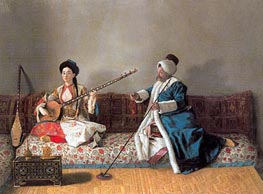
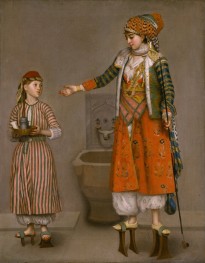
Returning west, he kept the Turkish clothes and beard that made him conspicuous. Sitters also embraced the fashion. Travellers commissioned portraits in Eastern costume, and even patrons who had never visited the Ottoman world, including Madame de Pompadour, participated in this cultivated exoticism. Yet the lasting interest of Liotard's Turkish imagery lies less in costume alone than in its attentiveness to surfaces, fabrics, faces and quiet interiors. A Turkish Lady and her Servant, dated 1750, belongs to this strand of his work.
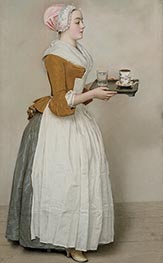
In 1742 he went to Vienna to portray members of the Imperial family. Three years later The Chocolate Girl was acquired by the dealer Francesco Algarotti for the Dresden pastel cabinet, securing one of the works most closely associated with Liotard today. The picture demonstrates why pastel suited him so well: dry pigment could retain a luminous freshness, while the absence of visible brushwork served his pursuit of an image that appeared almost optically immediate. Liotard pressed pastel firmly into the support to intensify its brilliance, often working on vellum, which held colour with exceptional clarity. He also prepared supports with fish glue, wine and fine pumice dust, and at times used blue paper, a common eighteenth-century choice for heightening the luminosity of pastel.
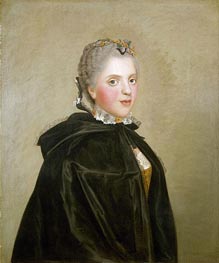
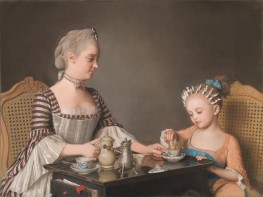
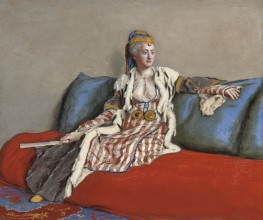
Back in Paris, and still working under distinguished patronage, he continued to build a European clientele. Breakfast of the Lavergne Family of 1752 shows how comfortably portraiture could merge with domestic genre. In 1753 he travelled to England and painted Princess Augusta of Saxe-Gotha, Princess of Wales. Three years later he went to the Dutch Republic, where in 1757 he married Marie Fargues, herself from a Huguenot family. She wanted him to shave his beard, a small domestic detail that also marks the fading of the public persona he had carried from Constantinople. A portrait of Marie in Turkish costume from about 1757 preserves that earlier mode within the intimacy of family life.
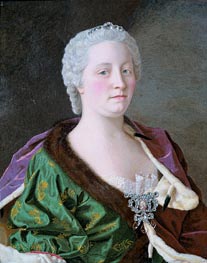
Liotard remained mobile. In 1762 he again worked in Vienna, where his sitters included the young Marie Antoinette; he was in Paris in 1770 and returned to England in 1772. During the following two years his name appeared among the exhibitors at the Royal Academy. He was also an expert collector and dealer in old master paintings, and on this second English visit he sold several works from his collection at high prices. In 1776 he returned to Geneva.
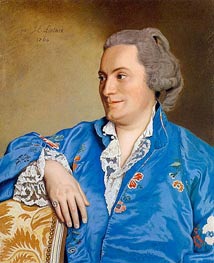
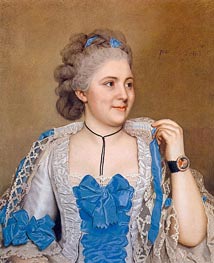
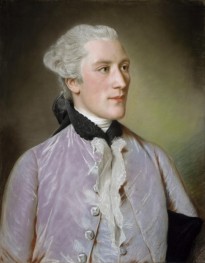
His later years reveal how coherent his ideas had become. In 1781 Jean-Étienne Liotard published the Traité des principes et des règles de la peinture, arguing that painting should act as a mirror of nature. He advocated the elimination of visible touches and believed pastel especially capable of producing convincing imitation. That theory clarifies his long preference for smooth surfaces, crisp contours, luminous colour and an almost stubborn resistance to painterly display. Even smiling sitters, unusual in much eighteenth-century formal portraiture, contribute to his sense of living presence rather than ceremonial distance.
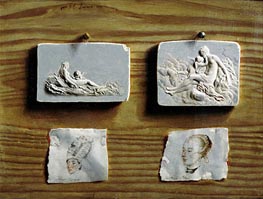
The range of the late work also widened. Trompe l'Oeil of 1771 shows his continued interest in illusion, while Still Life of Fruit on a Napkin, with a Bun and a Knife, dated 1782, belongs to a final period that included still lifes and landscapes. View of Mont Blanc with a Self-Portrait offers another aspect of an artist too often reduced to fashionable portraits. He died in Geneva on 12 June 1789.
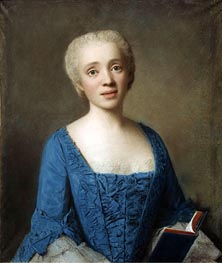
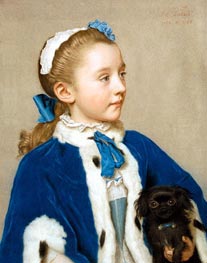
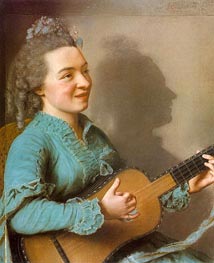
Liotard's reputation rests on a rare combination of technical restraint and visual intensity. His finest pastels, including The Chocolate Girl, The Artist's Niece, Marianne Lavergne, Known as "La Liseuse," and Maria Frederike van Reede-Athlone at Seven, refuse the easy grandeur of court portraiture without abandoning elegance. They ask the viewer to notice complexion, cloth, light, posture and expression with unusual patience. Perhaps this is why his art can still feel so immediate: he trusted observation enough to let detail carry emotion. Important groups of his work remain in Amsterdam, Bern and Geneva, while other examples are held in major European and American collections. The cosmopolitan traveller eventually returned home, but the accuracy he pursued had no single country.