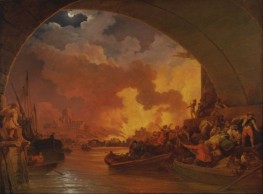
Philip James de Loutherbourg Painting Reproductions 1 of 2
1740-1812
French Romanticism Painter
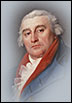
Few painters of the eighteenth century moved so easily between the easel, the theatre stage and mechanical spectacle. Philip James de Loutherbourg (1740-1812), French-born and later established in Britain, became a painter of landscapes, battles and naval drama, a celebrated designer for the London stage, and the creator of one of the period’s most curious visual inventions, the Eidophusikon. Born Philippe Jacques de Loutherbourg in Strasbourg on 31 October 1740, he spent a career searching for ways to make nature appear not merely represented, but almost physically present before the spectator.
His father was a Swiss miniature painter, although the young Loutherbourg was originally intended for the Lutheran ministry. He studied at the University of Strasbourg, but religious vocation gave way to painting. In 1755 he went to Paris and studied first under Charles-André van Loo and later under Francesco Giuseppe Casanova. The latter connection was particularly appropriate for an artist who would make storms, battles, animals and turbulent landscapes central to his work.
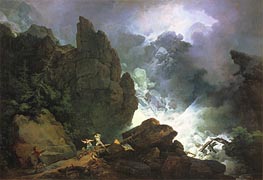
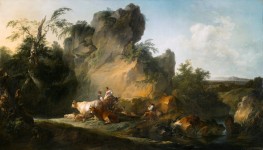
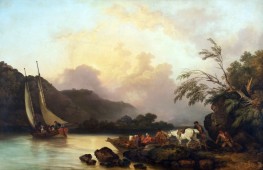
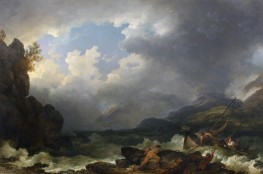
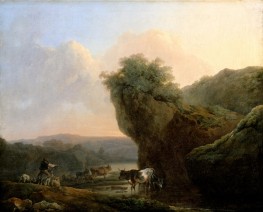
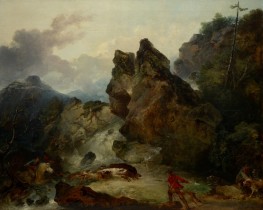
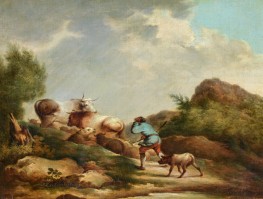
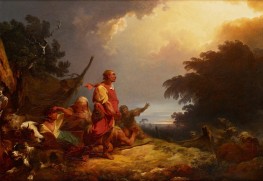
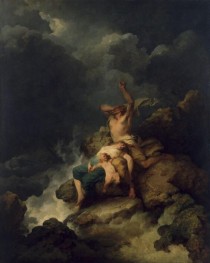
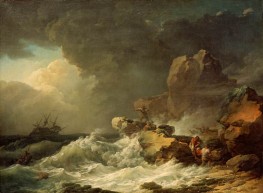
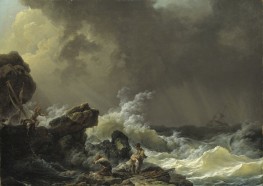
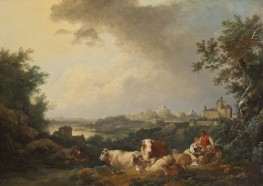
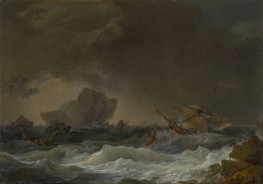
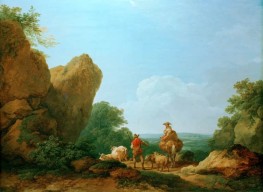
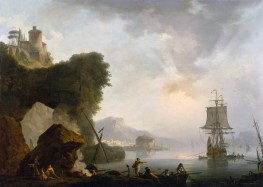
Success came quickly. At the Paris Salon of 1763 his Landscape with Figures and Animals drew favourable attention from Denis Diderot. Two years later he returned to the Salon with further works, among them Morning After the Rain. By 1767 his reputation had risen sufficiently for him to be elected to the French Academy despite being younger than its normal rules permitted. Landscapes, sea storms and military subjects formed much of his early output. Works such as Storm at Sunset, Night and Morning after Rain already reveal the range of atmospheric effects that would remain essential to his imagination.
Travel through Switzerland, Germany and Italy broadened his experience, but painting was only part of his curiosity. Mechanical illusion fascinated him. He experimented with model theatres in which concealed lighting could produce moonlight and stars, while sheets of blue metal, gauze and silver threads suggested moving water. Such devices belonged to the world of entertainment, yet they were also closely related to his painting. Light, motion and weather became materials to be manipulated.
In 1771 Loutherbourg settled in London, a decisive move in his career. David Garrick engaged him at Drury Lane Theatre for the substantial salary of £500 a year to design scenery and costumes and supervise stage machinery. There he transformed theatrical space through changing illumination and carefully controlled scenic effects. Green foliage could turn gradually to autumnal russet; a rising moon might illuminate the rims of moving clouds. Coloured lantern slides and transparencies helped create these transformations. Even Joshua Reynolds admired the results. Loutherbourg remained connected with Drury Lane until 1785.
Pushing illusion further, he created the Eidophusikon, a miniature mechanical theatre roughly six by eight feet in size. From March 1781 it was shown at his home before audiences of about 130 people. Moving painted scenes, lighting and colour effects imitated natural phenomena on a scale both intimate and theatrical. Argand lamps illuminated the miniature stage, while stained glass altered the colour of the light. The spectator was offered storms, landscapes and shifting atmospheres as events rather than static images.
Its ambitions soon became more elaborate. At Christmas 1781 Loutherbourg prepared a spectacle for William Beckford at Fonthill, and he later turned to subjects from Paradise Lost, including Satan assembling his forces beside the Fiery Lake and the appearance of Pandemonium. Yet ingenuity did not guarantee commercial success. New scenes were expensive and slow to make, while audiences demanded novelty faster than he could supply it. The Eidophusikon eventually closed. Loutherbourg has sometimes been associated with the origins of the panorama, although the first panorama itself was painted and exhibited by the Scottish artist Robert Barker.
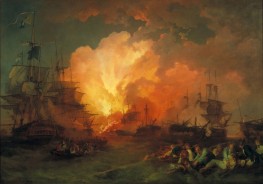
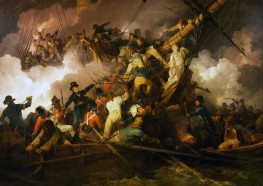
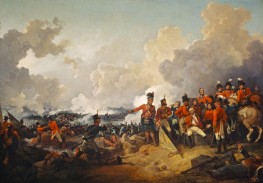
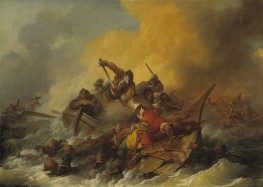
Painting nevertheless remained central. In 1781 Philip James de Loutherbourg was elected a member of the Royal Academy, securing his position within British artistic life. His large naval and military compositions answered the appetite for national history and public spectacle. Lord Howe's action, or the Glorious First of June, exhibited in 1795, commemorated a British naval victory; several such pictures later entered the Greenwich Hospital Gallery and ultimately the National Maritime Museum. The Defeat of the Spanish Armada, painted in 1796, became one of his most important historical battle scenes, while The Grand Attack on Valenciennes of 1793 treated a more recent military event.
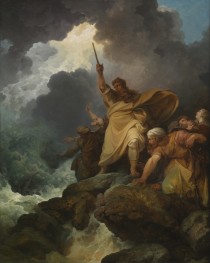
The theatrical designer remained visible inside the painter. In these works, space is rarely passive. Clouds gather, smoke spreads, waves break and light cuts across the action. Even when the subject is historical, Loutherbourg approaches it through atmosphere and movement. His experience of scenery and mechanical illusion had taught him how strongly an image could depend upon timing, contrast and controlled revelation.
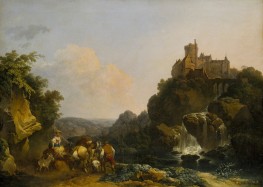
Another side of modern Britain appears in Coalbrookdale by Night of 1801. Here industrial production itself becomes spectacle. Furnaces burn against darkness, turning the landscape into a scene of heat, smoke and artificial illumination. Rather than separating landscape painting from the Industrial Revolution, Loutherbourg brought the two together. The picture gives industrial labour the visual drama he had previously found in storms and battles. Works such as Lodore Waterfall and Skating in Hyde Park, now among the paintings in the Government Art Collection, show how widely his subjects could range.
Alongside painting, he continued to work as a draughtsman and illustrator. Two groups of his drawings appeared in aquatint as Picturesque English Scenery in 1801 and 1805. He also supplied illustrations for Thomas Macklin's Bible, published in 1800. His 110 vignette drawings for that project were later preserved in the Bowyer Bible at Bolton Museum in Greater Manchester.
Yet Loutherbourg's restless curiosity also led him away from art. In 1789 he temporarily abandoned painting while pursuing alchemy, supernatural beliefs and faith-healing. He became associated with Alessandro Cagliostro and travelled with him for a period before separating from him prior to Cagliostro's condemnation. Loutherbourg and his wife also practised faith-healing. Mary Pratt's pamphlet A List of a Few Cures performed by Mr and Mrs De Loutherbourg, of Hammersmith Terrace, without Medicine claimed that they had treated some two thousand people between Christmas 1788 and July 1789. It is one of the strangest episodes in the career of an eighteenth-century Royal Academician.
Philip James de Loutherbourg died at Chiswick in west London on 11 March 1812 and was buried in Chiswick Old Cemetery near St Nicholas Church, not far from the graves of William Hogarth and, later, James Abbott McNeill Whistler. His paintings entered numerous British collections, including Tate Britain, the Victoria and Albert Museum, the National Portrait Gallery and the Royal Academy.
What makes Loutherbourg compelling today is the unusual unity beneath his apparently scattered interests. Theatre machinery, storm painting, naval spectacle, industrial fire and mechanical entertainment all reveal the same concern: how can light and movement persuade the eye? Perhaps this explains why even his most historical compositions retain a sense of immediacy. He did not simply depict spectacle. He spent his life trying to understand how spectacle works.