
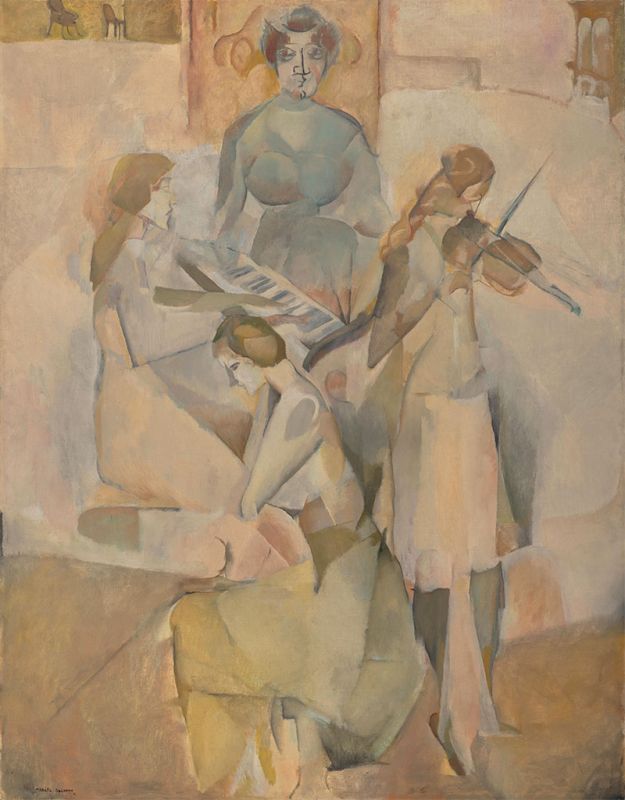
Sonata, 1911 Marcel Duchamp (1887-1968)
Location: Philadelphia Museum of Art Pennsylvania USAOriginal Size: 145 x 113.3 cm
Own a museum-quality reproduction of Sonata by Marcel Duchamp (1911), exclusively hand-painted in oils on linen canvas by European artists with academic training. Each masterpiece is created with meticulous craftsmanship, capturing the exceptional quality and authentic brushwork of the original painting.
Oil Painting Reproduction
If you want a different size than the offered
Description
Painted by European Аrtists with Academic Education
Museum Quality
+ 4 cm (1.6") Margins for Stretching
Creation Time: 8-9 Weeks
Creation Process
We create our paintings with museum quality and covering the highest academic standards. Once we get your order, it will be entirely hand-painted with oil on canvas. All the materials we use are the highest level, being totally artist graded painting materials and linen canvas.
We will add 1.6" (4 cm) additional blank canvas all over the painting for stretching.
High quality and detailing in every inch are time consuming. The reproduction of Marcel Duchamp also needs time to dry in order to be completely ready for shipping, as this is crucial to not be damaged during transportation.
Based on the size, level of detail and complexity we need 8-9 weeks to complete the process.
In case the delivery date needs to be extended in time, or we are overloaded with requests, there will be an email sent to you sharing the new timelines of production and delivery.
TOPofART wants to remind you to keep patient, in order to get you the highest quality, being our mission to fulfill your expectations.
We not stretch and frame our oil paintings due to several reasons:
Painting reproduction is a high quality expensive product, which we cannot risk to damage by sending it being stretched.
Also, there are postal restrictions, regarding the size of the shipment.
Additionally, due to the dimensions of the stretched canvas, the shipment price may exceed the price of the product itself.
You can stretch and frame your painting in your local frame-shop.
Delivery
Once the painting Sonata is ready and dry, it will be shipped to your delivery address. The canvas will be rolled-up in a secure postal tube.
We offer free shipping as well as paid express transportation services.
After adding your artwork to the shopping cart, you will be able to check the delivery price using the Estimate Shipping and Tax tool.
Museum Quality
The paintings we create are only of museum quality. Our academy graduated artists will never allow a compromise in the quality and detail of the ordered painting. TOPofART do not work, and will never allow ourselves to work with low quality studios from the Far East. We are based in Europe, and quality is our highest priority.
Additional Information
The colour palette is deliberate in its restraint. Duchamp tempers warm skin tones with slate greys and pale coral, allowing no hue to dominate. The subfusc harmony suggests both domestic intimacy and an exploratory modernism, drawing the eye across the canvas rather than anchoring it in any single chromatic flourish. Subtle modulations—the blush in Suzanne’s cheek, the blue underpainting that surfaces around Magdeleine’s bowing arm—generate a quiet vibrato, echoing the sisters’ two‑part harmony in pigment.
Technically, the work signals Duchamp’s tentative dialogue with Cubism. Brushstrokes are soft, almost powdered, yet the underlying structure is geometric. Planes overlap; edges shift from hard to dissolved; volumes are hinted at through tonal blocks rather than conventional modelling. The surface feels sanded down, lending the figures a marble‑like tactility, while leaving vestiges of the artist’s earlier Impressionist leanings in the atmospheric transitions between light and shadow.
Compositionally, Sonata is a study in equilibrium. The keyboard establishes a strong horizontal axis, bisected by the angled violin and the seated figure’s downward gaze, creating a subtle cruciform that holds the eye mid‑canvas. Duchamp balances mass and void: compressed forms at the centre open to airy, almost abstract passages at the periphery. The viewer’s gaze circulates—upward to the mother’s mask‑like face, across the keyboard’s rhythmic stripes, down the sweep of Suzanne’s skirt—before returning to the interlaced hands on piano keys and bow. This orchestrated movement suggests music translated into pictorial cadence.
Historically, the painting sits at a threshold. Executed in 1911, it bridges bourgeois subject matter and avant‑garde form, produced just as Duchamp and his brothers engaged with the Section d’Or circle. The familial theme tempers the radical geometry, offering a microcosm of French middle‑class culture on the eve of modernist rupture. That Duchamp would soon abandon painting for conceptual experiment renders Sonata poignant: it is an early chord struck before the composer left the instrument behind.


Portrait of Chess Players 1911
$2462
$96.33
Marcel Duchamp
Original Size:100.6 x 100.5 cm
Philadelphia Museum of Art, Pennsylvania, USA

The King and Queen Surrounded by Swift Nudes 1912
$2680
$86.79
Marcel Duchamp
Original Size:114.6 x 129 cm
Philadelphia Museum of Art, Pennsylvania, USA

Bride 1912
$1744
$64.14
Marcel Duchamp
Original Size:89.5 x 55.6 cm
Philadelphia Museum of Art, Pennsylvania, USA
Nude (Study), Sad Young Man in a Train c.1911/12
$2134
$68.22
Marcel Duchamp
Original Size:100 x 73 cm
Peggy Guggenheim Collection, Venice, Italy