Melchior d'Hondecoeter Painting Reproductions 1 of 4
1636-1695
Dutch Baroque Painter
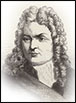
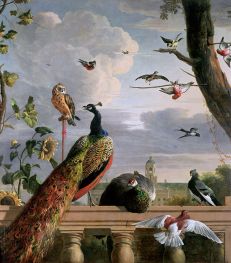
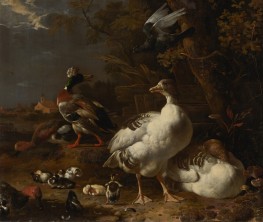
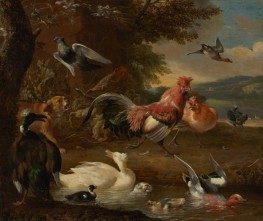
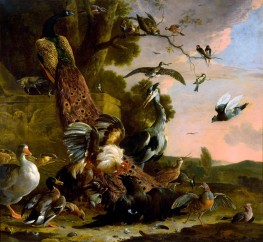
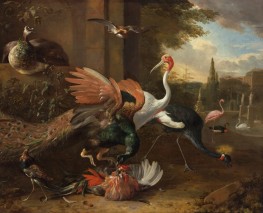
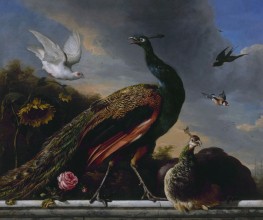
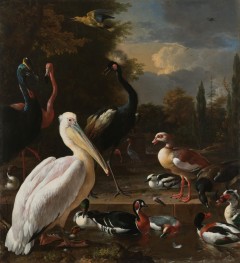
A peacock opening its tail, a crane pausing mid-step, a cock ready for combat - Melchior d'Hondecoeter understood that spectacle in nature is never merely decorative. Melchior d'Hondecoeter, born in Utrecht around 1636 and dead in Amsterdam on 3 April 1695, made himself one of the most distinctive Dutch painters of animal life by turning again and again to birds, not as trophies or ornaments, but as creatures with presence, vanity, alarm and appetite.
Utrecht gave him his beginning, yet painting already surrounded him. His grandfather was Gillis d'Hondecoeter, his father Gijsbert d'Hondecoeter, and through his aunt Josina - who married Jan Baptist Weenix - he also stood close to another important pictorial lineage. That environment did not simply offer instruction; it offered a way of seeing. An anecdote passed on by Jan Weenix to Arnold Houbraken adds an unexpected note. In youth, Melchior was said to be intensely devout, praying so loudly that his mother and uncle wondered whether his future lay in the studio or the pulpit. The remark lingers because it suggests an inward seriousness beneath the theatrical surface of his art.
His earliest known work points in another direction altogether. Tub with Fish, dated 1655 and now in the Herzog Anton Ulrich Museum, belongs to the beginning of his career, when he had not yet committed himself to the bird pictures by which he is remembered. There are references, too, to marine subjects. Yet he soon narrowed his field, and the narrowing was productive rather than limiting. Instead of dispersing his attention across many kinds of still life or animal painting, he concentrated on fowl, game birds and exotic species, studying motion, stance and interaction with remarkable persistence.
By 1659 he was in The Hague, where he joined the Confrerie Pictura. That membership placed him within the organized artistic life of the city and marks the first firm institutional point in his career. Four years later, in 1663, he married Susanne Tradel of Amsterdam, a woman of thirty who lived on the Lauriergracht. Amsterdam then became the true theatre of his mature life. Two children were baptized there, in 1666 and 1668. Domestic life, however, was apparently not serene. Houbraken describes Susanne as difficult, with her sisters also living in the house, and presents Hondecoeter as a man who sought relief in the garden or in the taverns of the Jordaan. Whether that portrait is sharpened by gossip or not, it gives him a social setting - one close to dealers, painters and the busy commercial life of the canal district. Later he moved to the Leliegracht, near what is now the Anne Frank House.
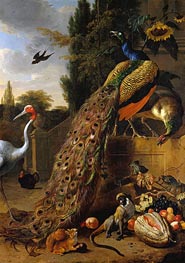
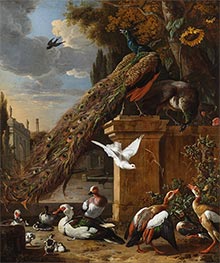
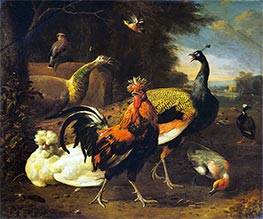
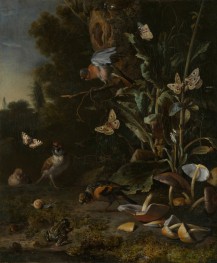
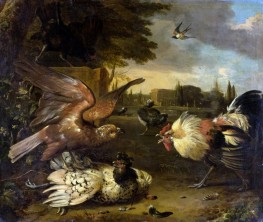
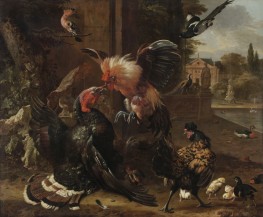
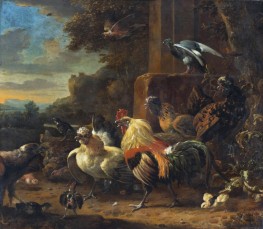
Birds became his true republic. Not dead game laid out for inventory, but animated creatures inhabiting park-like landscapes, theatrical enclosures and ornamental settings. In his pictures appear geese of several kinds, ducks, pigeons, partridges, fieldfares and magpies, but also a more cosmopolitan cast: peacocks, African grey crowned cranes, Asian sarus cranes, yellow-crested cockatoos from Indonesia, a purple-naped lory, grey-headed lovebirds from Madagascar, even the northern cardinal. Such range speaks not only of painterly curiosity but of the Dutch Republic's global horizons in the seventeenth century, when trade, collecting and display brought foreign species into princely gardens and private menageries.
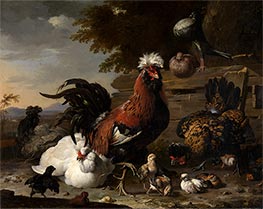
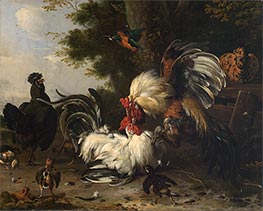
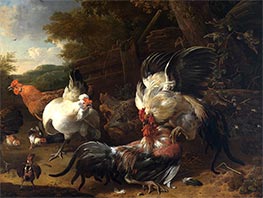
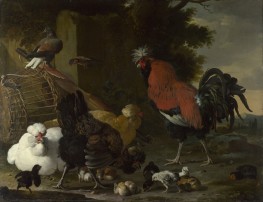
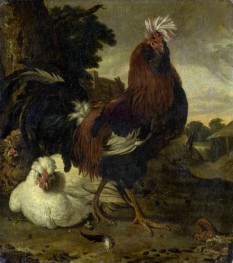
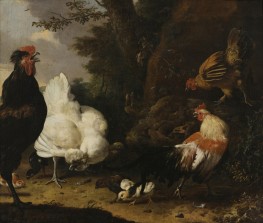
What matters most is the way d'Hondecoeter treated these creatures. Johannes Fyt had shown how richly plumage and game could be painted; Frans Snyders had already given animal painting scale and bravura. Hondecoeter chose a more concentrated theatre. He seldom strayed far beyond avian life, yet within that narrower province he found extraordinary drama. A hen gathers her chicks; a cock confronts a rival; waterfowl shuffle, preen or flare with irritation. Motion is everywhere - necks craning, wings half-lifted, claws testing ground. Often his composition reads almost like conversation. One overlooked detail from his estate inventory is revealing: he owned a small gallows used to hold birds in position. Observation, for him, required contrivance as well as sympathy. The same inventory listed seven paintings by Frans Snyders, a reminder that he knew exactly where his art stood in relation to a powerful Flemish precedent.
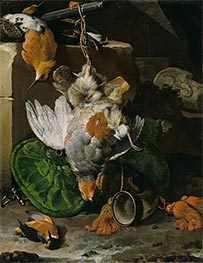
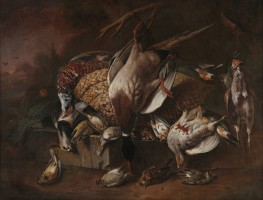
Few of his works are securely dated, though many are signed. That scarcity makes the dated paintings especially useful. Jackdaw deprived of his Borrowed Plumes of 1671, now in the Mauritshuis in The Hague, announces his taste for anecdote and avian character. Game and Poultry and A Spaniel hunting a Partridge of 1672, in the Royal Museums of Fine Arts of Belgium, show him handling the more traditional territory of game painting while keeping the scene alive with tension rather than mere display. A Park with Poultry of 1686, now in the Hermitage in St Petersburg, belongs to the late phase, when his brush had become broader and his surfaces denser. The early works are generally lighter, clearer and more transparent; the later ones sacrifice some of that lucidity for greater boldness. Yet his eye remains sure. He understands exactly how a bird shifts weight or occupies space.
Patronage confirmed his standing. William III employed him to paint the menagerie at Het Loo, an assignment that required not only decorative flair but the handling of unfamiliar animals - Indian cattle, elephants and gazelles among them. He also produced wall hangings with views of parks and buildings, and decorated the royal residences of Bensberg and Oranienstein. These commissions show that he was trusted in elevated circles and that his art answered a taste for nature made courtly, ordered and splendid. Still, he was often strongest when scale came down and attention sharpened - when a bird's vanity or vigilance became the subject itself.
Loss shadowed the end of his life. In 1692 Susanne died. Hondecoeter then lived in the house of his daughter Isabel in the Warmoesstraat. When he died in 1695, he was buried in the Westerkerk and left his daughter substantial debts. That sober conclusion jars slightly against the proud plumage and elaborate display of his paintings. Perhaps that contrast is part of his lasting appeal. Melchior d'Hondecoeter makes elegance feel unstable: beauty struts, quarrels, startles, defends itself. His pictures still speak because they understand performance in nature and in society. Beneath the decorative surface, he offers observation of a high order - exact, amused, and at moments unexpectedly tender.