
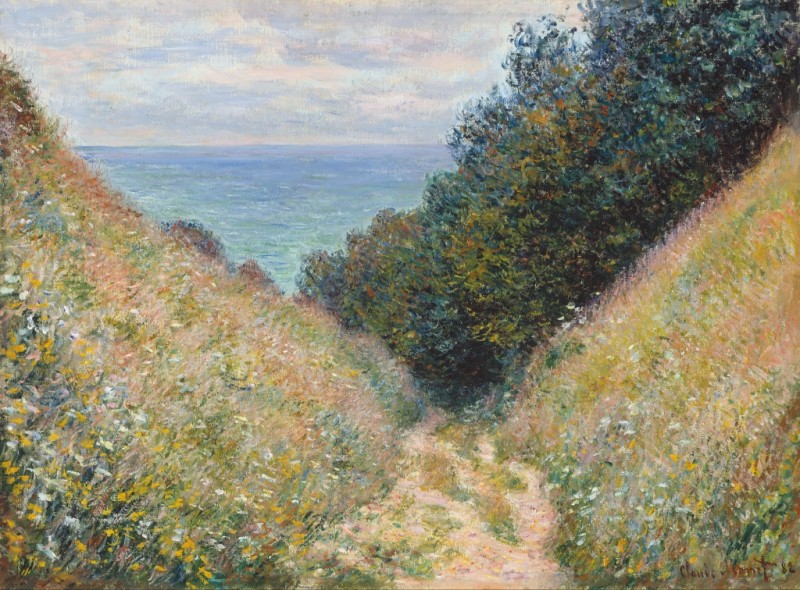
Road at La Cavée, Pourville, 1882 Claude Monet (1840-1926)
Location: Boston Museum of Fine Arts, USAOriginal Size: 60.3 x 81.6 cm
Own a museum-quality reproduction of Road at La Cavée, Pourville by Claude Monet (1882), exclusively hand-painted in oils on linen canvas by European artists with academic training. Each masterpiece is created with meticulous craftsmanship, capturing the exceptional quality and authentic brushwork of the original painting.

Recreating Claude Monet: A Video Journey into Museum-Quality Reproductions by TOPofART
Video showcasing the process of hand-painting a Claude Monet masterpiece with the utmost precision and care for detail.
Oil Painting Reproduction
If you want a different size than the offered
Description
Painted by European Artists with Academic Education
Museum Quality
+ 4 cm (1.6") Margins for Stretching
Creation Time: 8-9 Weeks
Creation Process
We create our paintings with museum quality and covering the highest academic standards. Once we get your order, it will be entirely hand-painted with oil on canvas. All the materials we use are the highest level, being totally artist graded painting materials and linen canvas.
We will add 1.6" (4 cm) additional blank canvas all over the painting for stretching.
High quality and detailing in every inch are time consuming. The reproduction of Claude Monet also needs time to dry in order to be completely ready for shipping, as this is crucial to not be damaged during transportation.
Based on the size, level of detail and complexity we need 8-9 weeks to complete the process.
In case the delivery date needs to be extended in time, or we are overloaded with requests, there will be an email sent to you sharing the new timelines of production and delivery.
TOPofART wants to remind you to keep patient, in order to get you the highest quality, being our mission to fulfill your expectations.
We not stretch and frame our oil paintings due to several reasons:
Painting reproduction is a high quality expensive product, which we cannot risk to damage by sending it being stretched.
Also, there are postal restrictions, regarding the size of the shipment.
Additionally, due to the dimensions of the stretched canvas, the shipment price may exceed the price of the product itself.
You can stretch and frame your painting in your local frame-shop.
Delivery
Once the painting Road at La Cavée, Pourville is ready and dry, it will be shipped to your delivery address. The canvas will be rolled-up in a secure postal tube.
We offer free shipping as well as paid express transportation services.
After adding your artwork to the shopping cart, you will be able to check the delivery price using the Estimate Shipping and Tax tool.
Museum Quality
The paintings we create are only of museum quality. Our academy graduated artists will never allow a compromise in the quality and detail of the ordered painting. TOPofART do not work, and will never allow ourselves to work with low quality studios from the Far East. We are based in Europe, and quality is our highest priority.
Additional Information
The banks organize the picture around opposing diagonals. On the left, the ground slopes down from the edge; on the right, a sunlit incline rises toward the upper corner beneath a dense mass of shrubs and trees. Together, these directions suggest an X, a compositional device Monet had explored as early as 1863-64. Here, the geometry is easy to feel without becoming rigid: uneven plants and rounded contours soften its lines.
Much of that softness comes from the paint. Small strokes of yellow, pink, pale blue, and green break up the grassy surfaces, so neither bank reads as a single stretch of color. The dark foliage on the right is busy too, with blue-green marks and warm flecks interrupting its shadows. Against this restless texture, the more horizontal strokes of the distant water provide a quieter interval. The sea looks farther away partly because its surface is less densely worked.
There is no walker to give the road a destination or turn the view into an incident. By this point, figures appear only occasionally in Monet’s paintings. Their absence here leaves the rounded banks themselves to carry the feeling of shelter. The comparison between landscape and the curves of a body belongs to a long artistic tradition; in this hollow, it has a concrete basis in the way the earth encloses the path.
For all that enclosure, the scene is not forbidding. Warm touches of paint continue along the road into the hollow, connecting the foreground with the shaded bend. The route beyond remains hidden: the sea is plainly visible above the dip, but the path never supplies an uninterrupted way to it.


Sea Coast at Trouville 1881
$796
$61.15
Claude Monet
Original Size:60.7 x 81.3 cm
Boston Museum of Fine Arts, USA

The Rocks at Pourville, Low Tide 1882
$822
$61.15
Claude Monet
Original Size:64.3 x 78.7 cm
Memorial Art Gallery at the University of Rochester, USA

The Rocks at Belle-Île, the Wild Coast 1886
$855
$91.20
Claude Monet
Original Size:65 x 81.5 cm
Musée d'Orsay, Paris, France

Woman with a Parasol Facing Left 1886
$822
$61.84
Claude Monet
Original Size:131 x 88 cm
Musée d'Orsay, Paris, France

Woman with a Parasol Facing Right 1886
$1170
$63.02
Claude Monet
Original Size:131 x 88 cm
Musée d'Orsay, Paris, France