
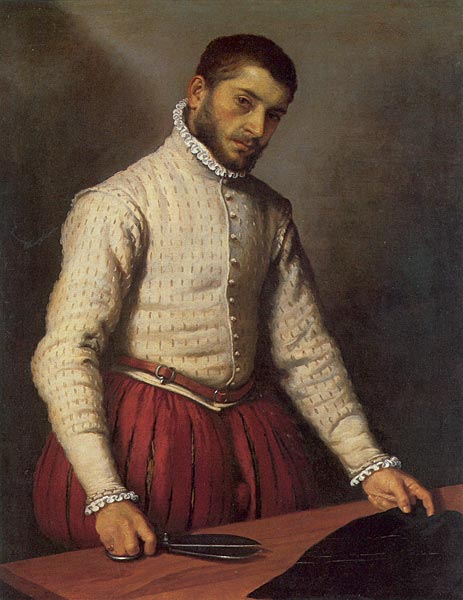
Portrait of a Man (The Tailor), c.1565/70 Giovanni Battista Moroni (c.1520-1578)
Location: National Gallery London UKOriginal Size: 99.5 x 77 cm
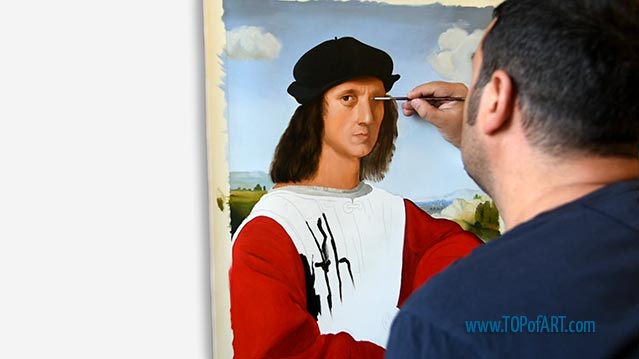
Own a museum-quality reproduction of Portrait of a Man (The Tailor) by Giovanni Battista Moroni (c.1565/70), exclusively hand-painted in oils on linen canvas by European artists with academic training. Each masterpiece is created with meticulous craftsmanship, capturing the exceptional quality and authentic brushwork of the original painting.
Oil Painting Reproduction
If you want a different size than the offered
Description
Painted by European Аrtists with Academic Education
Museum Quality
+ 4 cm (1.6") Margins for Stretching
Creation Time: 8-9 Weeks
Creation Process
We create our paintings with museum quality and covering the highest academic standards. Once we get your order, it will be entirely hand-painted with oil on canvas. All the materials we use are the highest level, being totally artist graded painting materials and linen canvas.
We will add 1.6" (4 cm) additional blank canvas all over the painting for stretching.
High quality and detailing in every inch are time consuming. The reproduction of Giovanni Battista Moroni also needs time to dry in order to be completely ready for shipping, as this is crucial to not be damaged during transportation.
Based on the size, level of detail and complexity we need 8-9 weeks to complete the process.
In case the delivery date needs to be extended in time, or we are overloaded with requests, there will be an email sent to you sharing the new timelines of production and delivery.
TOPofART wants to remind you to keep patient, in order to get you the highest quality, being our mission to fulfill your expectations.
We not stretch and frame our oil paintings due to several reasons:
Painting reproduction is a high quality expensive product, which we cannot risk to damage by sending it being stretched.
Also, there are postal restrictions, regarding the size of the shipment.
Additionally, due to the dimensions of the stretched canvas, the shipment price may exceed the price of the product itself.
You can stretch and frame your painting in your local frame-shop.
Delivery
Once the painting Portrait of a Man (The Tailor) is ready and dry, it will be shipped to your delivery address. The canvas will be rolled-up in a secure postal tube.
We offer free shipping as well as paid express transportation services.
After adding your artwork to the shopping cart, you will be able to check the delivery price using the Estimate Shipping and Tax tool.
Museum Quality
The paintings we create are only of museum quality. Our academy graduated artists will never allow a compromise in the quality and detail of the ordered painting. TOPofART do not work, and will never allow ourselves to work with low quality studios from the Far East. We are based in Europe, and quality is our highest priority.
Additional Information
Moroni’s chromatic restraint intensifies the dialogue between costume and cloth. Warm ochres and muted greys dominate, yet the earthen spectrum is repeatedly pierced—first by those arterial reds below the belt, later by the crimson gemstone, and finally by the emphatic blue‑black of the textile to be cut. The palette is neither sumptuous nor severe; rather, it sustains a measured equilibrium that allows the sitter’s flesh tints, finely modulated with cool greys and faint rose, to remain gently luminous. Light enters from the upper left, stroking cheekbone, collar, and knuckles, then sliding along the plane of the shears; shadows pool thickly in the hollow of the sleeve and behind the figure, heightening the optical immediacy.
Close scrutiny reveals a painter working wet‑into‑wet with swift assurance. The beard is woven from strokes of ginger, charcoal, and soft grey that mingle on the surface, creating a living texture. In the doublet, almost calligraphic dabs articulate the slashed padding, each mark catching minute inflections of the under‑tone. The breeches, by contrast, are handled more broadly, the alternating ribbons of red and green now abrupt where an original glaze has thinned. Flesh passages are laid thin enough to expose the weave of the canvas, a late Moroni practice that lends the complexion a dry, breathable realism and frees the surrounding tones to assume atmospheric softness.
Compositionally, Moroni orchestrates a diagonal descent from illuminated brow to departing elbow, a vector echoed by the angle of the shears and the edge of the cloth. The opposing tilt of the head sets up a visual counter‑rhythm, anchoring attention on the sitter’s enquiring gaze before directing it—via the pale ruff and the bright cuff—to those industrious hands. We experience the figure at life‑size, framed so tightly that elbows and tools press toward us, dissolving the customary barrier between observer and observed. The result is a portrait that feels less like formal display and more like a studied accident: a man recorded in the active theatre of his livelihood.
Painted in the unsettled years following the Council of Trent, this image of a tailor—or perhaps cloth merchant of guild rank—quietly challenges the hierarchy of portraiture. If contemporary etiquette frowned on depicting manual labour, Moroni nonetheless affirms the dignity of skilled craftsmanship, allowing the shears equal narrative weight with the sword‑looped belt that intimates social aspiration. The psychological acuity is Venetian in atmosphere yet Lombard in candour: sober, humane, and unsentimental. In presenting professional identity as moral worth, Moroni anticipated a broader, more democratic conception of the individual that would surface centuries later.

1 Reviews
5.00 Overall rating

Although the activity of Moroni, disciple of Moretto da Brescia, includes religious scenes, the painter's fame is connected with the series of portraits he executed during his Brescian period, which lasted until 1553, as well as after his return to Bergamo, where he acquired a vast clientele. Titian himself recommended Moroni for his 'naturalness' to a gentleman of the Albani family.
In fact it is inescapable that he has a particular ability to approach reality directly, which goes back to a Lombard tradition and relates him to other great contemporary artists of similar experience but belonging to the Venetian world: Lotto, Savoldo and Romanino.
Some compositions in the Mannerist taste appear to have been filtered through Venetian styles, as in the Portrait of a Poet, 1560, in the Pinacoteca Tosio Martinengo, Brescia. In Moroni's gallery of personalities, who are for the most part unknown, but who reveal their social positions and specific trades or professions - the tailor, the lawyer - this one is considered 'the official'. A consciousness of authority-emanates from the personage, from his golden collar that stands out on the rich garb, from the severity of the entire composition, both from the point of view of colour and from the sober architectural reference.
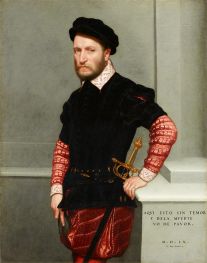
Don Gabriel de la Cueva, Count of Albuquerque 1560
$3795
$76.34
Giovanni Battista Moroni
Original Size:114.8 x 90.8 cm
Old Masters Gallery, Berlin, Germany
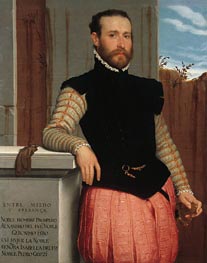
Portrait of Prospero Alessandri 1560
$3208
$76.34
Giovanni Battista Moroni
Original Size:105 x 84 cm
Liechtenstein Museum, Vienna, Austria
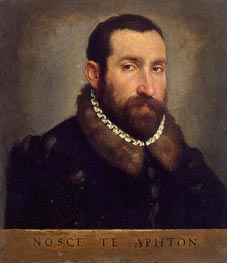
Portrait of a Man c.1565
$1908
$83.38
Giovanni Battista Moroni
Original Size:57.5 x 50 cm
State Hermitage Museum, St. Petersburg, Russia
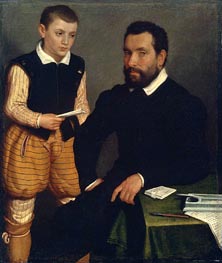
Portrait of a Man and a Boy (Count Alborghetti & Son) c.1545/50
$3738
Giovanni Battista Moroni
Original Size:98 x 83.5 cm
Boston Museum of Fine Arts, Massachusetts, USA