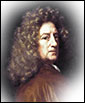
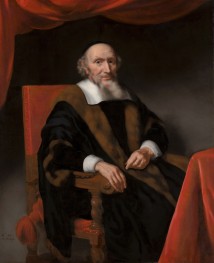
Few seventeenth-century painters changed direction as decisively as Nicolaes Maes. Born in Dordrecht in January 1634 and buried in Amsterdam on 24 December 1693, the Dutch artist began with intimate biblical scenes and psychologically acute domestic interiors before becoming one of the most sought-after portraitists of his generation. His career links the shadowed world of Rembrandt with the polished social portraiture of the later Dutch Golden Age.
Nicolaes Maes was the second son of Gerrit Maes, a prosperous cloth merchant and soap boiler, and Ida Herman Claesdr. His first instruction came from an undistinguished painter in Dordrecht, but around 1648 he moved to Amsterdam and entered Rembrandt's studio. He remained there for roughly five years. Those formative years were decisive, giving him a command of chiaroscuro, expressive gesture and concentrated narrative that would continue to shape his work even after his style changed dramatically.
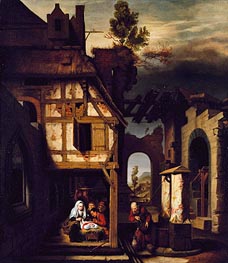
By December 1653, Maes had returned to Dordrecht. On 28 December he posted the banns for his marriage to Adriana Brouwers, widow of the preacher Arnoldus de Gelder. At almost the same moment he was beginning to establish himself as an independent painter. Among his early works were Suffer the Little Children to Come unto Me of 1652-53, now in the National Gallery, London, Vertumnus and Pomona, probably of 1653, and Woman of Samaria at the Well, painted around the same year.
Rembrandt's example is unmistakable in these pictures, but Maes was never merely an imitator. In Dismissal of Hagar and Ishmael of 1653, now in the Metropolitan Museum of Art, New York, the biblical narrative becomes an intensely human drama. Hagar's distress and Ishmael's isolation matter as much as the story itself. Rather than arranging figures as distant actors in sacred history, Maes makes rejection and sorrow almost physically present. Perhaps this ability to find emotional gravity in quiet gestures explains why his best early works remain so affecting.
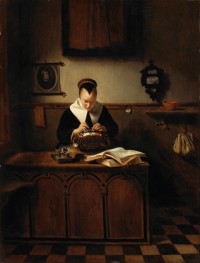
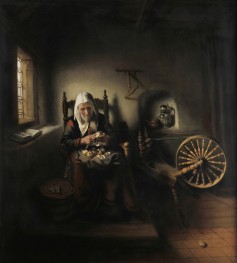
During the middle years of the 1650s, his attention increasingly shifted from biblical history to ordinary domestic life. Between about 1654 and 1658 he produced images of women sewing, spinning, making lace, caring for children, praying or reading. Limited colour, deep shadow and carefully directed light give these modest interiors an unexpected seriousness. In The Virtuous Woman, painted around 1655 and now in the Wallace Collection, a housewife sews in an orderly room while an open Bible rests nearby. Everyday diligence becomes an image of moral discipline, piety and domestic responsibility.
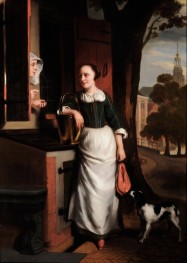
Equally distinctive were his doorstep scenes. Milkmaids, children seeking alms and figures exchanging payment occupy thresholds between private and public space. Maes treated such encounters with unusual dignity, finding drama where little apparently happened. Old women praying before simple meals or dozing over Bibles provided another recurring theme. These subjects reveal his particular strength: he could observe the ordinary without making it trivial.
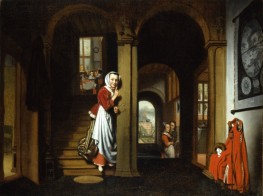
More important for the development of Dutch genre painting was his treatment of space. Instead of presenting an interior as a shallow box, Maes opened houses into sequences of rooms, passages and doorways. Figures might occupy separate spaces while remaining connected by sightlines and narrative. Such arrangements helped transform the domestic interior into a stage for observation, secrecy and human curiosity. His so-called eavesdropper compositions exploited precisely this possibility. The spatial ideas were important for later Delft painters, particularly Pieter de Hooch and Johannes Vermeer, while Maes's exterior scenes may also have contributed to the development of de Hooch's courtyard compositions.
Sometime in the middle or later 1650s Maes travelled to Antwerp, where he studied the work of Peter Paul Rubens, Anthony van Dyck and Jacob Jordaens. He was said to have visited Jordaens's studio and spoken with him at length about painting. The journey broadened his visual language. From the 1660s onward, genre painting receded and portraiture became his principal occupation.
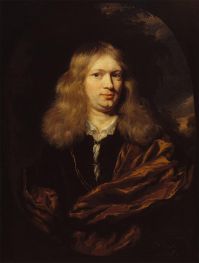
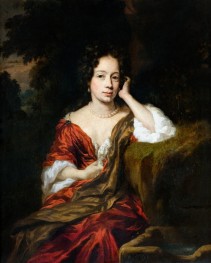
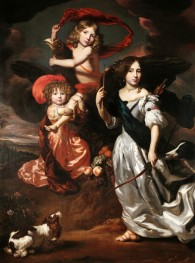
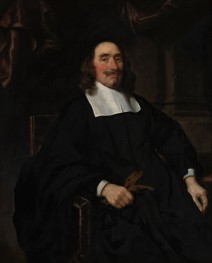
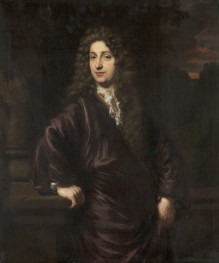
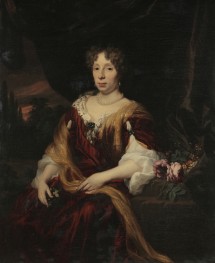
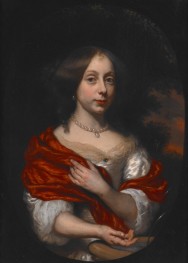
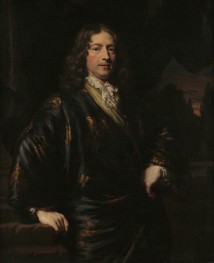
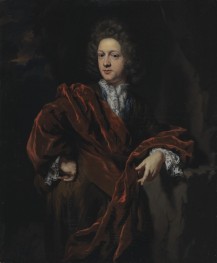
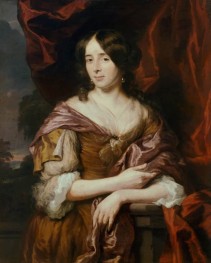
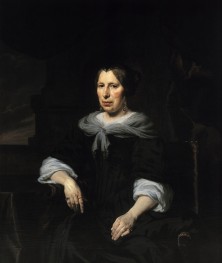
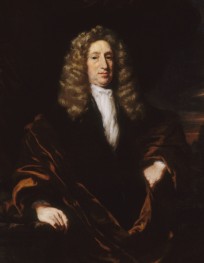
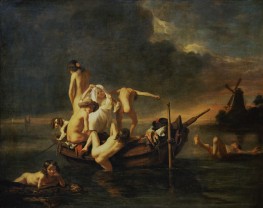
His earlier portraits had been comparatively sober, with sitters simply dressed against dark backgrounds. Gradually, Flemish precedent transformed this austerity. Van Dyck's elegant manner was especially important. Maes began introducing columns, fountains, terraces, landscape backgrounds and more elaborate costume. Gesture became more calculated, fabrics richer and poses increasingly theatrical. During the 1670s, lighter tonalities and freer brushwork entered his pictures, while fashionable gardens and sunset skies replaced the enclosed darkness of his youth.
Success in Dordrecht was substantial. Maes remained there until 1673, paying municipal taxes on capital valued at 3,000 and 4,000 guilders. His position in local society was reinforced by membership of the civic guard, in which he reached the rank of lieutenant. Among the pupils associated with his Dordrecht period were his stepson Justus de Gelder, Margaretha van Godewijk, Jacob Moelaert and Johannes Vollevens.
In 1673 he moved permanently to Amsterdam. The timing was significant. The Rampjaar of 1672, when the Dutch Republic faced invasion and economic disruption, had damaged art markets in several cities, including Dordrecht. Amsterdam nevertheless offered a larger population of prosperous patrons. The recent deaths of Abraham van den Tempel and Bartholomeus van der Helst had also created an opening for a specialist portrait painter. Maes entered that market with extraordinary success.
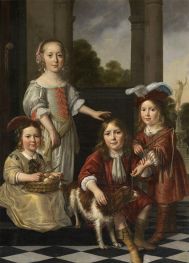
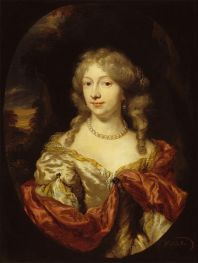
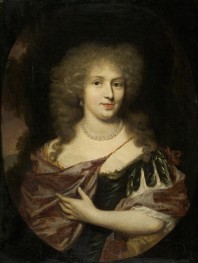
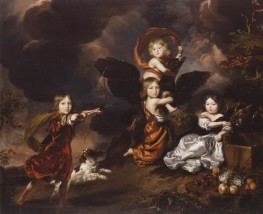
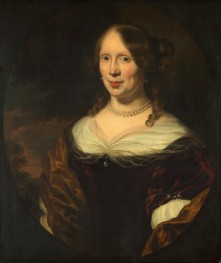
During the 1670s and 1680s he painted hundreds of portraits. Demand became so strong that obtaining a sitting with him was reportedly considered a favour. Two formats recur frequently: the half-length sitter framed within a painted oval, and the larger three-quarter-length portrait in which the figure leans against a column, rock or fountain. Gardens, terraces and open skies supplied an atmosphere of cultivated ease. Children could appear in mythological guise as Ganymede, Apollo or Diana, transforming family portraiture into a form of fashionable allegory.
Yet standardisation did not mean indifference. In his mature portraits, posture, gesture, hairstyle and costume become instruments of social description. They tell us how Amsterdam's prosperous citizens wished to appear - elegant, composed and unmistakably aware of rank. His Six Governors of the Amsterdam Surgeons' Guild of 1680-81, now in the Rijksmuseum, demonstrates that he could also handle the more demanding tradition of the Dutch group portrait.
Curiously, despite living in Amsterdam from 1673, Maes never became a citizen of the city. He did not register with the Amsterdam Guild of Saint Luke until 1688, when municipal authorities required the guild to provide a list of its members. Even then he registered as a resident rather than a burgher. Financially, however, his career had been remarkably secure. At his death his estate included 11,000 guilders in cash, two houses in Dordrecht and three in Amsterdam.
His final years were troubled by gout. Adriana Brouwers died before him and was buried in Amsterdam's Oude Kerk on 14 March 1690. Nicolaes Maes followed three years later and was buried beside her on 24 December 1693.
His reputation rests on two apparently different achievements. The youthful Maes transformed domestic genre painting through psychological observation, moral suggestion and inventive spatial construction; the mature Maes answered the changing tastes of Dutch society with elegant, internationally inflected portraiture. Seen together, these phases reveal not contradiction but adaptability. He understood that painting could describe both private conscience and public identity. That movement from the dimly lit household to the sunlit terrace remains one of the most fascinating transformations in seventeenth-century Dutch art.