
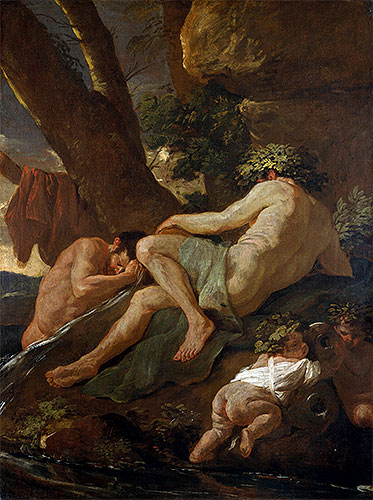
Midas Washing at the Source of the Pactolus, c.1627 Nicolas Poussin (1594-1665)
Location: Metropolitan Museum of Art New York USAOriginal Size: 97.5 x 72.7 cm
Own a museum-quality reproduction of Midas Washing at the Source of the Pactolus by Nicolas Poussin (c.1627), exclusively hand-painted in oils on linen canvas by European artists with academic training. Each masterpiece is created with meticulous craftsmanship, capturing the exceptional quality and authentic brushwork of the original painting.
Oil Painting Reproduction
If you want a different size than the offered
Description
Painted by European Аrtists with Academic Education
Museum Quality
+ 4 cm (1.6") Margins for Stretching
Creation Time: 8-9 Weeks
Creation Process
We create our paintings with museum quality and covering the highest academic standards. Once we get your order, it will be entirely hand-painted with oil on canvas. All the materials we use are the highest level, being totally artist graded painting materials and linen canvas.
We will add 1.6" (4 cm) additional blank canvas all over the painting for stretching.
High quality and detailing in every inch are time consuming. The reproduction of Nicolas Poussin also needs time to dry in order to be completely ready for shipping, as this is crucial to not be damaged during transportation.
Based on the size, level of detail and complexity we need 8-9 weeks to complete the process.
In case the delivery date needs to be extended in time, or we are overloaded with requests, there will be an email sent to you sharing the new timelines of production and delivery.
TOPofART wants to remind you to keep patient, in order to get you the highest quality, being our mission to fulfill your expectations.
We not stretch and frame our oil paintings due to several reasons:
Painting reproduction is a high quality expensive product, which we cannot risk to damage by sending it being stretched.
Also, there are postal restrictions, regarding the size of the shipment.
Additionally, due to the dimensions of the stretched canvas, the shipment price may exceed the price of the product itself.
You can stretch and frame your painting in your local frame-shop.
Delivery
Once the painting Midas Washing at the Source of the Pactolus is ready and dry, it will be shipped to your delivery address. The canvas will be rolled-up in a secure postal tube.
We offer free shipping as well as paid express transportation services.
After adding your artwork to the shopping cart, you will be able to check the delivery price using the Estimate Shipping and Tax tool.
Museum Quality
The paintings we create are only of museum quality. Our academy graduated artists will never allow a compromise in the quality and detail of the ordered painting. TOPofART do not work, and will never allow ourselves to work with low quality studios from the Far East. We are based in Europe, and quality is our highest priority.
Additional Information
The palette is restrained and autumnal—burnished umbers, olive greens, and dulled golds dominate—punctuated by that single shard of red. Poussin bathes flesh and foliage alike in a tawny, crepuscular light, so that bodies and boulders share a common tonality. Gold, the very substance of Midas’s folly, appears only as a subtle glimmer in the ivy leaves and in the warm reflection along the rock face, an irony quietly embedded in the chromatic scheme.
Executed in oil on a modest canvas, the painting still bears traces of the youthful Poussin’s brisk, porous brushwork before his later classicising severity took hold. Skins are modelled with sfumato transitions, yet the tree’s bark and rocky overhang are laid in with a more tactile, almost impasto touch. The water itself is rendered in swift, translucent strokes that catch the light, conveying both liquidity and urgency.
Compositionally, the scene is an object lesson in controlled movement. The diagonal of the stream slices the foreground, mirrored by the opposing slope of the river god’s torso, creating a quiet X that anchors the eye. A serpentine line then loops from the putto’s upraised jug, across the green drapery, and into the crook of Midas’s bent arm, only to rise again into the massive tree trunk—a circuit that keeps the viewer oscillating between human frailty and immutable nature.
Painted soon after Poussin’s arrival in Rome around 1627, the work discloses his studious engagement with antique sculpture and the nascent Baroque’s interest in narrative clarity. Yet its moral undertone—riches transmuted into sterility, hubris tempered by ritual cleansing—speaks equally to Counter‑Reformation concerns with repentance and grace. That such weighty themes are conveyed through a landscape of measured stillness rather than theatrical flourish signals Poussin’s emerging voice: philosophical, restrained, and deeply indebted to classical precedent.
What lingers is the paradox of plenty and privation: gold rendered invisible, salvation found in water, power surrendered to the patient flow of time. The painting invites a slow, almost meditative looking—an apt antidote to Midas’s haste, and perhaps to our own.

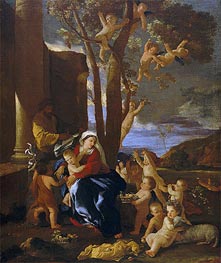
The Rest on the Flight into Egypt c.1627
$3154
$81.47
Nicolas Poussin
Original Size:76.2 x 63.5 cm
Metropolitan Museum of Art, New York, USA
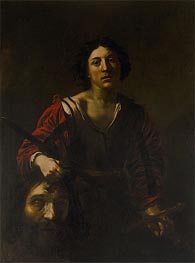
David with the Head of Goliath c.1615/20
$3385
$72.10
Nicolas Poussin
Original Size:132 x 99 cm
Galleria Spada, Rome, Italy
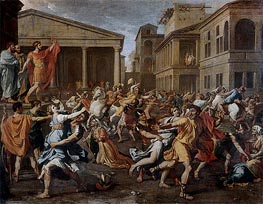
Rape of the Sabine Women c.1637/38
$14922
$75.29
Nicolas Poussin
Original Size:159 x 206 cm
Louvre Museum, Paris, France

Entombment of Christ c.1655/57
$4520
$72.64
Nicolas Poussin
Original Size:94 x 130 cm
National Gallery, Dublin, Ireland

Roman Landscape with Saint Matthew and the Angel c.1639/40
$3094
$70.51
Nicolas Poussin
Original Size:99 x 135 cm
Old Masters Gallery, Berlin, Germany