
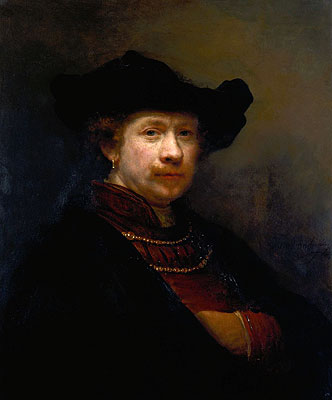
Self Portrait in a Flat Cap, 1642 van Rijn Rembrandt (1606-1669)
Location: The Royal Collection London UKOriginal Size: 70.5 x 57.8 cm
Own a museum-quality reproduction of Self Portrait in a Flat Cap by Rembrandt (1642), exclusively hand-painted in oils on linen canvas by European artists with academic training. Each masterpiece is created with meticulous craftsmanship, capturing the exceptional quality and authentic brushwork of the original painting.
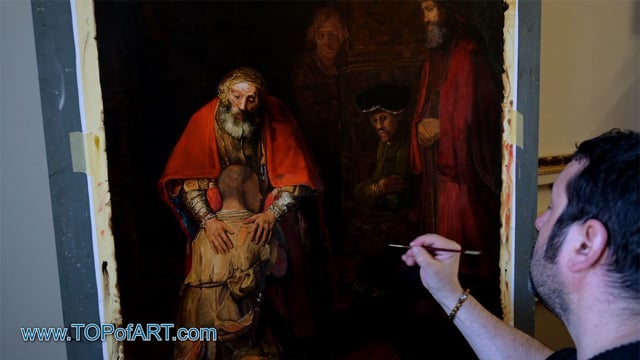
Recreating Rembrandt: A Video Journey into Museum-Quality Reproductions by TOPofART
Video showcasing the process of hand-painting a Rembrandt masterpiece with the utmost precision and care for detail.
Oil Painting Reproduction
If you want a different size than the offered
Description
Painted by European Аrtists with Academic Education
Museum Quality
+ 4 cm (1.6") Margins for Stretching
Creation Time: 8-9 Weeks
Creation Process
We create our paintings with museum quality and covering the highest academic standards. Once we get your order, it will be entirely hand-painted with oil on canvas. All the materials we use are the highest level, being totally artist graded painting materials and linen canvas.
We will add 1.6" (4 cm) additional blank canvas all over the painting for stretching.
High quality and detailing in every inch are time consuming. The reproduction of van Rijn Rembrandt also needs time to dry in order to be completely ready for shipping, as this is crucial to not be damaged during transportation.
Based on the size, level of detail and complexity we need 8-9 weeks to complete the process.
In case the delivery date needs to be extended in time, or we are overloaded with requests, there will be an email sent to you sharing the new timelines of production and delivery.
TOPofART wants to remind you to keep patient, in order to get you the highest quality, being our mission to fulfill your expectations.
We not stretch and frame our oil paintings due to several reasons:
Painting reproduction is a high quality expensive product, which we cannot risk to damage by sending it being stretched.
Also, there are postal restrictions, regarding the size of the shipment.
Additionally, due to the dimensions of the stretched canvas, the shipment price may exceed the price of the product itself.
You can stretch and frame your painting in your local frame-shop.
Delivery
Once the painting Self Portrait in a Flat Cap is ready and dry, it will be shipped to your delivery address. The canvas will be rolled-up in a secure postal tube.
We offer free shipping as well as paid express transportation services.
After adding your artwork to the shopping cart, you will be able to check the delivery price using the Estimate Shipping and Tax tool.
Museum Quality
The paintings we create are only of museum quality. Our academy graduated artists will never allow a compromise in the quality and detail of the ordered painting. TOPofART do not work, and will never allow ourselves to work with low quality studios from the Far East. We are based in Europe, and quality is our highest priority.
Additional Information
The palette is restricted yet resonant: a low-key orchestration of browns, blacks, and dulled reds, pierced by small points of gold and the cool flesh of face and hand. The darkness is not merely background but an active field, from which the head and hands press forward. Colour here is structural; the subdued range binds the figure to his own shadow, while the brighter passages—the cheekbone touched by light, the links of chain, the cuff at the wrist—slowly release the eye from the murk, pacing our encounter.
Brushwork is economical and various. The face is knitted together with short, descriptive strokes, moistly blended at the cheeks yet left rougher at the moustache and hair, conveying texture without fuss. The costume reads differently: broader, more summary handling in the cloak and hat, where deep glazes and scumbled passages swallow detail. Paint is both skin and substance; Rembrandt’s habitual probing of surface, the alternation between opacity and translucency, grants the image a living instability, as if decisions are still being made in the pigment.
Compositionally, the figure is anchored low and right, leaving an expanse of breathable dusk above and to the left. The diagonals formed by the arms and chains counter the horizontal sweep of the hat, creating a silent choreography of curves and bars that stabilises the frontal gaze. The triangle of illuminated face, hand, and chain forms the key visual chord; everything else is modulation and echo. The eye moves from face to hand, then up along the chain to the head again, a contained circuit that mirrors the artist’s self-scrutiny.
Historically, this is a moment of assurance. At thirty-six, before bankruptcy and bereavements recalibrated his self-scrutiny, the painter shows himself poised, self-possessed, even slightly affable. The antiquated costume—sixteenth-century bonnet, honorary-looking chains—places him purposefully outside contemporary fashion, a timeless actor in his own drama of identity. That he never received such chains matters less than the imaginative claim they make: status assumed, not bestowed. The panel’s technical history—earlier image beneath, later overpaint, misattribution undone by infrared evidence—echoes the artist’s own layered self, reworked over time.
The picture sits within a long serial meditation: some forty painted self-images, dozens of prints and drawings, each marking a station in the artist’s life. Here, clarity outweighs pathos. Yet the unflinching habit of looking—at ageing skin as carefully as at velvet or pearl—already underwrites the enterprise. The result is neither vanity nor confession, but a sustained inquiry into how paint can hold a human presence steady, for a moment, against the encroaching dark.


The Adoration of the Magi c.1657
$2946
$63.91
van Rijn Rembrandt
Original Size:122.6 x 104.1 cm
The Royal Collection, London, UK
A Rabbi with a Cap c.1635
$1460
$63.91
van Rijn Rembrandt
Original Size:72.5 x 62 cm
The Royal Collection, London, UK
A Man in Armour 1655
$1729
$73.44
van Rijn Rembrandt
Original Size:137.5 x 104.4 cm
Kelvingrove Art Gallery and Museum, Glasgow, UK
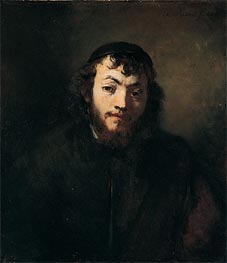
Bust of a Young Jew n.d.
$1320
$83.65
van Rijn Rembrandt
Original Size:65.8 x 57.5 cm
Kimbell Art Museum, Fort Worth, USA
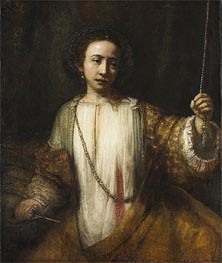
Lucretia 1666
$2192
$80.48
van Rijn Rembrandt
Original Size:110.2 x 92.3 cm
Minneapolis Institute of Arts, Minnesota, USA