
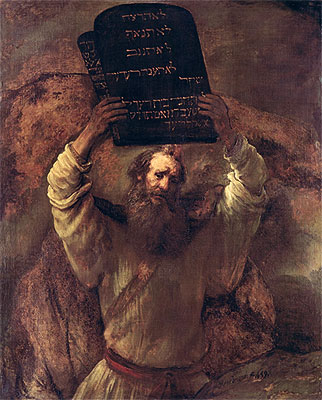
Moses Smashing the Tablets of the Law, 1659 van Rijn Rembrandt (1606-1669)
Location: Alte Nationalgalerie Berlin GermanyOriginal Size: 168.5 x 136.5 cm
Own a museum-quality reproduction of Moses Smashing the Tablets of the Law by Rembrandt (1659), exclusively hand-painted in oils on linen canvas by European artists with academic training. Each masterpiece is created with meticulous craftsmanship, capturing the exceptional quality and authentic brushwork of the original painting.
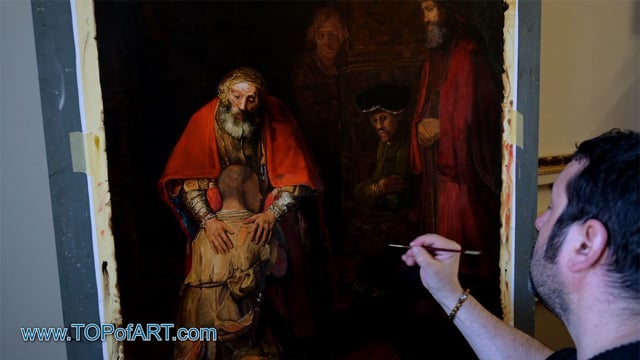
Recreating Rembrandt: A Video Journey into Museum-Quality Reproductions by TOPofART
Video showcasing the process of hand-painting a Rembrandt masterpiece with the utmost precision and care for detail.
Oil Painting Reproduction
If you want a different size than the offered
Description
Painted by European Аrtists with Academic Education
Museum Quality
+ 4 cm (1.6") Margins for Stretching
Creation Time: 8-9 Weeks
Creation Process
We create our paintings with museum quality and covering the highest academic standards. Once we get your order, it will be entirely hand-painted with oil on canvas. All the materials we use are the highest level, being totally artist graded painting materials and linen canvas.
We will add 1.6" (4 cm) additional blank canvas all over the painting for stretching.
High quality and detailing in every inch are time consuming. The reproduction of van Rijn Rembrandt also needs time to dry in order to be completely ready for shipping, as this is crucial to not be damaged during transportation.
Based on the size, level of detail and complexity we need 8-9 weeks to complete the process.
In case the delivery date needs to be extended in time, or we are overloaded with requests, there will be an email sent to you sharing the new timelines of production and delivery.
TOPofART wants to remind you to keep patient, in order to get you the highest quality, being our mission to fulfill your expectations.
We not stretch and frame our oil paintings due to several reasons:
Painting reproduction is a high quality expensive product, which we cannot risk to damage by sending it being stretched.
Also, there are postal restrictions, regarding the size of the shipment.
Additionally, due to the dimensions of the stretched canvas, the shipment price may exceed the price of the product itself.
You can stretch and frame your painting in your local frame-shop.
Delivery
Once the painting Moses Smashing the Tablets of the Law is ready and dry, it will be shipped to your delivery address. The canvas will be rolled-up in a secure postal tube.
We offer free shipping as well as paid express transportation services.
After adding your artwork to the shopping cart, you will be able to check the delivery price using the Estimate Shipping and Tax tool.
Museum Quality
The paintings we create are only of museum quality. Our academy graduated artists will never allow a compromise in the quality and detail of the ordered painting. TOPofART do not work, and will never allow ourselves to work with low quality studios from the Far East. We are based in Europe, and quality is our highest priority.
Additional Information
Although time and varnish have subdued the original pigmentation, the chromatic strategy remains intelligible. Earthy umbers and siennas gather in the rocky setting, while the robe, once reputedly a deep Tyrian purple, now registers as muted ash. Into this restrained register Rembrandt releases a shaft of ochre light that grazes forehead, beard and the underside of the tablets, fostering an interior radiance rather than theatrical glare. The colour economy, austere yet warm, steeps the scene in moral gravitas, inviting contemplation rather than spectacle.
Brushwork is deployed with discriminating variety. The linen sleeve is handled in swift, opaque strokes that suggest both the weight of fabric and the impulsive torsion of the gesture, whereas the tablets receive a slower, denser application, their Hebrew inscriptions incised with scholarly precision. Across the weathered rocks the pigment is scrubbed and dragged, leaving exposed ground to sparkle like mica—an optical counterpart to the narrative chafing between sacred law and earthly disobedience.
Compositionally, the arms describe an emphatic V that directs the gaze upward to the tablets, yet the downward tilt of Moses’ head, heavy with apprehension, reinscribes the drama as inward as much as public. The viewpoint from below magnifies the prophet to monumental scale while trapping him within the picture plane, a solitary mediator pressed between fury and compassion. Light emanating from the upper left locks the figure into a diagonal that counterbalances the vertical thrust of the tablets, knitting the design into a taut, expressive scaffold.
Painted in the late 1650s, this work belongs to Rembrandt’s final, introspective decade, when financial ruin and personal loss sharpened his preoccupation with the limits of human agency. His close contact with Amsterdam’s Jewish community is palpable in the near‑faultless Hebrew script. Yet the ultimate gravity of the scene lies not in philological accuracy but in the painter’s capacity to translate scriptural narrative into a meditation on the solitary burden of conscience.


The Apostle Paul in Prison 1627
$2188
$79.01
van Rijn Rembrandt
Original Size:72.8 x 60.3 cm
Staatsgalerie, Stuttgart, Germany
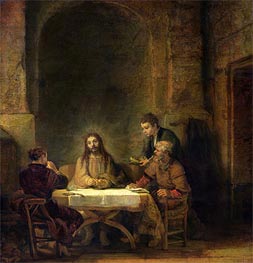
The Supper at Emmaus 1648
$2165
$92.02
van Rijn Rembrandt
Original Size:68 x 65 cm
Louvre Museum, Paris, France

The Rape of Europe n.d.
$3074
$123.73
van Rijn Rembrandt
Original Size:60 x 77.5 cm
Metropolitan Museum of Art, New York, USA
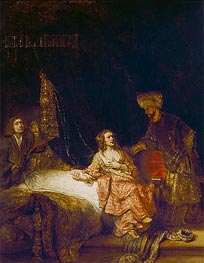
Joseph Accused by Potiphar's Wife 1655
$2913
$75.53
van Rijn Rembrandt
Original Size:113.5 x 90 cm
Alte Nationalgalerie, Berlin, Germany
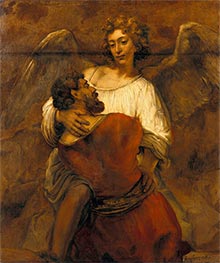
Jacob Wrestling with the Angel c.1659/60
$1574
$80.04
van Rijn Rembrandt
Original Size:137 x 116 cm
Alte Nationalgalerie, Berlin, Germany