
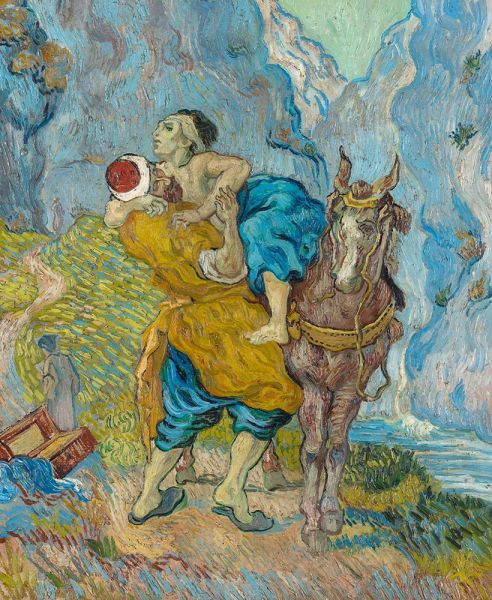
The Good Samaritan (after Delacroix), 1890 Vincent van Gogh (1853-1890)
Location: Kröller-Müller Museum Otterlo NetherlandsOriginal Size: 73 x 59.5 cm
Own a museum-quality reproduction of The Good Samaritan (after Delacroix) by Vincent van Gogh (1890), exclusively hand-painted in oils on linen canvas by European artists with academic training. Each masterpiece is created with meticulous craftsmanship, capturing the exceptional quality and authentic brushwork of the original painting.
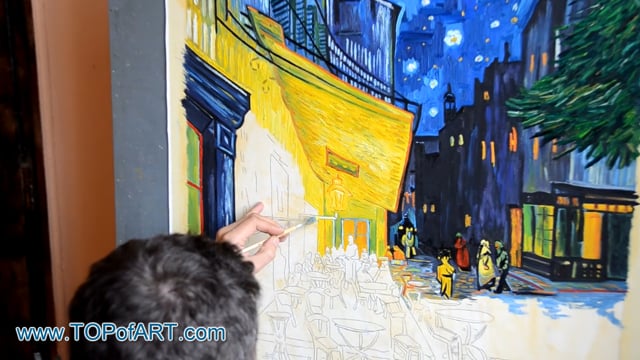
Recreating Vincent van Gogh: A Video Journey into Museum-Quality Reproductions by TOPofART
Video showcasing the process of hand-painting a Vincent van Gogh masterpiece with the utmost precision and care for detail.
Oil Painting Reproduction
If you want a different size than the offered
Description
Painted by European Аrtists with Academic Education
Museum Quality
+ 4 cm (1.6") Margins for Stretching
Creation Time: 8-9 Weeks
Creation Process
We create our paintings with museum quality and covering the highest academic standards. Once we get your order, it will be entirely hand-painted with oil on canvas. All the materials we use are the highest level, being totally artist graded painting materials and linen canvas.
We will add 1.6" (4 cm) additional blank canvas all over the painting for stretching.
High quality and detailing in every inch are time consuming. The reproduction of Vincent van Gogh also needs time to dry in order to be completely ready for shipping, as this is crucial to not be damaged during transportation.
Based on the size, level of detail and complexity we need 8-9 weeks to complete the process.
In case the delivery date needs to be extended in time, or we are overloaded with requests, there will be an email sent to you sharing the new timelines of production and delivery.
TOPofART wants to remind you to keep patient, in order to get you the highest quality, being our mission to fulfill your expectations.
We not stretch and frame our oil paintings due to several reasons:
Painting reproduction is a high quality expensive product, which we cannot risk to damage by sending it being stretched.
Also, there are postal restrictions, regarding the size of the shipment.
Additionally, due to the dimensions of the stretched canvas, the shipment price may exceed the price of the product itself.
You can stretch and frame your painting in your local frame-shop.
Delivery
Once the painting The Good Samaritan (after Delacroix) is ready and dry, it will be shipped to your delivery address. The canvas will be rolled-up in a secure postal tube.
We offer free shipping as well as paid express transportation services.
After adding your artwork to the shopping cart, you will be able to check the delivery price using the Estimate Shipping and Tax tool.
Museum Quality
The paintings we create are only of museum quality. Our academy graduated artists will never allow a compromise in the quality and detail of the ordered painting. TOPofART do not work, and will never allow ourselves to work with low quality studios from the Far East. We are based in Europe, and quality is our highest priority.
Additional Information
The palette is a crucible of complementary contrasts. Citrine yellows flare against lapis and viridian, and the single note of arterial red punctures the composition like an alarm. Rather than modelling form through chiaroscuro, Van Gogh orchestrates fields of vibrating colour, each laid with dense, undulating strokes. Pigment is handled so thickly that light seems to pool in the ridges, giving the surface a tactile insistence that thrusts the drama outward toward the viewer.
Such brushwork is never arbitrary: every directional gouge of the loaded brush describes structure and emotion simultaneously. The vertical thrust of Samaritan and horse is braced by the diagonal ravine, drawing the eye upward before releasing it into the swirling vault of sky. The serpentine path on the left, rendered in staccato dashes of citron and olive, acts as a narrative trace, guiding us from the abandoned traveller, through abandonment, to rescue. Depth is compressed, the picture plane tilting forward, intensifying immediacy.
Painted in 1890, the year of the artist’s death, the canvas is a translation rather than a copy of Delacroix’s engraving. Working from a monochrome print, Van Gogh re‑imagines the scene as an essay on chromatic compassion, acknowledging his mentor’s doctrine that colour alone can carry sentiment. The blue‑violet–yellow and red‑green dyads echo Delacroix’s theories, yet the rough muscularity of the brush belongs solely to the Dutchman. The theme of mercy is autobiographical: convalescing after a breakdown, he may have found in the Samaritan an emblem of his brother Theo’s sustaining loyalty.
What finally compels is the painting’s oscillation between frenzy and tenderness. The same strokes that churn the cliff faces cradle flesh; violence and care inhabit a single gesture. In collapsing narrative, feeling, and material into a single restless surface, Van Gogh achieves a vision both intimate and monumental, reminding us that empathy is an act as physical, and as urgent, as paint itself.

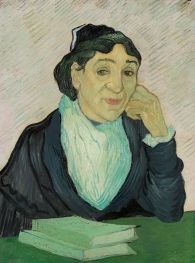
L'Arlésienne (Portrait of Madame Ginoux) 1890
$757
$71.96
Vincent van Gogh
Original Size:65.3 x 49 cm
Kröller-Müller Museum, Otterlo, Netherlands
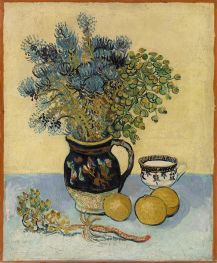
Still Life 1888
$1018
$81.28
Vincent van Gogh
Original Size:55 x 46.2 cm
Barnes Foundation, Merion, USA
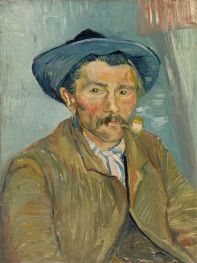
The Smoker 1888
$1033
$72.66
Vincent van Gogh
Original Size:63 x 47.6 cm
Barnes Foundation, Merion, USA
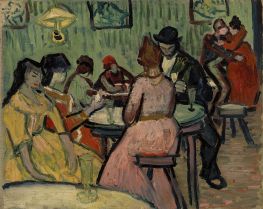
The Brothel 1888
$704
$63.85
Vincent van Gogh
Original Size:33 x 41 cm
Barnes Foundation, Merion, USA

The Ward in the Hospital at Arles 1889
$1209
$75.48
Vincent van Gogh
Original Size:72 x 91 cm
Oskar Reinhart Museum, Winterthur, Switzerland