
Portrait Painting Reproductions - Page 147
Portrait painting is a genre centered on the representation of a particular person or identifiable group, using likeness, pose, expression, and setting to shape an image of identity. A portrait can commemorate a life, preserve a personal attachment, assert authority, or establish a public reputation. The finished image reflects both the sitter’s presentation and the painter’s decisions about what to emphasize, simplify, or leave unexplained.
Scale and format establish different relationships with the viewer. A miniature invites close, private looking; a life-size, full-length portrait can give its subject a commanding presence. Head-and-shoulders and half-length formats concentrate attention on the face and hands, while double and group portraits introduce relationships between sitters. Profile, frontal, and three-quarter views offer different degrees of visual engagement. Clothing, gesture, and surrounding objects may identify a profession or social position, while the direction of the gaze makes the sitter seem attentive to the viewer or absorbed elsewhere.
The mummy portraits of Roman Egypt, dating mainly from the first to third centuries CE, are major survivals of ancient portrait painting. These likenesses were incorporated into mummy wrappings as part of funerary ritual. In China, ancestor portraits served family ceremonies and the remembrance of previous generations. Mughal court painters in South Asia cultivated precise likenesses of rulers and courtiers, often preserved in albums. Such traditions gave portraiture functions extending beyond the display of an individual face, connecting the image with ritual, ancestry, and political authority.
In 15th-century Europe, independent portraits flourished alongside images of donors in religious paintings. Jan van Eyck and Rogier van der Weyden gave individual features close attention through subtle distinctions of light and contour. Italian profile portraits drew on the authority of ancient coins and medals, while three-quarter views offered a fuller sense of bodily presence. Leonardo da Vinci’s “Mona Lisa” (c. 1503-1519, Musée du Louvre, Paris) combines a turned body, folded hands, and a distant landscape. Soft transitions of tone, known as sfumato, make the contours elusive and the expression difficult to fix.
A portrait could also make learning, wealth, and political connections visible. Hans Holbein the Younger’s “The Ambassadors” (1533, National Gallery, London) presents Jean de Dinteville and Georges de Selve beside an assembly of books, globes, and instruments. Their clothing and possessions establish social standing with extraordinary material precision. The distorted skull crossing the foreground becomes recognizable from an oblique angle, introducing a reminder of mortality into this display of worldly distinction. The two figures occupy a setting whose objects contribute substantially to their representation.
In the 17th century, court portraiture developed increasingly elaborate ways to express rank. Anthony van Dyck gave aristocratic sitters elegant poses, expansive settings, and gestures that made privilege appear effortless. Diego Velázquez achieved a different balance between ceremonial presentation and the particular presence of an individual, often using restrained backgrounds and economical brushwork. Full-length and equestrian formats allowed posture, costume, and scale to carry the language of authority. The placement of a hand or the angle of a body could be as significant as an insignia of office.
Dutch group portraiture gave civic and professional associations a collective public image. Frans Hals animated groups through varied gestures and lively exchanges of attention. Rembrandt’s “The Anatomy Lesson of Dr. Nicolaes Tulp” (1632, Mauritshuis, The Hague) organizes the portrayed men around a demonstration, turning their assembly into a scene of shared activity. Faces, hands, and glances create a sequence through the composition. Each participant remains distinguishable, yet the arrangement establishes relationships of knowledge, observation, and authority that extend beyond a row of separate likenesses.
Self-portraiture gave artists a further role as the makers of their own public image. Albrecht Dürer used dress and bearing to assert artistic standing; Rembrandt returned to his features through changing expressions, costumes, and age. Élisabeth Louise Vigée Le Brun’s “Self Portrait in a Straw Hat” (1782, National Gallery, London) combines direct eye contact with a visible palette and brushes. The shaded face, rose-colored dress, and open sky create an air of ease, while the tools establish her professional identity. The painter controls both the making of the image and the manner of her appearance within it.
In 18th-century Britain, Joshua Reynolds often borrowed the gravity of history painting for his sitters, while Thomas Gainsborough developed fluid brushwork and close relationships between figure and landscape. During the 19th century, official commissions coexisted with intimate studies of friends and family. Jean-Auguste-Dominique Ingres combined exacting drawing with adjusted proportions and meticulous descriptions of clothing. The growth of photography introduced new ways to circulate likenesses and provided painters with additional visual sources, expanding the exchanges between different forms of portraiture.
The public life of a portrait could be unpredictable. John Singer Sargent’s “Madame X” (1883-1884, The Metropolitan Museum of Art, New York) depicts Virginie Amélie Avegno Gautreau through a striking contrast between pale skin and a black dress. Her turned head and braced arm give the standing figure a deliberate tension. Sargent undertook the painting without a commission, with Gautreau’s cooperation. After its hostile reception at the Paris Salon of 1884, he repainted the shoulder strap that had originally slipped down her arm, placing it securely on her shoulder.
In the 20th century, the face became a field for experiments in color and structure. Henri Matisse used unexpected hues to organize features, and Pablo Picasso fractured or recombined familiar facial forms. Frida Kahlo made self-portraiture a setting for personal and cultural symbols; Lucian Freud investigated the sitter’s physical presence through sustained observation and dense paint. A tense hand, a tilted head, or the weight of a seated body could carry as much expressive force as the features of the face.
page 147 of 202


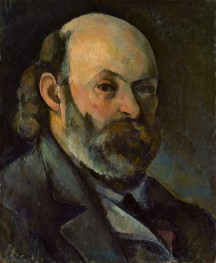


SKU: CEZ-7210
Paul Cézanne
Original Size: 55.5 x 45.5 cm
State Hermitage Museum, St. Petersburg, Russia
Paul Cézanne
Original Size: 55.5 x 45.5 cm
State Hermitage Museum, St. Petersburg, Russia

SKU: CEZ-7209
Paul Cézanne
Original Size: 53 x 39.7 cm
State Hermitage Museum, St. Petersburg, Russia
Paul Cézanne
Original Size: 53 x 39.7 cm
State Hermitage Museum, St. Petersburg, Russia


