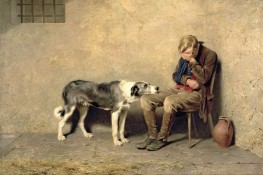
Briton Rivière (1840-1920) was a British painter best known for animal subjects, ranging from domestic dogs to lions in scenes drawn from literature and religious history. He was born in London and came from a family of Huguenot ancestry whose members included several artists.
His father, William Rivière, taught drawing at Cheltenham College and later taught art at Oxford. He also provided nearly all his son’s artistic instruction. Rivière attended Cheltenham College before continuing his education at Oxford; his uncle Henry Parsons Rivière was a watercolor painter. His earliest exhibition appearances were at the British Institution. In 1857, while still a teenager, he had three paintings accepted for the Royal Academy exhibition. He also found work as an illustrator, contributing to the satirical magazine Punch.
The direction of his painting was not yet settled. Between 1860 and 1863, his future brother-in-law Clarence Dobell encouraged his interest in the Pre-Raphaelites, but the Academy rejected his Elaine on the Barge and Hamlet and Ophelia. Rivière began exhibiting there regularly in 1863, initially with historical and literary subjects. Sleeping Deerhound, shown in 1865, marked a turn toward the animals that would dominate his work.
In 1867 he completed his Oxford degree and married Mary Alice Dobell, herself a painter who subsequently exhibited at the Royal Academy. They lived in Keston and Bromley before settling in London in 1871. The couple had seven children, including Hugh Goldwin Rivière, who became a portrait painter. Within his London circle were the Scottish painters William Quiller Orchardson and John Pettie.
Rivière often made the relationship between people and animals the center of a picture. Sympathy, dating from about 1878, places a dog beside a young girl seated on a staircase. In Requiescat of 1888, a dog accompanies the body of a knight laid out in armor. These intimate encounters formed only part of his range: he also tackled mythological subjects, including Prometheus in 1889.
Behind the animal paintings lay an exacting routine of observation. In an interview for Chums Boys Annual, Rivière explained that he needed an experienced animal handler when working with a dog. He found collies, greyhounds, and fox terriers particularly restless. Although he loved dogs, he admitted that painting them so often had made him weary of their constant presence. For wild animals, he accumulated studies and anatomical knowledge before attempting a finished picture. He worked from living and dead specimens, kept a lioness’s body in his studio, and studied in the dissection rooms of the London Zoological Gardens.
Professional recognition brought election first as an associate and then as a full member of the Royal Academy. Oxford awarded him an honorary doctorate in civil law in 1891. Five years later, following the death of John Everett Millais, Rivière narrowly lost the election for the Academy’s presidency.
Rivière died in 1920. After his death, his widow donated four drawings and an etching to the British Museum, whose collection also includes numerous reproductive prints after his paintings. Sympathy is at Royal Holloway, University of London, and Requiescat belongs to the Art Gallery of New South Wales in Sydney. His work is also represented in the Tate and the Metropolitan Museum of Art.