
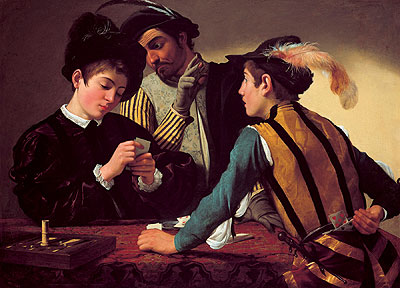
The Cardsharps (I Bari), c.1595/96 Michelangelo Merisi da Caravaggio (1571-1610)
Location: Kimbell Art Museum Fort Worth USAOriginal Size: 90 x 112 cm
Own a museum-quality reproduction of The Cardsharps (I Bari) by Caravaggio (c.1595/96), exclusively hand-painted in oils on linen canvas by European artists with academic training. Each masterpiece is created with meticulous craftsmanship, capturing the exceptional quality and authentic brushwork of the original painting.
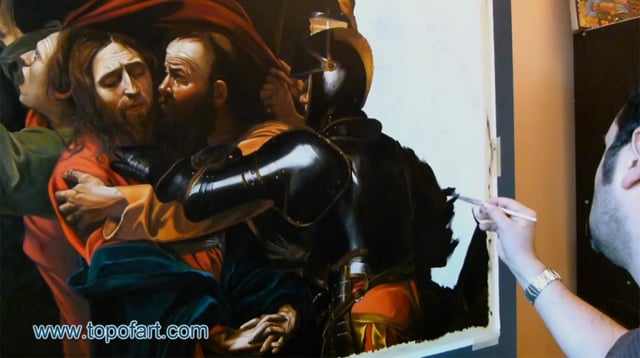
Recreating Caravaggio: A Video Journey into Museum-Quality Reproductions by TOPofART
Video showcasing the process of hand-painting a Caravaggio masterpiece with the utmost precision and care for detail.
Oil Painting Reproduction
If you want a different size than the offered
Description
Painted by European Аrtists with Academic Education
Museum Quality
+ 4 cm (1.6") Margins for Stretching
Creation Time: 8-9 Weeks
Creation Process
We create our paintings with museum quality and covering the highest academic standards. Once we get your order, it will be entirely hand-painted with oil on canvas. All the materials we use are the highest level, being totally artist graded painting materials and linen canvas.
We will add 1.6" (4 cm) additional blank canvas all over the painting for stretching.
High quality and detailing in every inch are time consuming. The reproduction of Michelangelo Merisi da Caravaggio also needs time to dry in order to be completely ready for shipping, as this is crucial to not be damaged during transportation.
Based on the size, level of detail and complexity we need 8-9 weeks to complete the process.
In case the delivery date needs to be extended in time, or we are overloaded with requests, there will be an email sent to you sharing the new timelines of production and delivery.
TOPofART wants to remind you to keep patient, in order to get you the highest quality, being our mission to fulfill your expectations.
We not stretch and frame our oil paintings due to several reasons:
Painting reproduction is a high quality expensive product, which we cannot risk to damage by sending it being stretched.
Also, there are postal restrictions, regarding the size of the shipment.
Additionally, due to the dimensions of the stretched canvas, the shipment price may exceed the price of the product itself.
You can stretch and frame your painting in your local frame-shop.
Delivery
Once the painting The Cardsharps (I Bari) is ready and dry, it will be shipped to your delivery address. The canvas will be rolled-up in a secure postal tube.
We offer free shipping as well as paid express transportation services.
After adding your artwork to the shopping cart, you will be able to check the delivery price using the Estimate Shipping and Tax tool.
Museum Quality
The paintings we create are only of museum quality. Our academy graduated artists will never allow a compromise in the quality and detail of the ordered painting. TOPofART do not work, and will never allow ourselves to work with low quality studios from the Far East. We are based in Europe, and quality is our highest priority.
Additional Information
Color orchestrates the moral temperature. The young victim’s deep claret clothing, nearly swallowing illumination, sets a register of inwardness; across the table, the cheat’s parti-colored costume—sulfur yellow, black bands, a slash of carmine girdle—announces theatricality and risk. The central figure’s striped sleeve mediates, knitting the chromatic extremes while his muted olive glove cools the temperature of deceit. Flesh notes, carefully modulated from pearly youth to weathered adult, carry psychological gradation. Accents—the pink and cream feathers, the bright card edge, the pale laces—punctuate the subdued ground, focusing vision where narrative hinges.
Caravaggio’s handling here, from the mid-1590s, is comparatively tight, before the later bravura swarths of loaded pigment. Surfaces are built with controlled layering: thin, absorbent darks; small, higher-key strokes catching rims of lace or the grain of kid leather; wet-in-wet transitions in faces that sustain an uncanny immediacy. Illusion depends less on minute description than on calibrated contrasts of value and texture—the bloom of youth set against worn glove, the nap of velvet against polished tabletop. Light is neither generalized nor symbolic but directional, raking across forms to isolate clues, as a stage director might freeze action in a spot.
Compositionally the painting is a lesson in triangulated deceit. The three heads form a shallow arc, yet the true vectors are the hands: from the boy’s cards to the gloved signal to the hidden card, a covert loop bypassing the innocent player. Caravaggio compresses depth; shoulders overlap, cropping pulls figures forward, denying us the comfortable detachment of spectatorship. We become, uncomfortably, potential witnesses—or marks. The table edge is the proscenium, and we stand in the pit.
Rome in the 1590s offered a market for lively, contemporary subjects; gaming, fortune-telling, and low-life encounters circulated among collectors alert to novelty. Newly arrived from Milan, the young painter used such scenes to demonstrate an unvarnished naturalism and a capacity for psychological narrative that differed from the idealized manners still influential in late Mannerism. This painting quickly attracted the attention of Cardinal Francesco Maria del Monte, who acquired it and drew the artist into a patronage network that would lead to major ecclesiastical commissions and to the broader dissemination of his radically observed art.
The treatment of fraud and credulity here proved fertile. Variants and thematic descendants spread through European collections; one thinks of later French interpretations, including Georges de La Tour’s exploration of cheating at cards. Yet what remains distinctive is the refusal to moralize overtly. Instead the painter offers an episode—observed, finely calibrated, morally ambiguous—in which human vulnerability is neither ridiculed nor excused, merely exposed under an unforgiving light.

The Musicians (Concert) c.1594/95
$4939
$73.71
Michelangelo Merisi da Caravaggio
Original Size:92.1 x 118.4 cm
Metropolitan Museum of Art, New York, USA
The Rest on the Flight into Egypt c.1595
$5796
$129.91
Michelangelo Merisi da Caravaggio
Original Size:135.5 x 166.5 cm
Galleria Doria Pamphilj, Rome, Italy
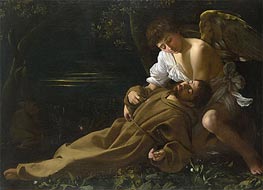
Saint Francis of Assisi in Ecstasy c.1594/95
$3041
$69.85
Michelangelo Merisi da Caravaggio
Original Size:93.9 x 129.5 cm
Wadsworth Atheneum, Hartford, USA
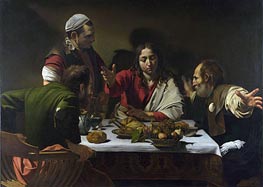
The Supper at Emmaus 1601
$6005
$114.46
Michelangelo Merisi da Caravaggio
Original Size:141 x 196.2 cm
National Gallery, London, UK
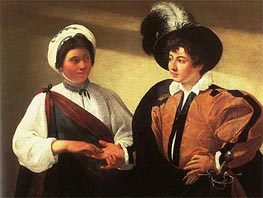
The Fortune Teller (La Zingara) c.1596/97
$3980
$70.36
Michelangelo Merisi da Caravaggio
Original Size:99 x 131 cm
Louvre Museum, Paris, France