
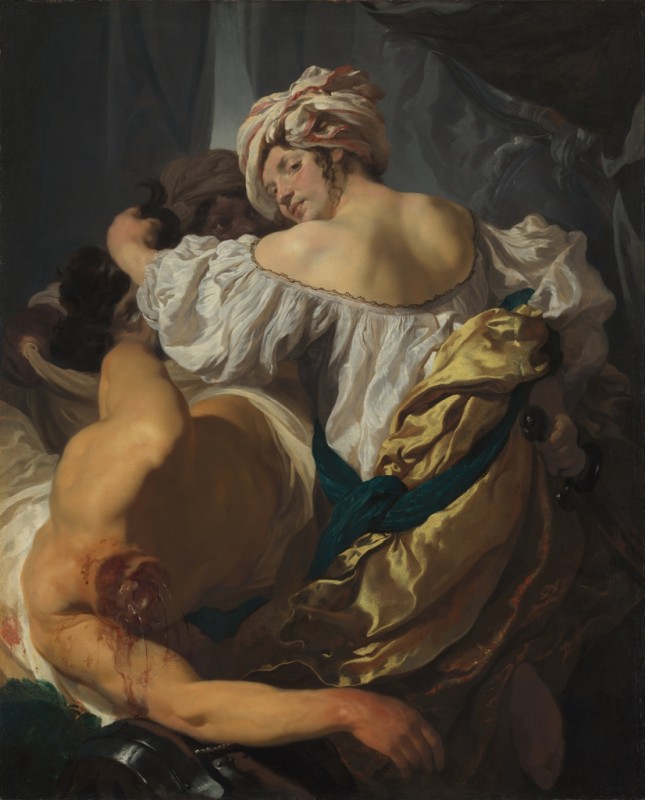
Judith in the Tent of Holofernes, 1620s Johann Liss (c.1597-c.1630/31)
Location: National Gallery London UKOriginal Size: 128.5 x 99 cm
Own a museum-quality reproduction of Judith in the Tent of Holofernes by Johann Liss (1620s), exclusively hand-painted in oils on linen canvas by European artists with academic training. Each masterpiece is created with meticulous craftsmanship, capturing the exceptional quality and authentic brushwork of the original painting.
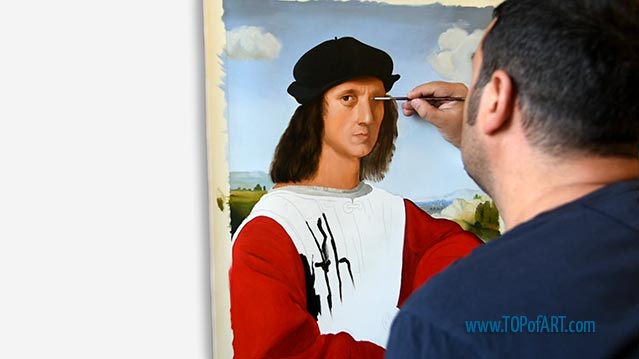
Oil Painting Reproduction
If you want a different size than the offered
Description
Painted by European Аrtists with Academic Education
Museum Quality
+ 4 cm (1.6") Margins for Stretching
Creation Time: 8-9 Weeks
Creation Process
We create our paintings with museum quality and covering the highest academic standards. Once we get your order, it will be entirely hand-painted with oil on canvas. All the materials we use are the highest level, being totally artist graded painting materials and linen canvas.
We will add 1.6" (4 cm) additional blank canvas all over the painting for stretching.
High quality and detailing in every inch are time consuming. The reproduction of Johann Liss also needs time to dry in order to be completely ready for shipping, as this is crucial to not be damaged during transportation.
Based on the size, level of detail and complexity we need 8-9 weeks to complete the process.
In case the delivery date needs to be extended in time, or we are overloaded with requests, there will be an email sent to you sharing the new timelines of production and delivery.
TOPofART wants to remind you to keep patient, in order to get you the highest quality, being our mission to fulfill your expectations.
We not stretch and frame our oil paintings due to several reasons:
Painting reproduction is a high quality expensive product, which we cannot risk to damage by sending it being stretched.
Also, there are postal restrictions, regarding the size of the shipment.
Additionally, due to the dimensions of the stretched canvas, the shipment price may exceed the price of the product itself.
You can stretch and frame your painting in your local frame-shop.
Delivery
Once the painting Judith in the Tent of Holofernes is ready and dry, it will be shipped to your delivery address. The canvas will be rolled-up in a secure postal tube.
We offer free shipping as well as paid express transportation services.
After adding your artwork to the shopping cart, you will be able to check the delivery price using the Estimate Shipping and Tax tool.
Museum Quality
The paintings we create are only of museum quality. Our academy graduated artists will never allow a compromise in the quality and detail of the ordered painting. TOPofART do not work, and will never allow ourselves to work with low quality studios from the Far East. We are based in Europe, and quality is our highest priority.
Additional Information
Turn to the turban and the painting becomes suddenly intimate: red strokes run through cream folds like a private echo of the blood below, while one small curl hangs damply against her neck. Her face is flushed, not prettified. One might imagine the heat inside this tent, the sour aftermath of wine, sweat, and fear. Johann Liss gives Judith neither saintly distance nor simple seductiveness. She has used the expectations placed on her body, and now that body is tired, uncovered, triumphant.
Blood is not an accessory. It pours from the ruined neck in glossy, dark ribbons, thick enough to catch the light; near the sack, a small pale glint from Holofernes’ upturned eye chills the scene. His torso, yellowed by the lamp-like illumination, is set against Judith’s buoyant sleeves, whose swelling folds mimic muscle while defeating it. At the bottom edge, the black metal of armour has a cold, hard shine, almost absurdly useless now. Liss paints cloth as if it had nerves: the white sleeve is dragged and loaded, the gold satin is slick and crumpled, the deep teal sash cuts across the body like a held breath.
Around this knot of limbs, Johann Liss builds a circular current. Up Judith’s curving back, across the three heads, down to the wound, along Holofernes’ slack arm, and back again, the story loops rather than settles. Caravaggio is near, of course, in the dramatic chiaroscuro and the refusal to tidy the horror; Artemisia Gentileschi’s Judith pictures haunt the subject too, though Liss is less about clenched force than about the strange, theatrical pause after force. That pause is his great invention. Beauty is not cancelled by gore here, and gore is not softened by beauty. Each makes the other more troubling.
For a seventeenth-century viewer, Judith’s chastity would have mattered to the righteousness of the deed. For us, perhaps, the sharper point lies elsewhere: she turns from the corpse with the look of someone who has done what history demanded, and must still get out of the room. The air feels heavy. No trumpet sounds.

The Fall of Phaeton c.1620/25
$3252
$79.98
Johann Liss
Original Size:126.5 x 110.3 cm
National Gallery, London, UK
The Satyr and the Peasant c.1623/26
$3217
$74.87
Johann Liss
Original Size:133.3 x 167.4 cm
National Gallery of Art, Washington, USA
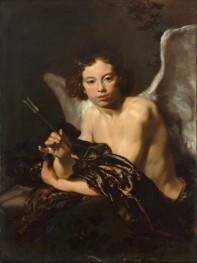
Cupid (Amor) c. 1630
$2538
$70.26
Johann Liss
Original Size:87.7 x 65.7 cm
Cleveland Museum of Art, Ohio, USA
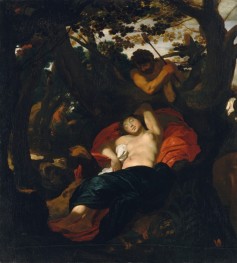
Nymph and Shepherd 1625
$3269
$84.76
Johann Liss
Original Size:104.5 x 94.9 cm
Metropolitan Museum of Art, New York, USA
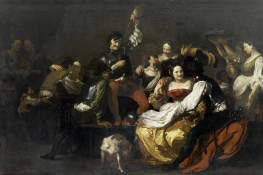
The Prodigal Son with the Prostitutes c.1622/23
$7628
$62.59
Johann Liss
Original Size:160.5 x 240 cm
Germanisches Nationalmuseum, Nuremberg, Germany