
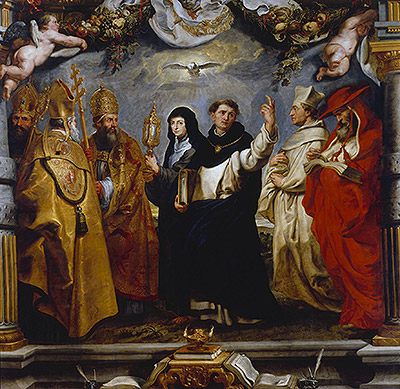
The Defenders of the Eucharist, c.1625 Peter Paul Rubens (1577-1640)
Location: John & Mable Ringling Museum of Art Florida USAOriginal Size: 434.3 x 444.5 cm
Own a museum-quality reproduction of The Defenders of the Eucharist by Rubens (c.1625), exclusively hand-painted in oils on linen canvas by European artists with academic training. Each masterpiece is created with meticulous craftsmanship, capturing the exceptional quality and authentic brushwork of the original painting.
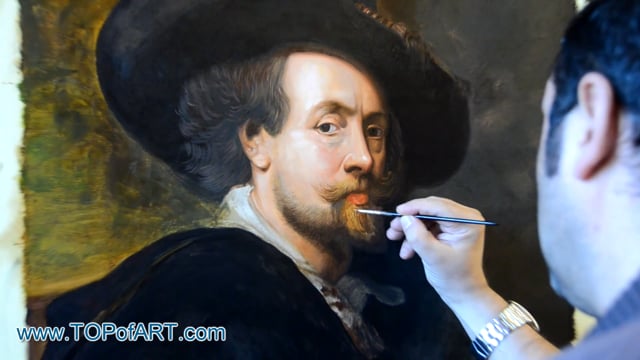
Recreating Rubens: A Video Journey into Museum-Quality Reproductions by TOPofART
Video showcasing the process of hand-painting a Rubens masterpiece with the utmost precision and care for detail.
Oil Painting Reproduction
If you want a different size than the offered
Description
Painted by European Аrtists with Academic Education
Museum Quality
+ 4 cm (1.6") Margins for Stretching
Creation Time: 8-9 Weeks
Creation Process
We create our paintings with museum quality and covering the highest academic standards. Once we get your order, it will be entirely hand-painted with oil on canvas. All the materials we use are the highest level, being totally artist graded painting materials and linen canvas.
We will add 1.6" (4 cm) additional blank canvas all over the painting for stretching.
High quality and detailing in every inch are time consuming. The reproduction of Peter Paul Rubens also needs time to dry in order to be completely ready for shipping, as this is crucial to not be damaged during transportation.
Based on the size, level of detail and complexity we need 8-9 weeks to complete the process.
In case the delivery date needs to be extended in time, or we are overloaded with requests, there will be an email sent to you sharing the new timelines of production and delivery.
TOPofART wants to remind you to keep patient, in order to get you the highest quality, being our mission to fulfill your expectations.
We not stretch and frame our oil paintings due to several reasons:
Painting reproduction is a high quality expensive product, which we cannot risk to damage by sending it being stretched.
Also, there are postal restrictions, regarding the size of the shipment.
Additionally, due to the dimensions of the stretched canvas, the shipment price may exceed the price of the product itself.
You can stretch and frame your painting in your local frame-shop.
Delivery
Once the painting The Defenders of the Eucharist is ready and dry, it will be shipped to your delivery address. The canvas will be rolled-up in a secure postal tube.
We offer free shipping as well as paid express transportation services.
After adding your artwork to the shopping cart, you will be able to check the delivery price using the Estimate Shipping and Tax tool.
Museum Quality
The paintings we create are only of museum quality. Our academy graduated artists will never allow a compromise in the quality and detail of the ordered painting. TOPofART do not work, and will never allow ourselves to work with low quality studios from the Far East. We are based in Europe, and quality is our highest priority.
Additional Information
Rubens deploys one of his richest palettes. The oppressive blacks and oyster whites of the Dominicans are relieved by the buttery gold of papal brocade, by scarlet that seems still warm from the dyer’s vat, and by nocturnal blues that slip into shadow. Colour is not decoration but argument: gold and crimson advance, insisting on doctrinal authority; cooler tones recede, creating atmospheric breadth. A liquid, honeyed light—Rubens’ hallmark—bathes flesh and silk alike, fusing the temporal and the divine.
Close inspection reveals brushwork that oscillates between bravura and precision. Translucent glazes lend depth to the velvets; swift, loaded strokes pick out chain, mitre and jewelled book‑clasp; a final flick of the wrist sparks the highlights on Jerome’s sleeve. Paint becomes substance—metal, flesh, stone—yet remains palpably, seductively paint.
Compositionally, the eye is shepherded upward. The diagonal of Aquinas’s arm, echoed by Norbert’s sloping shoulder and Jerome’s bowed head, converges on the dove, itself framed by the curving garland. Grouping is asymmetrical but balanced; subtle overlaps allow each figure to emerge without forfeiting cohesion. The stone parapet in the foreground—a familiar Baroque device—doubles as threshold, inviting the viewer into theological debate.
Created about 1625 in the Spanish Netherlands, at the height of the Counter‑Reformation, the painting is as much polemic as pageant. By arraying theologians and mystics across centuries, Rubens collapses time, proposing an unbroken lineage of belief. Spectacle, scholarship, and statecraft coalesce; the Eucharist is defended not only by words and gesture, but by colour, form, and the sumptuous rhetoric of Baroque painting.

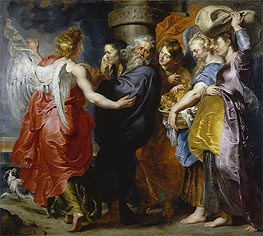
The Departure of Lot and His Family from Sodom c.1613/15
$6842
$86.47
Peter Paul Rubens
Original Size:220.3 x 243.8 cm
John & Mable Ringling Museum of Art, Florida, USA
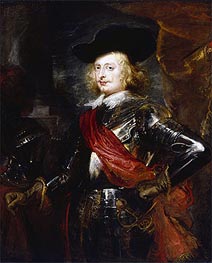
Portrait of Archduke Ferdinand 1635
$2683
$78.02
Peter Paul Rubens
Original Size:116.2 x 94 cm
John & Mable Ringling Museum of Art, Florida, USA
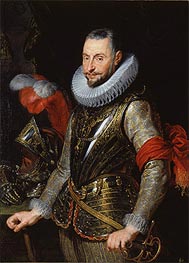
Marquis Ambrogio Spinola c.1630
$4262
$69.56
Peter Paul Rubens
Original Size:117.8 x 85.1 cm
Saint Louis Art Museum, Missouri, USA
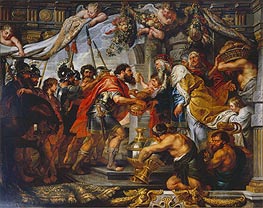
The Meeting of Abraham and Melchizedek c.1625
$9005
$76.43
Peter Paul Rubens
Original Size:445 x 571 cm
John & Mable Ringling Museum of Art, Florida, USA
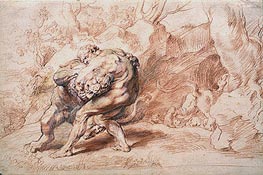
Hercules Strangling the Nemean Lion c.1620
$60.52
Peter Paul Rubens
Original Size:31.8 x 48.4 cm
The Clark Art Institute, Massachusetts, USA