
Northern Renaissance Artists Index
Alphabetical Index of the Great Masters of Northern Renaissance
The Northern Renaissance was an artistic and intellectual renewal north of the Alps during the fifteenth and sixteenth centuries, marked in painting by detailed naturalism. Its painters developed within late Gothic traditions, particularly in the Low Countries. Churches, courts, and prosperous merchants commissioned altarpieces and portraits. Robert Campin and Rogier van der Weyden gave sacred figures bodily weight, familiar surroundings, and strongly expressed emotions.
Oil paint enabled translucent glazes, subtle flesh tones, and distinctions between polished metal, glass, fur, and cloth. Jan van Eyck explored these possibilities in The Arnolfini Portrait (1434), in London's National Gallery. Window light touches the figures and furnishings, while a convex mirror reflects the room from another direction. Two additional figures appear in its surface, making the interior seem to extend beyond the scene directly before us.
Albrecht Dürer combined northern craftsmanship with Italian studies of proportion and perspective. His woodcuts and engravings circulated far beyond his native Nuremberg, allowing compositions to travel without the artist. In Self-Portrait (1500), at Munich's Alte Pinakothek, he faces the viewer in a fur-trimmed coat. The balanced arrangement of face and hair recalls traditional images of Christ, while precisely rendered features and textures give the figure an individual presence.
Hans Holbein the Younger worked in England and became a painter to Henry VIII. His The Ambassadors (1533), also in the National Gallery, places two Frenchmen beside books and scientific and musical instruments. Their luxurious clothing establishes their standing, but a distorted skull interrupts the foreground. Seen from an oblique angle, it becomes recognizable: an image of mortality embedded within a display of learning and worldly accomplishment.
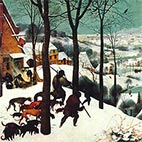
Hieronymus Bosch populated religious and moral subjects with hybrid creatures, temptations, and punishments. Pieter Bruegel the Elder gave village activities and seasonal labor a prominent place within expansive landscapes. His The Hunters in the Snow (1565), in Vienna's Kunsthistorisches Museum, leads the eye past dark trees toward frozen ponds and distant mountains. White slopes and blue-green ice organize the space. Small figures skate below, while hunters and their dogs descend through the foreground.
The Reformation changed artistic patronage. In some Protestant territories, the removal of church images reduced demand for altarpieces, while portraiture and secular subjects gained importance. At Fontainebleau, Italian artists employed by Francis I developed a courtly style of elongated figures, intricate poses, and elaborate decoration. These experiments contributed to Northern Mannerism during the sixteenth century, alongside the growing independence of landscape and scenes of everyday life.